

Red-headed Woodpecker vs Great Spotted Woodpecker
Melanerpes erythrocephalus versus Dendrocopos major
Play a quiz with Red-headed Woodpecker and Great Spotted Woodpecker
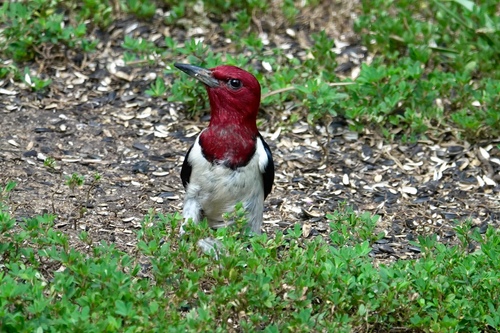 Red-headed Woodpecker
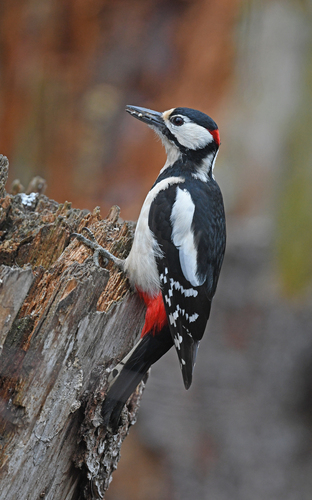 Great Spotted Woodpecker
In short
The most reliable field mark is the head color: adult Red-headed Woodpeckers show a solid, deep red head and neck, while Great Spotted Woodpeckers never have a fully red head—only a red nape (male) or red crown (juvenile). In flight, Red-headed Woodpeckers display bold white wing patches against black wings, whereas Great Spotted Woodpeckers show black-and-white barring on the wings and a large white shoulder patch. Juvenile confusion is possible: young Red-headed Woodpeckers have gray heads, while juvenile Great Spotted Woodpeckers have a red crown and less defined markings. Both are medium-sized woodpeckers with some overlap in size, but Great Spotted Woodpecker averages heavier. Structure and jizz are similar, so focus on head and wing pattern for a confident ID.
Identification tips
- Head color (all ages): Adult Red-headed Woodpecker has a completely red head and neck—no other medium woodpecker in its range shows this. Great Spotted Woodpecker never has a fully red head: males have a red nape, females lack red on the head, and juveniles have a red crown only.
- Juvenile confusion: Juvenile Red-headed Woodpeckers have a gray head (not red), while juvenile Great Spotted Woodpeckers have a red crown and brownish upperparts. If you see a red crown but not a red nape or full red head, think juvenile Great Spotted.
- Wing pattern in flight (all ages): Red-headed Woodpecker shows a large, bold white patch on the wings (from white secondaries), very striking against black primaries and back. Great Spotted Woodpecker shows black-and-white barring across the wings and tail, with a white shoulder patch but never a large white panel.
- Back color: Red-headed Woodpecker has a solid black back; Great Spotted Woodpecker's back is glossy black with a large white shoulder patch and barred wings.
- Underparts: Red-headed Woodpecker has a clean white belly and rump; Great Spotted Woodpecker has white underparts but always with a red vent/undertail (adults) or pinkish vent (juveniles).
- Tail pattern: Great Spotted Woodpecker's tail is barred black and white; Red-headed Woodpecker's tail is solid black.
- Facial pattern: Great Spotted Woodpecker has white sides to the face and neck, with black lines running from the shoulder to the nape and base of the bill. Red-headed Woodpecker lacks these facial stripes and has a plain red (or gray in juveniles) head.
- Sex differences: Red-headed Woodpecker sexes are identical in plumage. Great Spotted males have a red nape, females do not; juveniles of both sexes have a red crown.
- Bill color: Great Spotted Woodpecker has a slate-black bill; Red-headed Woodpecker's bill color is not specified but is not a key separator.
- Size: Great Spotted is heavier on average, but size overlap is considerable; do not rely on size alone.
- Habitat and range: Red-headed Woodpecker is North American, favoring open country and groves; Great Spotted is Eurasian, in forests and parks. If seen outside their normal range, check for vagrancy but use plumage first.
- Perched vs. flight views: In perched birds, focus on head and underparts; in flight, look for the white wing patch (Red-headed) vs. barred wings (Great Spotted).
- Seasonal variation: Both species undergo post-breeding molt, but this does not produce confusion in field marks relevant to separation.
- Common pitfalls: Do not confuse Red-headed Woodpecker with Red-bellied Woodpecker (which has a red crown and nape, not a full red head, and a barred back). Great Spotted can be confused with Syrian Woodpecker, but not with Red-headed.
- When in doubt: If you see a medium woodpecker with a fully red head and bold white wing patches, it is a Red-headed Woodpecker. If the head is not fully red and the wings are barred, it is a Great Spotted Woodpecker.
Size
Great Spotted Woodpecker is typically heavier (average 89 g vs. 71.6 g for Red-headed), but both are close in length (Red-headed: 19–25 cm; Great Spotted: 20–24 cm). Wingspan is slightly longer in Red-headed (42.5 cm) compared to Great Spotted (34–39 cm), but this is subtle in the field. Size alone is not a reliable separator, though Great Spotted may appear stockier.
Plumage
- Juvenile/immature birds: Juvenile Red-headed Woodpeckers have a gray head (not red), with the same bold black-and-white wing pattern as adults; the white wing patch is extensive and striking in flight. Juvenile Great Spotted Woodpeckers have a red crown (not a red nape like adult males), brownish upperparts, and less crisp black-and-white barring on the wings; their underparts are dirty white with a pinkish lower belly. The white shoulder patch is present but the overall pattern is less defined than in adults.
- Adults: Red-headed Woodpecker adults are sharply tricolored: solid red head and neck, black back and tail, white belly and rump, and black wings with broad white secondary panels. Great Spotted Woodpecker adults are pied: glossy black upperparts with white face and neck sides, a large white shoulder patch, black-and-white barred flight feathers and tail, white underparts with a red vent/undertail, and (in males) a red nape. Females lack red on the head. The head pattern is never fully red in any age or sex.
- In flight: Red-headed Woodpecker shows a bold white patch on the wings, contrasting with black primaries and back. Great Spotted Woodpecker shows black-and-white barring across the wings and tail, with a white shoulder patch but no large white panel like Red-headed.
Behaviour
Both species are typical woodpeckers in foraging and flight style: undulating flight, hitching up trunks and branches, and drumming. No strong behavioral differences are noted in the sources for field separation. Both may be seen in open woodlands, but Red-headed Woodpecker is more likely to be seen in open country, including isolated trees and groves, while Great Spotted is more often in continuous woodland or parks.
Habitat
Red-headed Woodpecker is native to temperate North America, breeding in open country, woodland edges, and groves across southern Canada and the east-central US. Great Spotted Woodpecker is a Eurasian species, found across the Palearctic, including forests, parks, and gardens from Ireland to Japan and parts of North Africa. Thus, location is a strong clue: in North America, a woodpecker with a red head is almost certainly Red-headed; in Eurasia, Great Spotted is the default medium woodpecker with a red vent and white shoulder patch.
Voice
Red-headed Woodpecker gives a 'tchur-tchur' call and drums on territory. Great Spotted Woodpecker's vocalizations are not described in the provided notes, so voice is not a reliable separator based on these sources.
Red-headed Woodpecker · Great Spotted Woodpecker · My Tricky Birds