

Red-eyed Vireo vs Western Bonelli's Warbler
Vireo olivaceus versus Phylloscopus bonelli
Play a quiz with Red-eyed Vireo and Western Bonelli's Warbler
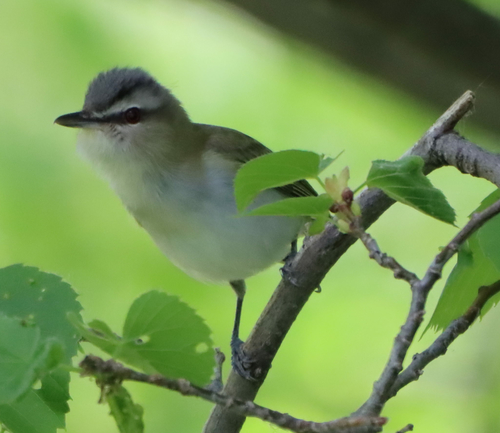 Red-eyed Vireo
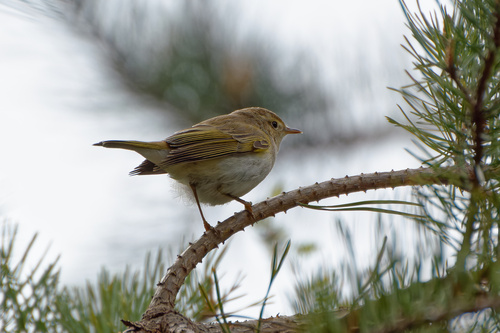 Western Bonelli's Warbler
In short
The most reliable field mark between Red-eyed Vireo and Western Bonelli's Warbler is the vireo's bold face pattern: a strong dark eye-stripe, broad white supercilium, and red eye (in adults), which is never matched by the warbler's much plainer face. Red-eyed Vireo is bulkier, with a heavier, stouter bill and blue-grey legs, while Western Bonelli's Warbler is more delicate, with a fine, pointed bill and brown legs. In flight or at rest, Bonelli's Warbler lacks any strong facial contrast and shows a plain grey-green upperpart with white underparts, while the vireo is olive above with yellowish flanks and a striking head pattern. If you see a bird with a plain face and brown legs, think Bonelli's; if the face is boldly marked and the legs blue-grey, it's a vireo.
Identification tips
- Face pattern is key: Red-eyed Vireo has a bold dark eye-stripe, broad white supercilium, and a grey crown edged with black; Bonelli's Warbler has a plain face with no strong supercilium or eye-stripe. This is the most reliable mark in all plumages.
- Iris color (adults): Red-eyed Vireo has a red iris (best seen in good light); Bonelli's Warbler has a dark eye. This mark is only reliable in adult vireos and can be hard to see at distance.
- Bill shape: The vireo has a stout, slightly hooked bill suited for gleaning; Bonelli's Warbler's bill is fine, straight, and pointed, typical of leaf warblers. This is visible at close range or in good photos.
- Leg color: Red-eyed Vireo has blue-grey legs; Bonelli's Warbler has brown legs. This can be a clincher if seen well, but beware of lighting effects.
- Overall build: Vireo is bulkier, with a thicker neck and heavier jizz; Bonelli's Warbler is slim and dainty, often appearing more delicate and agile.
- Upperparts: Vireo is olive-green above; Bonelli's Warbler is grey-green to brownish, sometimes with a greenish tinge on rump and wings, but never as olive as the vireo.
- Underparts: Both are white below, but vireo often shows yellowish flanks and undertail coverts (sometimes faint); Bonelli's Warbler is clean white below with no yellow.
- Crown: Vireo has a grey crown edged with black; Bonelli's Warbler's crown is not contrasting, blending with the rest of the upperparts.
- Flight style: Bonelli's Warbler is quick, flitting, and restless; vireo is more measured and deliberate, often pausing between movements.
- Habitat context: In North America, Bonelli's Warbler is an extreme rarity; in Europe/North Africa, Red-eyed Vireo is a vagrant. Use range and expected species as a strong clue.
- Voice: If heard, Bonelli's Warbler gives a fast monotone trill and a 'hu-it' call; vireo's song is a series of short, repetitive phrases. Calls are not likely to be confused in the field.
- Sex and age: Both species are sexually monomorphic; no strong age-specific marks are described for either, so rely on structural and facial features for all ages.
- Juvenile/immature confusion: No unique juvenile wing or flight marks are described for either, so do not expect to separate them by upperwing pattern in flight.
- Plumage pitfalls: In dull light or at distance, vireo's face may appear less marked, and Bonelli's Warbler may look greener above; always try to confirm face pattern and leg color.
- Bill and leg color together: A combination of a stout bill and blue-grey legs (vireo) vs. a fine bill and brown legs (Bonelli's) is a strong separator when seen well.
Size
Red-eyed Vireo is distinctly larger and heavier: 12–13 cm in length, 12–26 g in weight, and a wingspan of 23–25 cm [wikipedia]. Western Bonelli's Warbler is a typical small leaf warbler, noticeably more petite and lighter-billed, though exact measurements are not provided in the notes. In the field, the vireo often appears chunkier and more robust, while Bonelli's Warbler is slim and agile.
Plumage
No age-specific upperwing or flight marks are described for either species, so focus is on head and body plumage. Red-eyed Vireo (adult) is olive-green above, white below, with yellowish flanks and undertail coverts (sometimes faint), a grey crown edged with black, a bold dark eye-stripe, wide white supercilium, and a red iris. The bill is stout, and legs are blue-grey. Western Bonelli's Warbler (adult) is plain grey-green above, with a greenish tinge on the rump and wings, and clean white underparts. The face is plain, lacking any strong supercilium or eye-stripe, and the bill is small and pointed, with brown legs. Both sexes are similar in each species. Juvenile/immature plumages are not described in detail, but there is no mention of distinctive wing panels or flight marks for either species. Thus, the vireo's face pattern and the warbler's overall plainness are the main contrasts.
Behaviour
Red-eyed Vireo is often seen methodically gleaning insects from foliage, sometimes hovering or even hanging upside down for fruit in winter. It tends to move more deliberately and can appear less restless than typical warblers. Western Bonelli's Warbler is an active, agile forager, flitting through foliage in classic leaf warbler style, often hovering briefly to pick insects. The vireo's behavior is more measured and less frenetic than the warbler's.
Habitat
Red-eyed Vireo breeds in open wooded areas across Canada and the eastern/northwestern US, favoring broadleaf or mixed forests, and is a common summer bird in these habitats [wikipedia, ebird]. It winters in South America. Western Bonelli's Warbler breeds in forests and woodlands of southwest Europe and North Africa, nesting on the ground, and winters in sub-Saharan Africa. It is a rare vagrant in northern Europe. Thus, in North America, any confusion is almost certainly a vireo; in southern Europe/North Africa, Bonelli's Warbler is expected.
Voice
Red-eyed Vireo has a persistent, repetitive song of short phrases, but this is not described in the notes. Western Bonelli's Warbler gives a fast monotone trill as song, and its call is a disyllabic 'hu-it'. Voice is not a primary separator in the field between these two, especially outside the breeding range of Bonelli's Warbler.
Red-eyed Vireo · Western Bonelli's Warbler · My Tricky Birds