

Red-eyed Dove vs Vinaceous Dove
Streptopelia semitorquata versus Streptopelia vinacea
Play a quiz with Red-eyed Dove and Vinaceous Dove
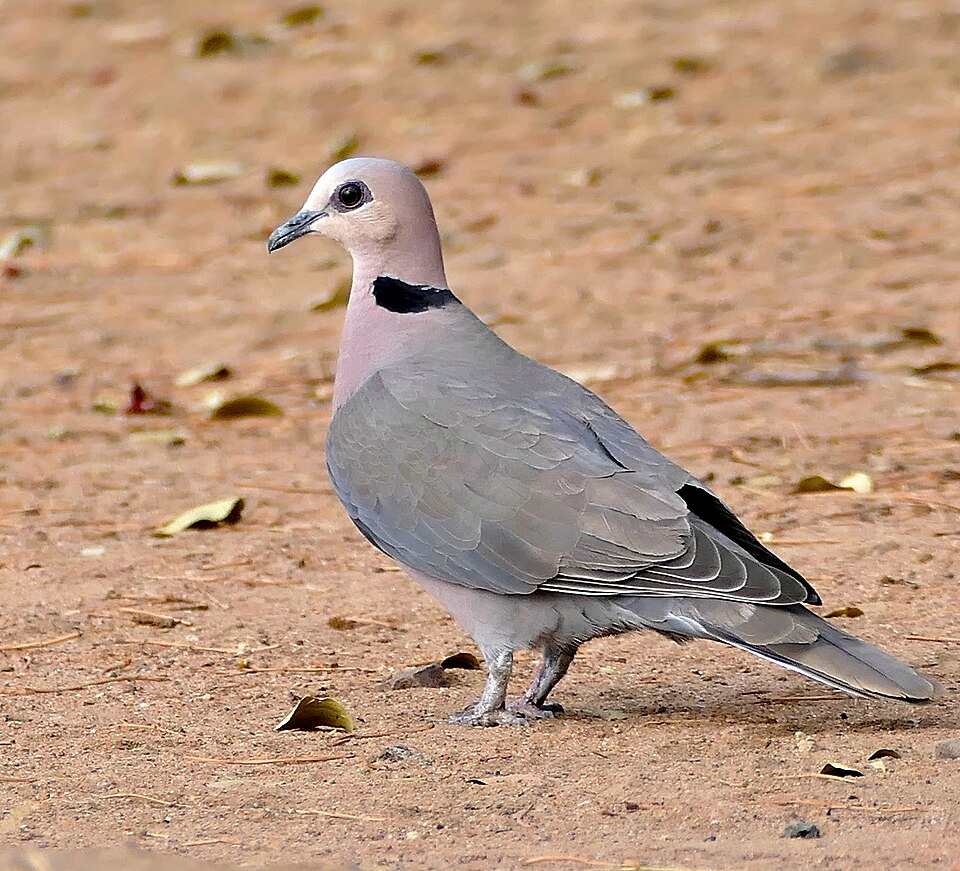 Red-eyed Dove
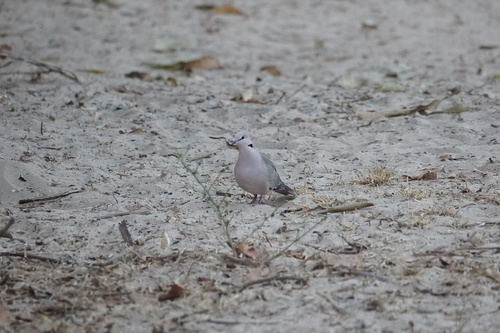 Vinaceous Dove
In short
The most reliable field mark between Red-eyed Dove and Vinaceous Dove is overall size and bulk: Red-eyed Dove is much larger and heavier, with a distinctly more robust build. In flight, Vinaceous Dove shows a blackish underwing and white in the tail, while Red-eyed Dove has more uniform, bluish-grey underwing coverts and lacks white in the tail. Both species have a black hind-neck patch, but only Vinaceous Dove’s is neatly edged with white. Eye color and facial skin are also helpful at close range: Red-eyed Dove has a red or orange-red iris and purplish-red orbital skin, while Vinaceous Dove’s eye is less striking. Juveniles of both are duller, but the size and wing/tail pattern remain good separators. Use structure and wing/tail pattern in flight, and neck patch and iris color when perched.
Identification tips
- Size and bulk: Red-eyed Dove is nearly twice as heavy as Vinaceous Dove and appears much larger and more robust in the field. Use this as a primary separator, especially when seen perched or feeding.
- Underwing in flight: Vinaceous Dove shows a blackish underwing, visible in all ages and especially obvious in flight. Red-eyed Dove’s underwing is bluish-grey and lacks the strong blackish contrast.
- Tail pattern in flight: Vinaceous Dove has white in the tail, often visible as white corners or tips during flight. Red-eyed Dove’s tail is dark grey basally and light brownish-grey at the tip, but never shows white.
- Neck patch: Both have a black hind-neck patch, but Vinaceous Dove’s is sharply outlined with white, while Red-eyed Dove’s is less distinct and only on the sides of the neck.
- Iris and orbital skin: At close range, Red-eyed Dove has a red to orange-red iris and purplish-red orbital skin, making the eye area look striking. Vinaceous Dove’s eye is less vivid.
- Head and forehead color: Red-eyed Dove’s forehead is pale bluish-grey merging into a darker crown, while Vinaceous Dove’s head is pale pinkish-grey.
- Underparts color: Red-eyed Dove has dark mauve-pink to wine-red underparts; Vinaceous Dove is paler, with pinkish-grey underparts.
- Upperparts: Red-eyed Dove’s upperparts are greyish-brown with dark slaty-blue outer wing-coverts; Vinaceous Dove’s are pale brown overall.
- Leg color: Both have reddish legs, but Red-eyed Dove’s are purplish-red, which may be slightly darker.
- Juvenile plumage: Juveniles of both are duller and browner, but size and flight pattern (underwing and tail) remain reliable.
- Behavior: Red-eyed Dove is less gregarious, often alone or in pairs; Vinaceous Dove’s social habits are not distinctive in the notes.
- Habitat: Red-eyed Dove prefers wooded areas, especially near rivers; Vinaceous Dove is more typical of open country and acacia trees, especially in drier northern regions.
- Voice: If heard, Vinaceous Dove’s fast coo-cu-cu-coo can help, but Red-eyed Dove’s call is not described here.
- Sexes: Both species are sexually similar, so do not rely on sex for identification.
- Pitfalls: Beware of dull juveniles, but rely on size, underwing, and tail pattern in flight for best separation.
Size
Red-eyed Dove is substantially larger and heavier, averaging 235 g compared to Vinaceous Dove’s 110 g. In the field, Red-eyed Dove appears much bulkier and longer-bodied, and is the largest of the 'ringneck' doves. Vinaceous Dove is noticeably smaller, more compact, and stockier, with a shorter, less imposing profile. If seen together, the size difference is immediately obvious, but even singly, Red-eyed Dove’s bulk and length stand out.
Plumage
Juveniles of both species are duller and browner than adults, but key contrasts persist across ages. In flight, Vinaceous Dove shows a distinctive blackish underwing and white in the tail, which are visible in all plumages and especially useful for separating juveniles. Red-eyed Dove’s underwing is bluish-grey and lacks the strong blackish contrast; its tail is dark grey basally and light brownish-grey at the tip, without white. Perched, both species have a black hind-neck patch, but Vinaceous Dove’s is sharply outlined with white, while Red-eyed Dove’s is less distinct and restricted to the sides of the neck. Red-eyed Dove’s forehead is pale bluish-grey merging into a darker crown, with dark mauve-pink to wine-red underparts and greyish-brown upperparts, while Vinaceous Dove is paler overall, with pale brown back/wings/tail and pale pinkish-grey head and underparts. Red-eyed Dove’s iris is red to orange-red, surrounded by purplish-red orbital skin; Vinaceous Dove’s eye is less vivid. Both have reddish legs, but Red-eyed Dove’s are purplish-red.
Behaviour
Both species build stick nests in trees and lay two white eggs. Their flight is similar, with quick, regular wingbeats and occasional sharp flicks typical of pigeons. Red-eyed Dove is less gregarious, often feeding alone or in pairs, while Vinaceous Dove’s social habits are not described as distinctive in the sources. Both can be seen perched in trees, but Red-eyed Dove’s larger size and more solitary behavior may stand out.
Habitat
Red-eyed Dove is widespread and common throughout most of sub-Saharan Africa, except in deserts, and is found in a wide range of wooded habitats, including forests near rivers. Vinaceous Dove is also widespread but is more typical of northern sub-Saharan Africa and often associated with open country and acacia trees. Both species overlap in range in some areas, but Vinaceous Dove is more likely in drier, more open habitats, while Red-eyed Dove prefers lusher, wooded environments.
Voice
Vinaceous Dove has a fast, rhythmic coo-cu-cu-coo call. No distinctive vocalization is described for Red-eyed Dove in the provided sources, so voice is not a strong separator unless the Vinaceous Dove’s rapid cooing is heard.