

Red-eyed Dove vs Common Bulbul
Streptopelia semitorquata versus Pycnonotus barbatus
Play a quiz with Red-eyed Dove and Common Bulbul
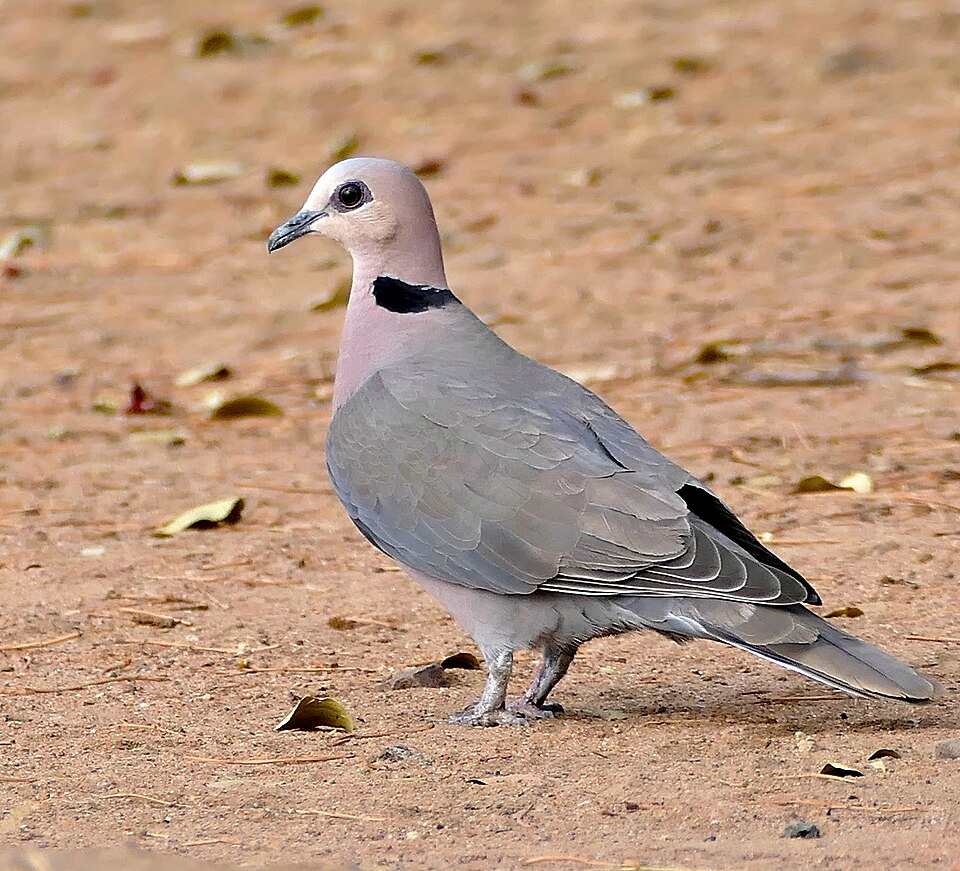 Red-eyed Dove
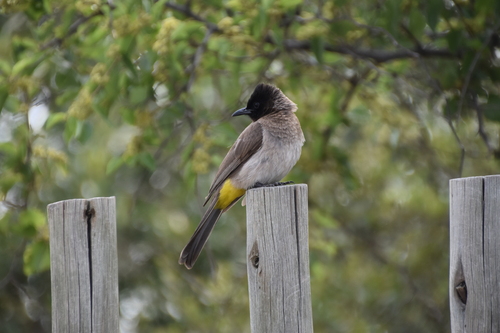 Common Bulbul
In short
The most reliable field mark to separate Red-eyed Dove from Common Bulbul is overall size and structure: Red-eyed Dove is a very large, heavy-bodied pigeon with broad wings and a long tail, while Common Bulbul is a much smaller, slimmer songbird with a shorter, thinner bill and a more upright posture. In flight, the dove shows broad, rounded wings and a steady, powerful flight, whereas the bulbul moves with quick, bounding hops. Plumage is also diagnostic: the dove has a distinctive mauve-pink to wine-red breast and a black half-collar on the neck, while the bulbul is brown above and dull grey below, sometimes with yellow undertail coverts. Juvenile doves are duller and browner, but still much larger and structurally different from any bulbul. Confusion is most likely at a distance or in poor light, but careful attention to size, shape, and color will resolve most cases.
Identification tips
- Size is the fastest check: Red-eyed Dove is much larger and bulkier than Common Bulbul; if you see both together, the difference is striking. This holds for all ages and sexes.
- Structure: Doves have a thick neck, large head, and long, broad tail; bulbuls are slim, upright, with a thinner, slightly downcurved bill and a shorter tail.
- Flight style: Doves fly with strong, steady wingbeats and occasional sharp flicks; bulbuls have a more bounding, erratic flight, often moving in short bursts between perches.
- Plumage—underparts: Red-eyed Dove shows a mauve-pink to wine-red wash on neck, breast, and underparts (adults), sometimes duller in juveniles. Bulbul is always dull grey below, never pinkish or reddish.
- Plumage—upperparts: Dove is greyish brown above with slaty blue wing-coverts and black primaries; bulbul is plain brown above with no blue or black on the wings.
- Neck collar: Dove has a black half-collar on the side of the neck (sometimes faint), absent in bulbul.
- Undertail coverts: Some bulbul subspecies have yellow undertail coverts, never present in dove. If you see yellow under the tail, it's a bulbul.
- Eye and facial color: Dove's iris can be yellowish, orange, or red, with purplish red orbital skin; bulbul has a dark brown eye with a subtle eye-ring, no bright colors.
- Bill color and shape: Dove's bill is black, thick, and pigeon-like; bulbul's is black, thin, and slightly downcurved.
- Leg color: Dove has purplish red legs; bulbul's legs are black.
- Juvenile confusion: Young doves are browner and duller but still much larger and bulkier than any bulbul; they never show yellow undertail or upright perching.
- Perching posture: Doves perch horizontally and often high in trees; bulbuls are upright, often in exposed, bushy spots.
- Habitat context: In dense gardens or urban parks, bulbul is more likely; in tall trees or woodland edges, especially near water, dove is more likely.
- Voice: Persistent, loud, musical song is bulbul; deep, slow coos are dove.
- Feeding behavior: Doves often feed on the ground or in trees; bulbuls are rarely on the ground, preferring shrubs and low branches.
Size
Red-eyed Dove is dramatically larger, with an average body mass of 235 g compared to the bulbul's 35 g—a nearly sevenfold difference [wikidata]. The dove reaches about 30 cm in length, making it the largest 'ringneck' dove, while the bulbul is only 18–20 cm long. This size gap is obvious even at a distance: the dove appears bulky and pigeon-like, with a large head and thick neck, whereas the bulbul is a small, slim, upright percher. In direct comparison, the dove's bill is much thicker and longer, and its tail is longer and broader than the bulbul's.
Plumage
No age-specific upperwing patterns are described for either species, but overall coloration and pattern are key. Adult and juvenile Red-eyed Doves have a pale bluish-grey forehead, darker crown, and a distinctive dark mauve-pink to wine-red wash on the neck, breast, and underparts. The upperparts are greyish brown, with black primaries and dark slaty blue outer wing-coverts. The dove's neck shows a black half-collar, which is restricted to the sides and often indistinct, but still a useful mark. The iris is variable but often reddish, and the orbital skin and legs are purplish red. Juveniles are duller and browner, but still show the overall pigeon structure and lack the bulbul's yellow undertail.
Common Bulbul is much plainer: brown upperparts, dark brown head, and dull grey underparts. The bill, legs, and feet are black, and the eye is dark brown with a subtle eye-ring. Some subspecies have yellow undertail coverts, which are never present in the dove. There is no neck collar or pinkish wash. Sexes are similar in both species. The bulbul's plumage is consistent year-round, with only minor regional variation.
Behaviour
Red-eyed Doves are typically seen singly or in pairs, often feeding on the ground or perched high in trees. Their flight is strong, direct, and steady, with regular wingbeats and occasional sharp flicks typical of pigeons. They are not particularly gregarious. Common Bulbuls, by contrast, are active, restless, and often found in small groups. They hop and flit through shrubs and trees, rarely feeding on the ground, and their flight is more bounding and erratic. Bulbuls perch upright, often in exposed spots, and are much more vocal and conspicuous in their movements than the more sedate dove.
Habitat
Both species are widespread in sub-Saharan Africa and can overlap in gardens, woodland edges, and riverine forests. However, Red-eyed Dove is more often found in mature woodland, forest edges, and near water, avoiding deserts and very open country. Common Bulbul is highly adaptable, thriving in gardens, parks, bush, and urban areas, and is less tied to large trees or water. If seen in dense undergrowth or urban gardens, bulbul is more likely; a large pigeon in tall trees or flying across open spaces is more likely the dove.
Voice
Red-eyed Dove's voice is not described in the provided notes, but doves typically have deep, resonant, cooing calls. Common Bulbul is very vocal, with a loud, varied song described as 'doctor-quick doctor-quick be-quick be-quick.' The bulbul's calls are sharper and more musical, while the dove's are lower-pitched and more monotonous. In the field, persistent, bubbling song points to bulbul; deep, slow coos suggest dove.