

Red-crested Malkoha vs Besra
Dasylophus superciliosus versus Tachyspiza virgata
Play a quiz with Red-crested Malkoha and Besra
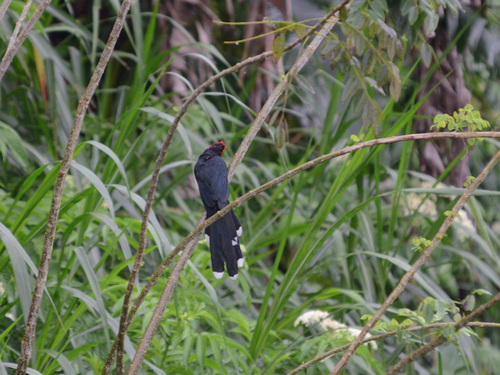 Red-crested Malkoha
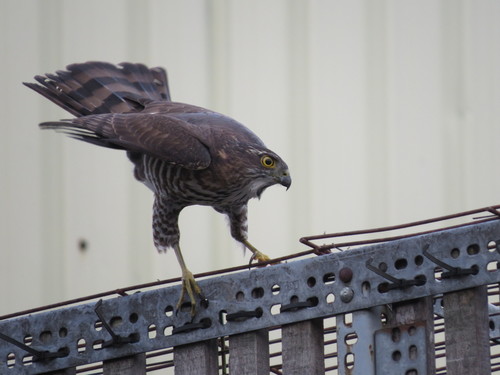 Besra
In short
The most reliable field mark between Red-crested Malkoha and Besra is the presence of a long, shaggy red eyebrow (supercilium) and a prominent crest on the malkoha, which is never shown by the besra. In flight or perched, the malkoha’s glossy black plumage with a greenish sheen and white-tipped, graduated tail contrasts sharply with the besra’s raptor build, blue-grey or brown upperparts, and strong underpart barring. Juvenile besras show brown upperparts and barred underparts, but never the malkoha’s unique facial features or tail pattern. Structure and behavior are also very different: malkoha is a large, long-tailed cuckoo, while besra is a compact, broad-winged hawk. Confusion is most likely with perched birds in dense forest, but careful attention to face, tail, and overall shape will separate them.
Identification tips
- Look for the long, shaggy red eyebrow (supercilium): Only Red-crested Malkoha shows this feature, running from the lores to the nape. Besra never shows any red on the face.
- Check for a crest: Malkoha has a unique, loose crest formed by the superciliary feathers; besra has a smooth, rounded head with no crest.
- Tail shape and pattern: Malkoha’s tail is very long, graduated (stepped), and tipped white. Besra’s tail is long but more even-tipped, with 3–4 equally sized dark bands and no white tips.
- Plumage gloss: Malkoha is glossy black with a bluish-green sheen above; besra is matte blue-grey (male) or brown (female/juvenile) above, never glossy or greenish.
- Underparts: Malkoha is black with a dull greenish tinge below; besra is white with reddish-brown (adult) or brown (juvenile) barring.
- Underwing pattern in flight: Besra shows strong underwing barring; malkoha’s wings are all dark and glossy.
- Bill shape: Malkoha has a long, slightly decurved bill typical of cuckoos; besra has a short, hooked raptor bill.
- Legs and feet: Besra has thin, long legs and toes for grasping prey; malkoha’s legs are shorter and less robust.
- Posture: Perched malkoha is elongated and horizontal; besra sits upright and alert like a hawk.
- Flight style: Malkoha is weak-flying and rarely soars; besra uses rapid, direct flights with "flap–flap–glide" and may soar.
- Habitat context: Only expect malkoha in lowland forest on Luzon; besra can be found in a wider range of wooded habitats across Asia.
- Juvenile confusion: Juvenile besra may appear brown above and barred below, but will never show a red supercilium or white-tipped tail.
- Sexual dimorphism: Malkoha is sexually monomorphic (males and females look alike); besra females are browner above and larger than males.
- If in doubt, focus on the face: The presence or absence of the red supercilium is the single most decisive mark.
- Do not rely on size alone: Both can appear large and long-tailed, but structure and plumage are far more reliable.
Size
Red-crested Malkoha is a large cuckoo with a body mass of about 123 g [wikidata], and appears long-tailed and elongated. Besra is a medium-sized raptor (29–36 cm length) with a more compact, muscular build, short broad wings, and a long but less graduated tail. The malkoha will look bulkier and longer-tailed, while besra is more compact and powerful, especially in flight. Only malkoha’s mass is available, but besra is generally lighter and smaller-bodied for its length due to raptor proportions.
Plumage
-
Juvenile/immature birds: Juvenile besra is dark brown above and white below, with brown barring on the underparts and 3–4 equally sized dark bands on the uppertail. It never shows a red supercilium or greenish gloss. Malkoha does not have described age-specific variation; all ages show the long, red eyebrow and glossy black upperparts.
-
Adults: Red-crested Malkoha is black above with a bluish-green gloss, a striking long red supercilium, and white-tipped, graduated tail feathers. Underparts are black with a dull greenish tinge. Besra adult male is dark blue-grey above, white below with reddish-brown barring, and a broad gular stripe; female is browner above. Both sexes have 3–4 dark tail bands and strongly barred underwings. No red on the face, no green gloss, and no white tail tips.
-
Flight views: Besra shows short, broad wings and a long, banded tail; underwings are strongly barred. Malkoha’s wings and tail are all dark with a greenish gloss, tail is graduated and tipped white, and lacks any barring.
Behaviour
Red-crested Malkoha moves slowly and deliberately through dense forest foliage, often creeping along branches and using its long tail for balance. It is not a strong flier and rarely soars. Besra is an active, agile raptor, often seen making rapid, direct flights with a characteristic "flap–flap–glide" pattern, and hunts by surprise attacks from cover. Perched, besra sits upright and alert, while malkoha appears more horizontal and elongated. If you see a bird soaring or making fast, powerful flights, it is a besra; a skulking, branch-walking bird is a malkoha.
Habitat
Red-crested Malkoha is endemic to Luzon, Philippines, and restricted to tropical moist lowland forests. Besra is widespread across southern Asia, including the Philippines, and occupies dense forests but can also be found in more open woodland, savannah, and even cultivation, especially in winter. If seen outside Luzon or in open country, it is almost certainly not a malkoha. Both can occur in dense forest, but only malkoha is strictly tied to lowland forest on Luzon.