

Motmot

Red Collared Dove vs Key West Quail-Dove

Streptopelia tranquebarica versus Geotrygon chrysia

Play a quiz with Red Collared Dove and Key West Quail-Dove
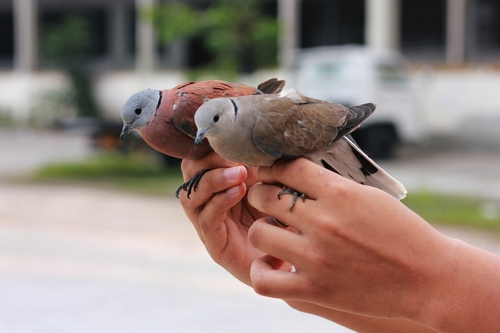
Red Collared Dove (Streptopelia tranquebarica) Red Collared Dove
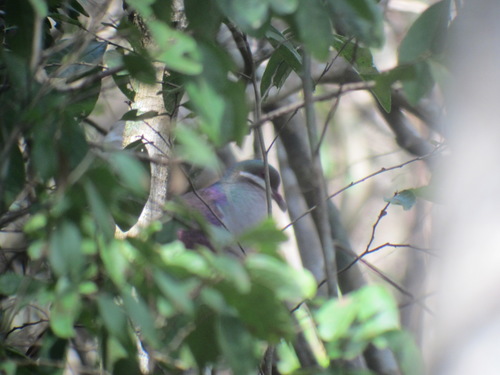
Key West Quail-Dove (Geotrygon chrysia) Key West Quail-Dove

Media

Loading…

In short

The most reliable field mark to separate Red Collared Dove from Key West Quail-Dove is the head and facial pattern: Red Collared Dove males have a blue-grey head and a neat black collar, while Key West Quail-Dove shows a bold white facial stripe and iridescent crown/nape. In flight or perched, Red Collared Dove is noticeably smaller and slimmer, with a plain, pale appearance in females, whereas Key West Quail-Dove is larger and bulkier, with rich rusty and iridescent tones. Juvenile or immature-specific upperwing patterns are not described for either species, so focus on head, face, and overall coloration. Habitat and range are also strong clues: Red Collared Dove is an open-country Asian species, while Key West Quail-Dove is a Caribbean forest bird.

Identification tips

  1. Head and facial pattern: Male Red Collared Dove has a blue-grey head and a sharp black collar; Key West Quail-Dove has a bold white facial stripe and iridescent crown/nape. The white facial stripe is unique to Key West Quail-Dove and is visible even at a distance.
  2. Overall coloration: Key West Quail-Dove is rich rusty-brown above with strong iridescence (amethyst/bronze-green on head and neck, purplish-red on back and wing coverts); Red Collared Dove is more uniform, with males showing light red-brown and females/pinkish or pale brown.
  3. Sexual dimorphism: Red Collared Dove females are much plainer and paler than males, lacking strong contrast and iridescence. Key West Quail-Dove does not show such marked sexual dimorphism in the field.
  4. Size and structure: Red Collared Dove is small and slim (20.5–23 cm, ~104 g), while Key West Quail-Dove is larger and heavier (27–31 cm, 169 g). If the bird appears bulky or large for a dove, Key West Quail-Dove is more likely.
  5. Iridescence: Only Key West Quail-Dove has amethyst/bronze-green iridescence on the crown, nape, and neck, and purplish-red on mantle/back/wing coverts. Red Collared Dove lacks any iridescence.
  6. Black collar: The neat black collar is a feature of adult male Red Collared Dove, not present in Key West Quail-Dove.
  7. White facial stripe: Present only in Key West Quail-Dove, absent in Red Collared Dove of all ages and sexes.
  8. Habitat context: Red Collared Dove is found in open, well-wooded lowlands, plantations, and urban edges in Asia; Key West Quail-Dove is a Caribbean forest specialist, rarely in open country.
  9. Behavior: Red Collared Dove often perches in the open or on wires; Key West Quail-Dove is secretive, foraging on the forest floor and rarely perching in the open.
  10. Flight style: Not detailed here, but Red Collared Dove is likely to flush into open flight, while Key West Quail-Dove may skulk or burst low through undergrowth.
  11. Juvenile/immature confusion: No distinctive juvenile or immature upperwing patterns are described for either species, so age is less likely to cause confusion than in some other doves.
  12. Vocalizations: If heard, a single-pitched moan in dense woodland supports Key West Quail-Dove; Red Collared Dove's calls are not detailed here.
  13. Geographic range: Red Collared Dove is Asian; Key West Quail-Dove is Caribbean. Out-of-range records should be scrutinized carefully.
  14. Flock size: Red Collared Dove may be seen in small flocks, especially on arrival in breeding areas; Key West Quail-Dove is almost always solitary or in pairs.
  15. Plumage pitfalls: Female Red Collared Dove can appear very plain and may be confused with other brown doves, but lacks the iridescence and bold facial pattern of Key West Quail-Dove.

Size

Red Collared Dove is significantly smaller and lighter, with a length of 20.5–23 cm and a mass around 104 g (per Wikipedia), compared to the Key West Quail-Dove's 27–31 cm length and 169 g mass [wikidata]. This size difference is apparent in the field: Red Collared Dove appears petite and delicate, while Key West Quail-Dove is much bulkier and longer-bodied. If seen together, the Key West Quail-Dove would dwarf the Red Collared Dove.

Plumage

No age-specific upperwing or juvenile flight marks are described for either species, so focus on adult and general plumage. Male Red Collared Dove shows a blue-grey head, light red-brown body, and a neat black collar; females are plainer, with overall pale brown or pinkish tones and lack strong contrast. Key West Quail-Dove of both sexes is rich rusty-brown above, with amethyst or bronze-green iridescence on the crown, nape, and neck, and a bold white facial stripe. The mantle, back, rump, and inner wing coverts of Key West Quail-Dove show purplish-red iridescence, never seen in Red Collared Dove. In summary: Red Collared Dove is more uniform and subdued (especially females), while Key West Quail-Dove is more richly colored and iridescent, with a distinctive facial pattern.

Behaviour

Red Collared Dove is often seen in pairs or small flocks, especially when arriving in breeding areas, and is comfortable in open or semi-open country, sometimes perching on wires or exposed branches. Key West Quail-Dove is typically solitary or in pairs, foraging quietly on the forest floor and rarely perching in the open. Their movements are more furtive and ground-oriented, in contrast to the more arboreal and open-country behavior of Red Collared Dove.

Habitat

Red Collared Dove prefers open, well-wooded tracts in the lowlands, such as canal or roadside tree plantations, and is widespread in the plains of Asia, avoiding rocky foothills and deserts. It is not found in dense forests. In contrast, Key West Quail-Dove is a Caribbean species of dense forests and thickets, rarely venturing into open country. If the bird is in deep woodland or forest floor, Key West Quail-Dove is far more likely; if in open farmland, plantations, or urban edges in Asia, Red Collared Dove is expected.

Voice

The Red Collared Dove's vocalizations are not described in detail here. Key West Quail-Dove gives a single-pitched moan, similar to the White-tipped Dove. If you hear a low, mournful call in dense woodland, it may point to Key West Quail-Dove, but voice is not a primary separator with the information given.

Submit a better description

Use the same sections as the comparison. Your text is published immediately.

The most reliable field mark to separate Red Collared Dove from Key West Quail-Dove is the head and facial pattern: Red Collared Dove males have a blue-grey head and a neat black collar, while Key West Quail-Dove shows a bold white facial stripe and iridescent crown/nape. In flight or perched, Red Collared Dove is noticeably smaller and slimmer, with a plain, pale appearance in females, whereas Key West Quail-Dove is larger and bulkier, with rich rusty and iridescent tones. Juvenile or immature-specific upperwing patterns are not described for either species, so focus on head, face, and overall coloration. Habitat and range are also strong clues: Red Collared Dove is an open-country Asian species, while Key West Quail-Dove is a Caribbean forest bird.

  1. Head and facial pattern: Male Red Collared Dove has a blue-grey head and a sharp black collar; Key West Quail-Dove has a bold white facial stripe and iridescent crown/nape. The white facial stripe is unique to Key West Quail-Dove and is visible even at a distance.
  2. Overall coloration: Key West Quail-Dove is rich rusty-brown above with strong iridescence (amethyst/bronze-green on head and neck, purplish-red on back and wing coverts); Red Collared Dove is more uniform, with males showing light red-brown and females/pinkish or pale brown.
  3. Sexual dimorphism: Red Collared Dove females are much plainer and paler than males, lacking strong contrast and iridescence. Key West Quail-Dove does not show such marked sexual dimorphism in the field.
  4. Size and structure: Red Collared Dove is small and slim (20.5–23 cm, ~104 g), while Key West Quail-Dove is larger and heavier (27–31 cm, 169 g). If the bird appears bulky or large for a dove, Key West Quail-Dove is more likely.
  5. Iridescence: Only Key West Quail-Dove has amethyst/bronze-green iridescence on the crown, nape, and neck, and purplish-red on mantle/back/wing coverts. Red Collared Dove lacks any iridescence.
  6. Black collar: The neat black collar is a feature of adult male Red Collared Dove, not present in Key West Quail-Dove.
  7. White facial stripe: Present only in Key West Quail-Dove, absent in Red Collared Dove of all ages and sexes.
  8. Habitat context: Red Collared Dove is found in open, well-wooded lowlands, plantations, and urban edges in Asia; Key West Quail-Dove is a Caribbean forest specialist, rarely in open country.
  9. Behavior: Red Collared Dove often perches in the open or on wires; Key West Quail-Dove is secretive, foraging on the forest floor and rarely perching in the open.
  10. Flight style: Not detailed here, but Red Collared Dove is likely to flush into open flight, while Key West Quail-Dove may skulk or burst low through undergrowth.
  11. Juvenile/immature confusion: No distinctive juvenile or immature upperwing patterns are described for either species, so age is less likely to cause confusion than in some other doves.
  12. Vocalizations: If heard, a single-pitched moan in dense woodland supports Key West Quail-Dove; Red Collared Dove's calls are not detailed here.
  13. Geographic range: Red Collared Dove is Asian; Key West Quail-Dove is Caribbean. Out-of-range records should be scrutinized carefully.
  14. Flock size: Red Collared Dove may be seen in small flocks, especially on arrival in breeding areas; Key West Quail-Dove is almost always solitary or in pairs.
  15. Plumage pitfalls: Female Red Collared Dove can appear very plain and may be confused with other brown doves, but lacks the iridescence and bold facial pattern of Key West Quail-Dove.

Red Collared Dove is significantly smaller and lighter, with a length of 20.5–23 cm and a mass around 104 g (per Wikipedia), compared to the Key West Quail-Dove's 27–31 cm length and 169 g mass [wikidata]. This size difference is apparent in the field: Red Collared Dove appears petite and delicate, while Key West Quail-Dove is much bulkier and longer-bodied. If seen together, the Key West Quail-Dove would dwarf the Red Collared Dove.

No age-specific upperwing or juvenile flight marks are described for either species, so focus on adult and general plumage. Male Red Collared Dove shows a blue-grey head, light red-brown body, and a neat black collar; females are plainer, with overall pale brown or pinkish tones and lack strong contrast. Key West Quail-Dove of both sexes is rich rusty-brown above, with amethyst or bronze-green iridescence on the crown, nape, and neck, and a bold white facial stripe. The mantle, back, rump, and inner wing coverts of Key West Quail-Dove show purplish-red iridescence, never seen in Red Collared Dove. In summary: Red Collared Dove is more uniform and subdued (especially females), while Key West Quail-Dove is more richly colored and iridescent, with a distinctive facial pattern.

Red Collared Dove is often seen in pairs or small flocks, especially when arriving in breeding areas, and is comfortable in open or semi-open country, sometimes perching on wires or exposed branches. Key West Quail-Dove is typically solitary or in pairs, foraging quietly on the forest floor and rarely perching in the open. Their movements are more furtive and ground-oriented, in contrast to the more arboreal and open-country behavior of Red Collared Dove.

Red Collared Dove prefers open, well-wooded tracts in the lowlands, such as canal or roadside tree plantations, and is widespread in the plains of Asia, avoiding rocky foothills and deserts. It is not found in dense forests. In contrast, Key West Quail-Dove is a Caribbean species of dense forests and thickets, rarely venturing into open country. If the bird is in deep woodland or forest floor, Key West Quail-Dove is far more likely; if in open farmland, plantations, or urban edges in Asia, Red Collared Dove is expected.

The Red Collared Dove's vocalizations are not described in detail here. Key West Quail-Dove gives a single-pitched moan, similar to the White-tipped Dove. If you hear a low, mournful call in dense woodland, it may point to Key West Quail-Dove, but voice is not a primary separator with the information given.

Discard your changes?

You have unsaved edits. If you leave now, those changes will be lost.

Red Collared Dove · Key West Quail-Dove · My Tricky Birds