

Red-billed Tropicbird vs Red-tailed Tropicbird
Phaethon aethereus versus Phaethon rubricauda
Play a quiz with Red-billed Tropicbird and Red-tailed Tropicbird
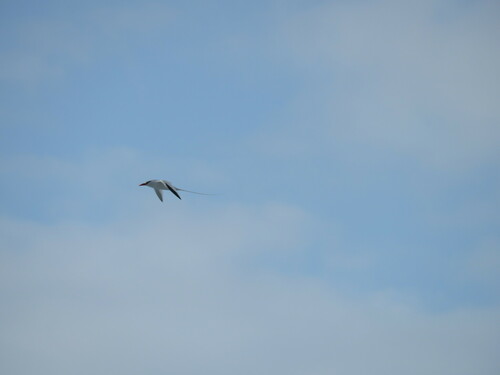 Red-billed Tropicbird
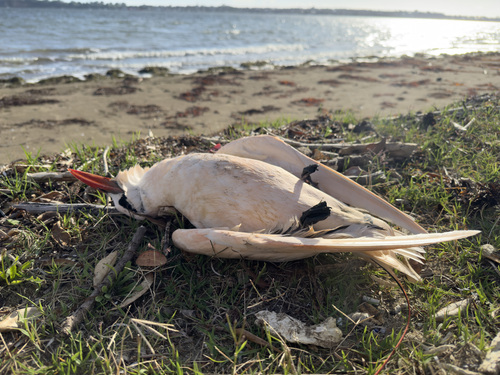 Red-tailed Tropicbird
In short
The most reliable field mark between Red-billed and Red-tailed Tropicbirds is the color of the tail streamers: Red-billed has long, white streamers with black shaft streaks, while Red-tailed has shorter, red or orange streamers with white bases. Juvenile birds are especially tricky, but Red-billed juveniles show heavier barring above and black-tipped tail feathers, while Red-tailed juveniles have more extensive black barring and scaling across the upperparts and a partly red bill. Both species have mostly white plumage, a black mask, and a red bill, but subtle differences in wing markings, tail shape, and size help separate them. Flight views are often confusing, so pay special attention to the tail and upperwing pattern, especially in young birds.
Identification tips
- Tail streamer color and length (adults): Red-billed has long, white streamers with black shaft streaks (up to twice body length, especially in males); Red-tailed has shorter, red or orange streamers with white bases (about a tenth of their length). This is the single best field mark for adults in flight or perched.
- Juvenile tail and upperparts: Juvenile Red-billed lacks streamers and has black-tipped tail feathers and heavier barring above; juvenile Red-tailed also lacks streamers but shows more extensive black barring and scaling on the upperparts and a wedge-shaped tail.
- Bill color (adults): Both have bright red bills, but Red-billed's is solid red, while Red-tailed's is bright red, slightly paler at the base and black around the nostrils. In juveniles, Red-billed's bill is less vividly red, Red-tailed's is blackish-grey with a blue-grey base.
- Wing pattern (adults): Red-billed shows black wing tips and a back finely barred in black; Red-tailed has white wings with dark chevron-shaped patches on the tertials and a pink tinge to the upperwing remiges.
- Facial mask: Both have a black mask, but Red-billed's mask extends from above the lores to the nape, sometimes with gray mottling near the nape; Red-tailed's mask is a dark brown comma-shaped stripe from the lores, through and over the eyes to the ear coverts.
- Plumage tinge: Red-tailed often shows a pink tinge to the plumage, especially on the wings; Red-billed is white with gray mottling on the nape and hindneck, but lacks the pink wash.
- Back pattern (adults): Red-billed's back is finely barred in black; Red-tailed's mantle and back have dark brown shaft bases, but the barring is less fine and more limited.
- Leg color: Red-billed has orange-yellow legs and toes with black on the rest of the feet; Red-tailed has pale blue-mauve legs and base of toes, with black webbing and rest of toes.
- Size and shape: Red-billed appears more elongated in flight due to longer streamers; Red-tailed is stockier, with a more compact look and shorter streamers.
- Flight jizz: Red-billed is more direct and tern-like; Red-tailed appears heavier-set and less elongated.
- Juvenile facial pattern: Juvenile Red-billed has black stripes above the eye connecting at the nape; juvenile Red-tailed has more extensive black barring and scaling on the crown and nape.
- Tail shape (juveniles): Juvenile Red-billed has a straight tail with black-tipped feathers; juvenile Red-tailed has a wedge-shaped tail.
- Vocalizations: Red-billed is more likely to be heard screaming near colonies; Red-tailed is mostly silent except for brief squawks or growls at the nest.
- Context: If seen in the Atlantic or eastern Pacific, Red-billed is more likely; in the central Pacific or Indian Ocean, Red-tailed is more likely, but overlap occurs.
- Sex differences: Male Red-billed have longer streamers than females, but this is only useful if both sexes are present for comparison.
Size
Red-billed Tropicbird is slightly smaller in wingspan (99–106 cm) compared to Red-tailed (111–119 cm), but the difference is subtle in the field. Red-billed's tail streamers are longer (up to twice body length, 46–56 cm), making it appear more elongated, especially in males. Red-tailed's streamers are shorter (about 35 cm) and red, contributing to a stockier, more compact look. No direct body mass comparison is available for Red-billed, but Red-tailed averages 219 g. Both are large, tern-like seabirds, but Red-billed often looks more slender due to its longer streamers.
Plumage
Juveniles: Red-billed juveniles have a mostly white crown, with black stripes above the eye usually connecting at the nape, and tail feathers with black tips or subterminal dots but lacking streamers. Their upperparts are heavily barred, more so than other tropicbirds. Red-tailed juveniles have glossy white forehead, chin, and underparts, but show prominent black barring and scaling on the crown, nape, mantle, back, rump, and upperwing coverts. Their bills are blackish-grey with a blue-grey base, and their legs are grey. The tail is wedge-shaped, and the streamers are absent or just beginning to grow.
Adults: Red-billed adults have mostly white plumage with black wing tips, a black mask, and white tail streamers with black shaft streaks. The back is finely barred in black, and the bill is bright red. Red-tailed adults are almost all white, often with a pink tinge, a black mask, and a bright red bill. Their tail streamers are red or orange with white bases (about a tenth of their length), and the wings show dark chevron-shaped patches on the tertials. The pink tinge is often more pronounced in the upperwing remiges. Both sexes are similar in plumage, but male Red-billed have longer streamers.
Behaviour
Both species are aerial and tern-like, often seen circling above the sea, especially near breeding colonies. Red-billed Tropicbird tends to fly with a more direct, purposeful flight, while Red-tailed can appear heavier-set and slightly less elongated due to shorter streamers. Both species perform aerial courtship displays, but these are rarely diagnostic in the field. Red-tailed is noted for being more aggressive at nest sites, adopting a distinctive defensive posture and engaging in prolonged bill-wrestling fights.
Habitat
Both species inhabit tropical oceans and are typically seen far offshore or near remote islands. Red-billed is found in the Atlantic, eastern Pacific, and parts of the Indian Ocean, while Red-tailed is native to the Indian and Pacific Oceans. In areas where both occur, context is not usually diagnostic, but Red-tailed is more likely in the central Pacific and Indian Ocean islands, while Red-billed is more common in the Atlantic and eastern Pacific.
Voice
Red-billed Tropicbird is more vocal near breeding colonies, producing loud, harsh screams ("kreeeee-kreeeee-kri-kri-kri-kr"). Chicks emit piercing shrieks when disturbed. Red-tailed Tropicbird is generally silent in flight, except during courtship displays, when it may give a short greeting squawk. At the nest, it can give a low growling call as a defense, and chicks chatter repetitively when parents are nearby. In the field, vocalizations are rarely diagnostic unless at a colony.
Red-billed Tropicbird · Red-tailed Tropicbird · My Tricky Birds