

Red-backed Shrike vs Eurasian Jay
Lanius collurio versus Garrulus glandarius
Play a quiz with Red-backed Shrike and Eurasian Jay
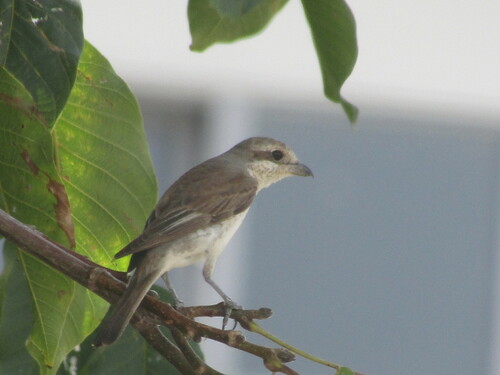 Red-backed Shrike
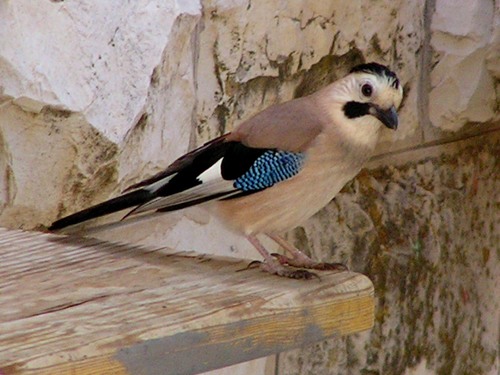 Eurasian Jay
In short
The most reliable field mark to separate Red-backed Shrike from Eurasian Jay is the presence of a bright blue wing panel on the Jay, which is completely absent in the Shrike. Red-backed Shrike males have a striking grey head and black mask, while females and juveniles are brown and finely barred, never showing blue or bold black-and-white wing patches. Eurasian Jays are much larger, with pinkish-brown bodies, a black moustache, and a prominent blue-and-black barred patch on the upperwing. Shrikes perch upright on exposed branches or wires, while Jays are bulkier, often seen in woodland, and rarely perch so openly. Even in flight, the Jay’s blue wing panel and white rump are distinctive, while the Shrike shows a more uniform wing and a black-and-white tail pattern.
Identification tips
- Blue wing panel (all ages, Jay only): Eurasian Jay always shows a bright blue patch with fine black bars on the upperwing, visible both perched and in flight. Red-backed Shrike never shows any blue in the wing.
- Size (all ages): Jays are nearly twice as long as Shrikes and much bulkier. If you see a bird that looks crow-sized, it is not a Shrike.
- Head pattern (adult male Shrike): Male Red-backed Shrike has a grey head and bold black mask through the eye. Jays have a whitish crown with black streaks and a black moustache, never a full mask.
- Underparts (all ages): Shrike underparts are pinkish (male) or buff (female/juvenile), often finely barred. Jay underparts are pinkish-brown, plain, and never vermiculated.
- Tail pattern: Shrike has a black-and-white tail, sometimes reminiscent of a wheatear. Jay has a solid black tail with a contrasting white rump, especially obvious in flight.
- Perching behavior: Shrikes perch upright and exposed on wires or bare branches. Jays are more secretive, usually in trees, rarely perching in the open for long.
- Habitat: Shrikes favor open country, hedgerows, and farmland. Jays are woodland birds, especially with oaks, and only occasionally venture into open areas.
- Bill shape: Shrike has a hooked, predatory bill typical of shrikes. Jay has a stout, straight bill, not hooked.
- Juvenile/female confusion: Young Shrikes are brown and barred but never show blue or a white rump. Young Jays look like adults and always have the blue wing panel.
- Flight style: Jays have a bounding, undulating flight, often noisy. Shrikes fly more directly and quietly.
- Vocalization: If you hear a loud, harsh screech, it is likely a Jay. Shrikes are quieter, with churring or warbling calls.
- Feeding behavior: Shrikes may be seen impaling prey on thorns or wire. Jays are often seen burying acorns or foraging on the ground.
- Crown pattern: Jay’s crown is whitish with black streaks; Shrike’s crown is plain grey (male) or brown (female/juvenile).
- Context: In the UK, Red-backed Shrike is now very rare and local, while Jay is widespread and common in suitable woodland.
- When in doubt: Look for the blue wing panel (Jay) and the upright, exposed perching (Shrike) as your quickest field checks.
Size
Eurasian Jay is substantially larger than Red-backed Shrike: Jays are 34–35 cm long with a 52–58 cm wingspan, while Shrikes are much smaller at 16–18 cm in length [wikipedia]. The Jay’s bulk and long wings make it appear almost crow-like, while the Shrike is more slender and thrush-sized. If you see both together, the Jay will dwarf the Shrike. This size difference is consistent across all ages and sexes.
Plumage
- Juvenile/immature birds: Red-backed Shrike juveniles and females are brown above and buff below, both heavily vermiculated (finely barred) across upperparts and underparts. They never show blue or bold contrasting wing panels. Eurasian Jay juveniles look similar to adults, with pinkish-brown plumage, black moustache, and always a blue-and-black barred wing patch and white rump.
- Adult males: Red-backed Shrike males have a grey head, black eye-stripe, reddish upperparts, pink-tinged underparts, and a black-and-white tail. Eurasian Jay adults have a pinkish-brown body, black moustache, whitish throat, white rump, black tail, and the key blue wing panel with fine black bars.
- Adult females: Female Shrikes resemble juveniles but lack the Jay’s blue wing and black moustache. Jays do not show sexual dimorphism in plumage.
- In flight: Jays show a white rump, blue wing panel, and black tail; Shrikes show a more uniform brown or reddish upperwing (depending on age/sex) and a black-and-white tail with no blue or white rump.
Behaviour
Red-backed Shrikes typically perch upright on prominent, exposed perches (fence posts, wires, tops of bushes), scanning for prey. They are often seen alone or in pairs, and are famous for impaling prey on thorns or barbed wire. Eurasian Jays are woodland birds, moving through trees with a bounding flight, rarely perching in the open for long. Jays are often seen flying between trees, foraging on the ground for acorns, or making short, noisy flights. Jays may visit gardens but are much less likely to be seen perched out in the open like a Shrike.
Habitat
Red-backed Shrikes prefer open country with scattered bushes, hedgerows, and edges of farmland, often in drier habitats. They are rarely found deep in woodland. Eurasian Jays are woodland specialists, especially where oaks are present, and are most often found in mixed or deciduous forests. Jays have recently expanded into urban parks and large gardens but remain closely tied to wooded habitats. Seeing a bird in open farmland or perched on a wire strongly favors Shrike; in dense woodland or among oaks, Jay is more likely.
Voice
No direct comparison in the notes. However, Eurasian Jay is known for harsh, screeching calls and can mimic other birds, while Red-backed Shrike is generally quieter, with harsh churring calls and sometimes a soft warble. If you hear a loud, raucous screech, suspect Jay.