
Radde's Warbler vs Dusky Warbler
Phylloscopus schwarzi versus Phylloscopus fuscatus
Play a quiz with Radde's Warbler and Dusky Warbler
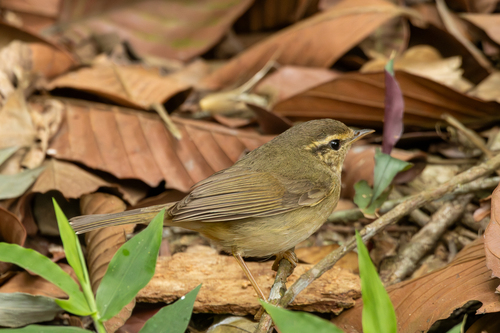 Radde's Warbler
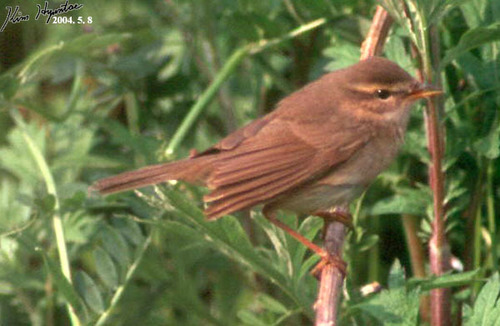 Dusky Warbler
In short
Radde's Warbler and Dusky Warbler are notoriously similar leaf warblers, but careful attention to bill thickness, leg color, and subtle plumage tones can separate them. The most reliable field marks are Radde's Warbler's thicker, more robust bill and distinctly paler legs, compared to the Dusky Warbler's finer bill and darker legs. Both species show a prominent whitish supercilium and unstreaked brown upperparts, but Radde's Warbler often looks more terrestrial and has larger-looking feet. Juvenile plumage differs subtly: young Radde's are yellower below, while young Dusky Warblers are more olive-tinged above. These differences are best seen at close range or in good light.
Identification tips
- Bill thickness: Radde's Warbler has a noticeably thicker, more robust and pointed bill than Dusky Warbler, whose bill is finer and more delicate. This is often the quickest structural clue at close range.
- Leg color: Radde's Warbler shows paler legs compared to the darker legs of Dusky Warbler. This difference is subtle but reliable in good light, especially when birds are perched low or hopping on the ground.
- Feet size: Radde's Warbler has larger-looking feet, reflecting its more terrestrial habits. If you see the bird walking or hopping on the ground, check for this chunky-footed look.
- Supercilium length: Both species have a prominent whitish supercilium, but Radde's tends to be longer and more striking, sometimes extending further behind the eye. However, this can be variable and affected by feather wear or posture.
- Juvenile plumage: Young Radde's Warblers are yellower below, while juvenile Dusky Warblers are more olive-tinged above. This is most useful in autumn migration when fresh juveniles are present.
- Underpart tone: Radde's Warbler often looks warmer or buffier below, while Dusky Warbler can appear colder or duller, but this is subtle and can be affected by light.
- Overall structure: Radde's Warbler may appear bulkier or more robust, with a heavier bill and feet, while Dusky Warbler is slightly more delicate overall.
- Behavior: If the bird is spending a lot of time on the ground or moving heavily through low cover, lean toward Radde's. If it is more active in shrubs and less often on the ground, Dusky is more likely, but this is not definitive.
- Habitat: Both species prefer dense, shrubby cover, so habitat is not a strong separator, but Radde's may be seen more often foraging on the ground.
- Sex and season: Both species are sexually monomorphic (sexes look alike), so do not use sex as a separator. Seasonal variation is limited to the subtle juvenile differences noted above.
- Flight views: No distinctive flight or wing pattern marks are described for either species, so do not rely on upperwing or tail pattern.
- Voice: Radde's gives a soft 'chick' call, but Dusky's call is not described here. Use voice only with caution and in combination with other marks.
- Pitfalls: Poor light can obscure leg color and bill thickness; always try for multiple views and use a combination of marks. Beware of individual variation and feather wear, especially in autumn.
- When in doubt: If you cannot see the bill or legs clearly, and plumage tones are ambiguous, it may not be possible to separate them with confidence. Prioritize structural marks and juvenile plumage when available.
Size
Both species are very similar in size, falling within the typical range for small Phylloscopus warblers. Radde's Warbler has a recorded body mass of about 11.5g [wikidata], which is close to Dusky Warbler's expected mass (not directly given, but similar by context). In the field, neither species is noticeably larger or smaller than the other, so size is not a reliable separator.
Plumage
Adult Radde's and Dusky Warblers both have unstreaked brown backs and buff underparts, with a prominent whitish supercilium. The key plumage differences are subtle and age-dependent: juvenile Radde's Warblers are yellower below, while juvenile Dusky Warblers have a more olive-tinged upper side. In both species, sexes are identical. The supercilium is very long and prominent in Radde's, sometimes appearing longer than in Dusky. No distinctive age-specific upperwing or flight marks are described for either species in the sources. Both have plain wings and lack strong wing bars or panels. In poor light, these subtle color differences can be hard to judge, so structural marks become more important.
Behaviour
Radde's Warbler is more terrestrial in its habits, often seen foraging low in dense cover or even on the ground, which is reflected in its larger-looking feet. Dusky Warbler is also skulking but may be slightly more arboreal, often keeping to low shrubs and thickets. Both species are active and restless, but Radde's may appear heavier-footed and less delicate in movement.
Habitat
Both species breed in the east Palearctic and are migratory, but Radde's Warbler is noted for breeding in Siberia and wintering in Southeast Asia, while Dusky Warbler breeds more broadly across the east Palearctic. In migration and vagrancy contexts, both can turn up in similar dense, shrubby habitats, so habitat alone is not a strong separator. Both favor thick cover and are rarely seen in open areas.
Voice
Radde's Warbler gives a soft 'chick' call. No distinctive vocal differences are provided for Dusky Warbler in the sources, so voice is not a reliable separator based on the information at hand. Both can be quiet and elusive, especially outside the breeding season.