

Motmot

Purple-throated Carib vs Green-throated Carib

Eulampis jugularis versus Eulampis holosericeus

Play a quiz with Purple-throated Carib and Green-throated Carib

Purple-throated Carib (Eulampis jugularis) Purple-throated Carib
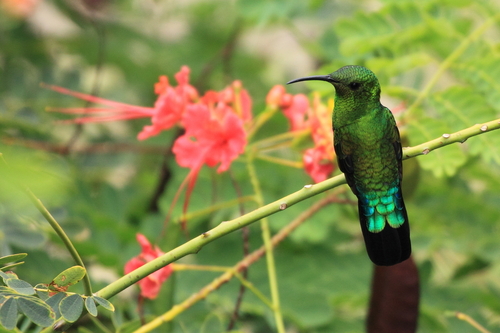
Green-throated Carib (Eulampis holosericeus) Green-throated Carib

Media

Loading…

In short

The most reliable field mark between Purple-throated Carib and Green-throated Carib is the color of the throat and chest: Purple-throated Carib shows a fiery purplish-red throat and chest in adults, while Green-throated Carib has a bright green gorget. Immature Purple-throated Caribs have an orange throat with red speckles, which is never seen in Green-throated. Both species are similar in size and structure, but the back color and subtle tail hues can help with careful observation. Bill shape is similar, but females of both species have longer, more curved bills than males. In the field, focus on throat color and back tone for the most consistent separation.

Identification tips

  1. Juvenile/immature throat color: Immature Purple-throated Carib shows an orange throat and chest with red speckles—never seen in Green-throated Carib. This is the best mark for young birds.
  2. Adult throat color: Adult Purple-throated Carib has a fiery purplish-red throat and chest; Green-throated Carib always has a bright green gorget (sometimes with a hidden blue border in males).
  3. Back color: Purple-throated Carib has a velvety black crown and back, while Green-throated Carib's back is bright green (duller in females). In good light, this is a strong field mark.
  4. Tail color: Both have metallic tails, but Purple-throated Carib's is greenish-blue, while Green-throated Carib's is dark blue to nearly black in poor light.
  5. Belly and vent: Green-throated Carib has a black belly and green vent area; Purple-throated's underparts are dominated by the purplish-red throat/chest, with less contrast to the belly.
  6. Bill shape: Both species have a medium-length, slightly decurved bill in males; females of both have longer, more strongly curved bills. Bill shape is not a strong separator unless sex is known and differences are extreme.
  7. Sex differences: Both species have similar male/female plumage, but females have longer, more curved bills. Do not rely on plumage to sex either species in the field.
  8. Wing color: Purple-throated Carib has bright golden-green wings; Green-throated Carib's wing color is not described as distinctive, so use this mark with caution.
  9. Size: Purple-throated Carib is slightly heavier on average, but size overlap is extensive. Use only as a supporting mark.
  10. Voice: Green-throated Carib gives a sharp 'chup!' or 'chuwp!' and makes rattles/whirs with wings in disputes. If you hear these calls, Green-throated is more likely, but silence is not diagnostic.
  11. Habitat: If in Puerto Rico, only Green-throated Carib is expected. Elsewhere, both species can occur together, especially in the Lesser Antilles.
  12. Lighting pitfalls: In poor light, the greenish-blue tail of Purple-throated and the dark blue tail of Green-throated can both appear dark, so do not rely on tail color alone unless seen well.
  13. Back color in shade: The green back of Green-throated can look darker in deep shade, but should still contrast with the blackish back of Purple-throated in direct comparison.
  14. Gorget border: The blue border on Green-throated Carib's gorget is usually not visible in the field; do not use this as a primary mark.
  15. Feeding behavior: Both species defend flower territories and feed on insects; behavior is not a separator, but context (e.g., garden vs forest) may support an ID if combined with plumage.

Size

Both species are large hummingbirds for the region, with overlapping length (10.5–12 cm for Green-throated, 11–12 cm for Purple-throated). Green-throated Carib is slightly lighter on average (body mass 6.2 g per Wikidata), while Purple-throated Carib males can reach up to 12 g. Size alone is not a reliable field mark, but a very bulky individual is more likely Purple-throated, especially if at the upper end of the weight range.

Plumage

Juvenile and immature separation is straightforward: young Purple-throated Caribs have an orange throat and chest with red speckles, a feature never shown by Green-throated Carib at any age. In adults, Purple-throated Carib has a velvety black crown and back, fiery purplish-red throat and chest, bright golden-green wings, and a metallic greenish-blue tail. Green-throated Carib adults have a bright green back (duller in females), a bright green gorget (with a usually hidden blue border in males), black belly, green vent, and a dark blue tail that can appear black in poor light. Both have metallic tails, but the tail of Green-throated is darker overall. The back color is a helpful secondary mark: blackish in Purple-throated, green in Green-throated. Both sexes of both species are similar, but female bills are longer and more curved.

Behaviour

Both species feed on nectar and small arthropods, often defending flower-rich territories. Males of both species defend territories year-round, while females do so mainly outside the breeding season. Both species catch insects on the wing and glean from vegetation. Their foraging and territorial behaviors are very similar, so behavior is not a strong separator.

Habitat

Both species are found in the Lesser Antilles, but Green-throated Carib also occurs in Puerto Rico. Green-throated adapts well to gardens and second growth near human habitation, while Purple-throated is resident on most Lesser Antillean islands and can be a vagrant further afield. Habitat overlap is extensive, so context is only weakly helpful unless in Puerto Rico, where only Green-throated occurs.

Voice

Green-throated Carib gives a sharp 'chup!' or 'chuwp!' call, and during disputes, makes rattles and wing whirs. No distinctive vocalization is described for Purple-throated Carib in the sources, so calls are only weakly diagnostic.

Submit a better description

Use the same sections as the comparison. Your text is published immediately.

The most reliable field mark between Purple-throated Carib and Green-throated Carib is the color of the throat and chest: Purple-throated Carib shows a fiery purplish-red throat and chest in adults, while Green-throated Carib has a bright green gorget. Immature Purple-throated Caribs have an orange throat with red speckles, which is never seen in Green-throated. Both species are similar in size and structure, but the back color and subtle tail hues can help with careful observation. Bill shape is similar, but females of both species have longer, more curved bills than males. In the field, focus on throat color and back tone for the most consistent separation.

  1. Juvenile/immature throat color: Immature Purple-throated Carib shows an orange throat and chest with red speckles—never seen in Green-throated Carib. This is the best mark for young birds.
  2. Adult throat color: Adult Purple-throated Carib has a fiery purplish-red throat and chest; Green-throated Carib always has a bright green gorget (sometimes with a hidden blue border in males).
  3. Back color: Purple-throated Carib has a velvety black crown and back, while Green-throated Carib's back is bright green (duller in females). In good light, this is a strong field mark.
  4. Tail color: Both have metallic tails, but Purple-throated Carib's is greenish-blue, while Green-throated Carib's is dark blue to nearly black in poor light.
  5. Belly and vent: Green-throated Carib has a black belly and green vent area; Purple-throated's underparts are dominated by the purplish-red throat/chest, with less contrast to the belly.
  6. Bill shape: Both species have a medium-length, slightly decurved bill in males; females of both have longer, more strongly curved bills. Bill shape is not a strong separator unless sex is known and differences are extreme.
  7. Sex differences: Both species have similar male/female plumage, but females have longer, more curved bills. Do not rely on plumage to sex either species in the field.
  8. Wing color: Purple-throated Carib has bright golden-green wings; Green-throated Carib's wing color is not described as distinctive, so use this mark with caution.
  9. Size: Purple-throated Carib is slightly heavier on average, but size overlap is extensive. Use only as a supporting mark.
  10. Voice: Green-throated Carib gives a sharp 'chup!' or 'chuwp!' and makes rattles/whirs with wings in disputes. If you hear these calls, Green-throated is more likely, but silence is not diagnostic.
  11. Habitat: If in Puerto Rico, only Green-throated Carib is expected. Elsewhere, both species can occur together, especially in the Lesser Antilles.
  12. Lighting pitfalls: In poor light, the greenish-blue tail of Purple-throated and the dark blue tail of Green-throated can both appear dark, so do not rely on tail color alone unless seen well.
  13. Back color in shade: The green back of Green-throated can look darker in deep shade, but should still contrast with the blackish back of Purple-throated in direct comparison.
  14. Gorget border: The blue border on Green-throated Carib's gorget is usually not visible in the field; do not use this as a primary mark.
  15. Feeding behavior: Both species defend flower territories and feed on insects; behavior is not a separator, but context (e.g., garden vs forest) may support an ID if combined with plumage.

Both species are large hummingbirds for the region, with overlapping length (10.5–12 cm for Green-throated, 11–12 cm for Purple-throated). Green-throated Carib is slightly lighter on average (body mass 6.2 g per Wikidata), while Purple-throated Carib males can reach up to 12 g. Size alone is not a reliable field mark, but a very bulky individual is more likely Purple-throated, especially if at the upper end of the weight range.

Juvenile and immature separation is straightforward: young Purple-throated Caribs have an orange throat and chest with red speckles, a feature never shown by Green-throated Carib at any age. In adults, Purple-throated Carib has a velvety black crown and back, fiery purplish-red throat and chest, bright golden-green wings, and a metallic greenish-blue tail. Green-throated Carib adults have a bright green back (duller in females), a bright green gorget (with a usually hidden blue border in males), black belly, green vent, and a dark blue tail that can appear black in poor light. Both have metallic tails, but the tail of Green-throated is darker overall. The back color is a helpful secondary mark: blackish in Purple-throated, green in Green-throated. Both sexes of both species are similar, but female bills are longer and more curved.

Both species feed on nectar and small arthropods, often defending flower-rich territories. Males of both species defend territories year-round, while females do so mainly outside the breeding season. Both species catch insects on the wing and glean from vegetation. Their foraging and territorial behaviors are very similar, so behavior is not a strong separator.

Both species are found in the Lesser Antilles, but Green-throated Carib also occurs in Puerto Rico. Green-throated adapts well to gardens and second growth near human habitation, while Purple-throated is resident on most Lesser Antillean islands and can be a vagrant further afield. Habitat overlap is extensive, so context is only weakly helpful unless in Puerto Rico, where only Green-throated occurs.

Green-throated Carib gives a sharp 'chup!' or 'chuwp!' call, and during disputes, makes rattles and wing whirs. No distinctive vocalization is described for Purple-throated Carib in the sources, so calls are only weakly diagnostic.

Discard your changes?

You have unsaved edits. If you leave now, those changes will be lost.

Purple-throated Carib · Green-throated Carib · My Tricky Birds