

Purple Starling vs Bronze-tailed Starling
Lamprotornis purpureus versus Lamprotornis chalcurus
Play a quiz with Purple Starling and Bronze-tailed Starling
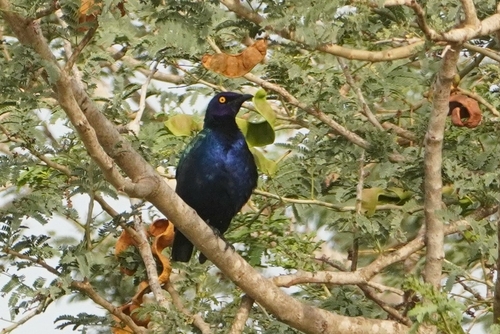 Purple Starling
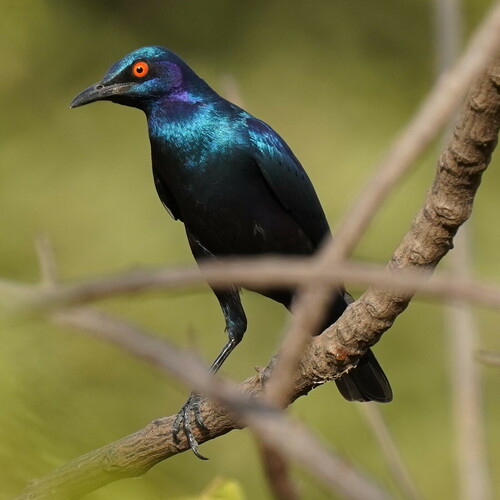 Bronze-tailed Starling
In short
The most reliable field mark between Purple Starling and Bronze-tailed Starling is the overall body color: adult Purple Starlings have a striking metallic purple head and body with glossy green wings, while Bronze-tailed Starlings lack this strong purple coloration and instead show a more subdued glossy appearance with a bronze-toned tail. Juveniles of Purple Starling are much duller, with grey underparts and a brown iris, which can help separate them from Bronze-tailed Starling juveniles if seen well. Both species are similar in size and structure, so focus on the color and gloss of the body and tail. In poor light or at distance, confusion is most likely with dull immatures or when only the upperparts are visible.
Identification tips
- Body Color (Adults): Look for the strong metallic purple head and body of Purple Starling; Bronze-tailed Starling lacks this and instead has a more subdued glossy appearance with a bronze-toned tail. This is the single most useful field mark for adults.
- Wing Color (Adults): Purple Starling has glossy green wings contrasting with the purple body. If you see this sharp contrast, it points to Purple Starling. Bronze-tailed Starling's wings are not described as green or as strongly contrasting.
- Tail Color: Bronze-tailed Starling shows a distinctive bronze gloss to the tail, which is lacking in Purple Starling. If the tail looks bronzy or coppery in good light, favor Bronze-tailed.
- Eye Color (Juveniles): Juvenile Purple Starlings have a brown iris, while adults have yellow. If you see a dull starling with a brown iris, it is likely a young Purple Starling. Bronze-tailed Starling juvenile iris color is not described, so use with caution.
- Underparts (Juveniles): Purple Starling juveniles have grey underparts, which is duller than adults. If you see a starling with greyish underparts and little gloss, suspect a juvenile Purple Starling.
- Gloss Quality: The overall gloss of Purple Starling is more intense and purple-toned, especially on the head and body. Bronze-tailed Starling's gloss is less purple and more uniform, with the tail being the most bronzed area.
- Sex Differences: Both species have similar plumage between sexes, so do not rely on sex for identification.
- Size and Structure: Both are stocky, short-tailed starlings of similar size (about 22–23 cm for Purple Starling). Structure is not a reliable separator.
- Flight Views: No distinctive wing or flight pattern differences are described for either species; focus on body and tail color if seen in flight.
- Perched Views: Perched birds showing a strong purple gloss and green wings are Purple Starling; those with a bronzy tail and less purple are Bronze-tailed Starling.
- Iris Color (Adults): Both species have yellow eyes as adults, so this is not a separator except in juveniles.
- Range and Context: If you are in Sudan or adjacent areas, Bronze-tailed Starling is more likely, but Purple Starling is widespread in West and Central Africa. Overlap is possible, so do not rely solely on range.
- Confusion Risk: In poor light or with distant views, the gloss may be hard to judge; focus on tail color and any visible contrast between head/body and wings.
- Seasonality: No seasonal plumage differences are described for either species; use the same marks year-round.
- Flock Association: Both species may flock with other starlings, so do not use flock composition as a separator.
Size
Both species are similar in size and proportions, with Purple Starling adults measuring about 22–23 cm in length. There is no specific measurement data provided for Bronze-tailed Starling, but there is no indication of a significant size difference between the two. Structure, including tail length and bill shape, is not noted as a reliable separator in the available sources.
Plumage
- Adults: Purple Starling stands out with a metallic purple head and body, contrasting with glossy green wings and a short tail. The eye is yellow. Bronze-tailed Starling does not show the strong purple gloss; instead, it has a more uniform glossy appearance with a distinctive bronze-toned tail, which is a key feature for this species.
- Juveniles: Purple Starling juveniles are much duller than adults, with grey underparts and a brown iris. This lack of gloss and the dull underparts can help distinguish them from Bronze-tailed Starling juveniles, though specific juvenile plumage details for Bronze-tailed are not provided in the sources. If you see a starling with a brown iris and greyish underparts, Purple Starling is more likely.
- Sexes: Both species have similar plumage between sexes, so sex is not a useful field mark.
Behaviour
No behavioral differences are described in the available sources that would reliably separate these two species in the field. Both are typical starlings in the family Sturnidae and likely share similar foraging and flight behaviors.
Habitat
Bronze-tailed Starling is noted as native to Sudan and adjacent areas, while Purple Starling is more widespread in West and Central Africa. However, habitat overlap can occur, and habitat alone is not a reliable separator without more specific information.