
Purple Roller vs Broad-billed Roller
Coracias naevius versus Eurystomus glaucurus
Play a quiz with Purple Roller and Broad-billed Roller
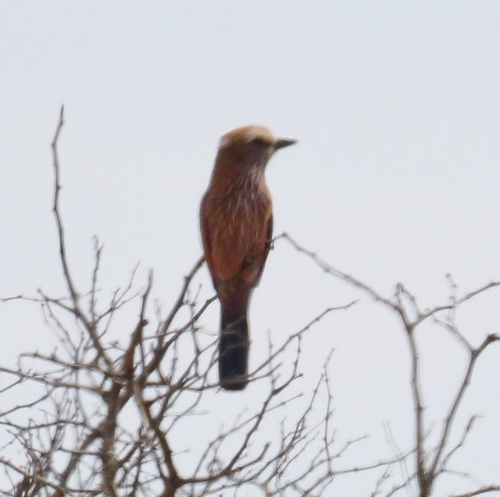 Purple Roller
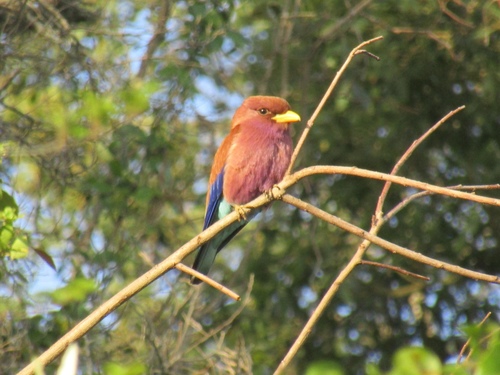 Broad-billed Roller
In short
The most reliable field mark between Purple Roller and Broad-billed Roller is the overall coloration and flight impression: Purple Roller appears large, dull brownish with a pale supercilium and streaked purplish underparts, while Broad-billed Roller is smaller, with a warm brown back, lilac breast, and flashes of bright blue on wings and tail in flight. Juvenile Broad-billed Rollers are duller but still show blue in the wings, unlike the Purple Roller, which remains more uniformly brownish and streaked. Bill color is also a key separator: Broad-billed Roller has a conspicuous bright yellow bill, while Purple Roller's bill is dark. In perched views, look for the Purple Roller's white supercilium and nape patch versus the Broad-billed Roller's plain face and warm tones.
Identification tips
- Flight coloration (all ages): Broad-billed Roller shows brilliant blue in the wings and tail in flight, even in juveniles, while Purple Roller never shows blue—its flight is overall dull brownish.
- Bill color (adults and older juveniles): Broad-billed Roller has a bright yellow bill, easily seen at rest or in good light. Purple Roller's bill is dark and less conspicuous.
- Facial pattern (adults): Purple Roller has a distinct white supercilium (eyebrow) and a white patch on the nape, both lacking in Broad-billed Roller, which has a plain, warm brown face.
- Underpart color and streaking (adults): Purple Roller has purplish-pink underparts with strong white streaks. Broad-billed Roller has a lilac breast and foreneck, with the rest of the underparts brown and less streaked.
- Crown color (regional adults): Northern Purple Rollers have a rufous crown, southern birds an olive-green crown; Broad-billed Roller has a warm brown head.
- Overall brightness: Broad-billed Roller is more colorful and contrasting, especially in flight. Purple Roller is duller and more uniform.
- Tail shape: Both have square-cut tails, so this is not a separator.
- Size and bulk: Purple Roller is significantly larger and heavier; this may be apparent when seen with other birds or if both species are present.
- Perching behavior: Purple Roller often perches very high and exposed, scanning for prey, while Broad-billed Roller may be more inactive and less conspicuous until late afternoon.
- Group vs solitary: Broad-billed Rollers may gather in groups, especially when feeding on swarming insects; Purple Roller is more often solitary or in pairs.
- Habitat: Purple Roller favors dry, open thornveld; Broad-billed Roller is more typical of moister woodland and forest edge.
- Voice: Listen for the harsh, repeated 'ka' of Purple Roller versus the rattling 'k-k-k-k-k-r-r-r' of Broad-billed Roller.
- Juvenile confusion: Juvenile Broad-billed Rollers are duller but still show blue in the wings and tail; Purple Roller juveniles are not described in detail but should lack blue and remain streaked and brownish.
- Supercilium and nape patch: The white supercilium and nape patch of Purple Roller are unique among these two, useful in perched views.
- Contextual cues: If seen in very dry, thorny country, Purple Roller is more likely; in wetter woodland, Broad-billed Roller is expected, especially outside the driest regions.
Size
Purple Roller is noticeably larger and heavier, reaching 35–40 cm in length and averaging 168 g in weight, making it the largest African roller. Broad-billed Roller is smaller at 29–30 cm and 104 g. This size difference is often apparent if both species are seen together or with familiar reference birds, but can be subtle at a distance or in isolation.
Plumage
- Juvenile/immature: Juvenile Broad-billed Rollers are duller than adults, with a pale breast, but still show blue in the wings and tail during flight. Juvenile Purple Rollers are not described in detail, but the species overall is much duller, with brownish upperparts and purplish-pink streaked underparts, lacking any blue flashes.
- Adult: Purple Roller is overall dull brownish with a white supercilium, white nape patch, rufous or olive crown (depending on region), and purplish-pink streaked underparts. The wings are long and rounded, but lack blue. Broad-billed Roller adults have a warm brown back and head, lilac foreneck and breast, and brilliant blue in the wings and tail, especially obvious in flight. The bill is bright yellow in Broad-billed, dark in Purple Roller.
- Flight: Broad-billed Roller is striking in flight due to the strong contrast between brown back and blue wings/tail, while Purple Roller remains dull and brownish with no blue. Both have square-cut tails, but only Broad-billed shows blue.
Behaviour
Purple Rollers often perch conspicuously atop thorn trees or poles, scanning for prey, and are territorial, sometimes aggressively chasing other birds. Their display flight involves rocking and rolling with a raucous call. Broad-billed Rollers are more inactive during the day, becoming active in late afternoon to feed on swarming insects, sometimes in large groups. They drink on the wing like swallows and are less likely to be seen alone. Both species may chase intruders, but group foraging is more typical of Broad-billed.
Habitat
Purple Roller prefers dry thornveld and open country, often in arid or semi-arid regions, and is more likely to be found in drier habitats. Broad-billed Roller breeds across tropical Africa and Madagascar, avoiding only the driest regions, and is associated with moister woodland and forest edges. During the dry season, Broad-billed Rollers migrate toward wetter equatorial zones. Habitat overlap is possible, but Purple Roller is a bird of drier, more open country, while Broad-billed Roller favors wetter, wooded areas.
Voice
Purple Roller has a harsh, grating 'ka' or 'gaa' call, repeated rapidly and evenly, often given during display flights. Broad-billed Roller's call is a snarling 'k-k-k-k-k-r-r-r-r-r' sound. Both are noisy, but the Purple Roller's voice is harsher and more monotonous, while Broad-billed's is more rattling or snarling.