

Purple Gallinule vs Western Swamphen
Porphyrio martinica versus Porphyrio porphyrio
Play a quiz with Purple Gallinule and Western Swamphen
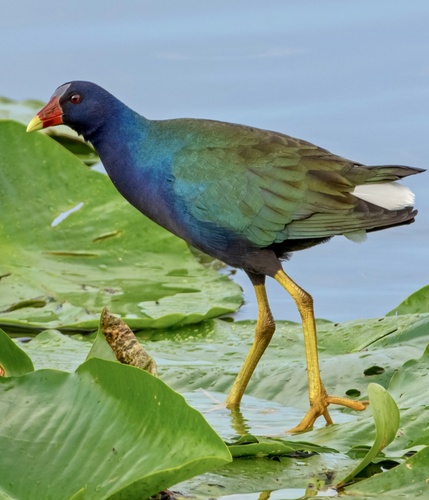 Purple Gallinule
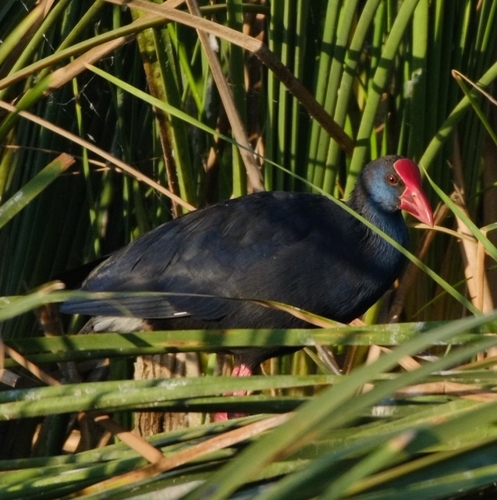 Western Swamphen
In short
The most reliable way to separate Purple Gallinule from Western Swamphen is by their overall coloration and the color of the bill and frontal shield: Purple Gallinule adults show a pale blue shield and a red-and-yellow bill, while Western Swamphen has a solid red bill and shield. Immature Purple Gallinules are brownish with hints of bronze and a pale bill/shield, which can be confused with young swamphens, but Western Swamphen never shows the same combination of pale shield and brownish legs. Both species have large feet and bright plumage, but Purple Gallinule is distinctly smaller and more delicate, with yellow legs (adults) and a more iridescent, multicolored sheen. Western Swamphen is bulkier, chicken-sized, and always has a red bill and shield in all plumages.
Identification tips
- Bill and shield color: Adult Purple Gallinule has a pale blue forehead shield and a red-and-yellow bill; Western Swamphen always has a solid red bill and shield. This is the single most reliable field mark at all ages.
- Leg and foot color: Adult Purple Gallinule has bright yellow legs and feet; immatures have brownish-yellow legs, juveniles brown legs. Western Swamphen typically has reddish or duller legs (not yellow), and never the bright yellow of adult gallinule.
- Body size and shape: Purple Gallinule is much smaller and slimmer, with a more delicate build and proportionally longer toes for its size. Western Swamphen is bulkier, chicken-sized, and appears much heavier-bodied.
- Plumage iridescence: Purple Gallinule adults show a shimmering mix of purple, green, and turquoise in good light, while Western Swamphen is more uniformly deep blue or purple, lacking the same iridescent sheen.
- Juvenile/immature confusion: Young Purple Gallinules are brownish with green-bronze hints and a pale bill/shield; Western Swamphen juveniles do not show this combination and are never as brown overall. If you see a brownish rail with a pale shield and bill, it's a young gallinule.
- Flight jizz: Both species fly with legs dangling, but the gallinule's yellow feet (adults) or brownish feet (immatures) are distinctive. Western Swamphen appears bulkier and heavier in flight.
- Habitat and range: In the Americas, Purple Gallinule is the only option; in Western Europe and NW Africa, Western Swamphen is expected. Out-of-range records are extremely rare and usually involve vagrants.
- Perched behavior: Purple Gallinule is more likely to be seen balancing on floating plants or reeds, using its long toes. Western Swamphen is more often seen striding on firmer ground or in denser vegetation.
- Plumage in poor light: Purple Gallinule can look dusky or brownish in bad light, but the shield and bill color remain diagnostic. Western Swamphen's color is more stable across lighting conditions.
- Sex and season: No significant sexual dimorphism in either species; all field marks apply year-round.
- Courtship and display: Only Purple Gallinule is described as performing a mutual display with wings held at right angles and primaries angled down, but this is rarely useful for field ID.
- Vagrancy: Purple Gallinule is a notorious vagrant, but almost all extralimital records are juveniles; check for brownish plumage and pale bill/shield if you suspect an out-of-range bird.
- Confusion risk: The main pitfall is mistaking a dull or immature gallinule for a swamphen, especially in poor light or at distance. Always check bill/shield color and leg color before relying on overall size or color impression.
- Feet size: Both have large feet, but the gallinule's are more slender and yellow (adults); swamphen's are thicker and never yellow.
- No distinctive upperwing pattern: Neither species shows a unique upperwing pattern in flight that is useful for separation in the field.
Size
Purple Gallinule is notably smaller and lighter (average adult mass ~236 g) compared to the Western Swamphen, which is described as chicken-sized and bulkier (no precise mass given, but consistently larger in all field encounters). The gallinule appears more slender and less robust, with proportionally longer toes for its size. In direct comparison, Western Swamphen will look much heavier-bodied and taller, especially when both are seen side by side or with familiar wetland birds.
Plumage
- Juvenile/Immature: Purple Gallinule juveniles are light brown with green-bronze hints on the wings and back, and white undertail coverts; their bill and shield are pale, and legs are brown. Immatures are brown-bronze overall with some purple on the chest, still with a pale bill and shield and brownish-yellow legs. Western Swamphen juveniles are not described in detail here, but never show the same pale shield and bill combination; even young birds have a red bill and shield, and their overall coloration is more blue or purple, lacking the brown-bronze tones of gallinule immatures.
- Adult: Purple Gallinule adults are strikingly iridescent purple-blue, with green and turquoise highlights in good light, a pale blue forehead shield, and a red-and-yellow bill. Legs and feet are bright yellow. Western Swamphen adults are deep blue to purple, with a solid red bill and frontal shield, and large feet (color not specified here, but typically reddish or duller in swamphens). The gallinule's plumage is more variable in light, sometimes looking dusky or brownish in poor light, but the shield and bill pattern remain distinctive.
- Flight: Purple Gallinule often flies with legs dangling, showing yellow feet (adults) or brownish feet (immatures); Western Swamphen also has large feet, but the color and bulk of the bird are different. No distinctive upperwing pattern is described for either species in these notes.
Behaviour
Both species are adapted for walking on floating vegetation with their large feet, but Purple Gallinule is more agile and often seen clambering on lily pads or reeds, using its long toes to distribute weight. It usually flies only short distances and often with legs trailing. Western Swamphen is heavier and moves more deliberately, often seen striding through marshes or open wetland edges. Both can be bold in the open, but the gallinule is more likely to be seen balancing on flimsy vegetation.
Habitat
Purple Gallinule is found in the Americas, especially in marshes, lakes, and rivers with dense floating or emergent vegetation. Western Swamphen is restricted to wetlands around the western Mediterranean (Spain, Portugal, France, Italy, NW Africa), often in large reedbeds, marshes, and sometimes paddy fields. Their ranges do not overlap except in rare vagrancy events. In the Americas, any swamphen is almost certainly a Purple Gallinule; in Iberia, France, or NW Africa, Western Swamphen is the default large purple rail.