

Pomarine Skua vs Black Guillemot
Stercorarius pomarinus versus Cepphus grylle
Play a quiz with Pomarine Skua and Black Guillemot
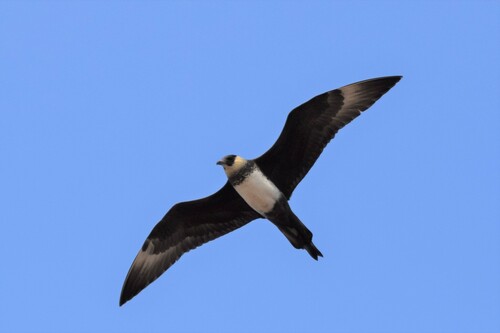 Pomarine Skua
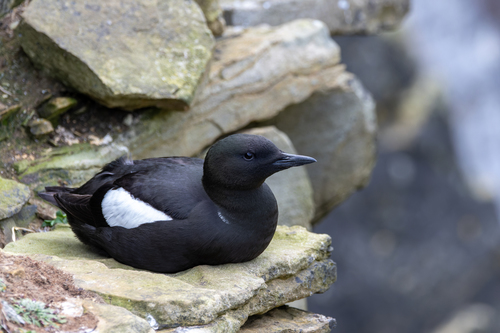 Black Guillemot
In short
The most reliable field mark to separate Pomarine Skua from Black Guillemot is the flight profile and wing pattern: Pomarine Skuas (especially adults and immatures) show a bold white double flash on the underwing and, in breeding adults, long spoon-shaped central tail feathers, while Black Guillemots always show a large white patch on the upperwing, never a double flash, and have compact, auk-like bodies. Juvenile Pomarine Skuas are notoriously tricky, but even then, their bulkier build and broader wings contrast with the guillemot’s small, pigeon-like shape. In perched or close views, Black Guillemots in breeding plumage are entirely black with a striking white wing patch and bright red legs, while Pomarine Skuas are never all-black and lack red legs. Habitat is also a strong clue: Pomarine Skuas are oceanic migrants, rarely seen close to shore except on passage, while Black Guillemots are coastal and often seen near rocky shores or cliffs.
Identification tips
- Underwing pattern in flight (all ages): Pomarine Skua always shows a diagnostic white double flash on the underwing, while Black Guillemot has a single large white patch on the upperwing, never a double flash.
- Tail shape (breeding adults): Pomarine Skua adults have long, twisted, spoon-shaped central tail feathers; Black Guillemot has a short, square tail with no streamers.
- Overall structure: Pomarine Skua is much larger, bulkier, and broader-winged, with a more powerful, measured flight. Black Guillemot is compact, short-necked, and pigeon-like, with rapid, direct flight low over water.
- Bill: Pomarine Skua has a robust, hooked bill typical of skuas; Black Guillemot has a long, slender, straight bill.
- Leg color: Black Guillemot has bright coral-red legs and feet (and mouth lining) in all seasons; Pomarine Skua never shows red legs.
- Breeding plumage (summer): Black Guillemot is entirely black with a large white upperwing patch; Pomarine Skua (light morph) is brown above, white below, with a yellowish-white head/neck and black cap, and never all-black.
- Non-breeding plumage (winter): Black Guillemot is pale grey above with barred upperparts and white underparts, retaining the white wing patch and red legs; Pomarine Skua is never as pale and lacks the bold white upperwing patch.
- Juvenile/immature plumage: Juvenile Black Guillemots have a white wing patch spotted with grey/brown, easily seen even at distance; juvenile Pomarine Skuas are variable but never show a single bold white upperwing patch.
- Perched behavior: Black Guillemots often perch on rocks or cliffs near shore; Pomarine Skuas are rarely seen perched except at breeding sites or on migration.
- Habitat: Black Guillemots are coastal, rarely far from land; Pomarine Skuas are oceanic, usually far offshore except on migration.
- Flight jizz: Pomarine Skua soars and glides with slow, powerful wingbeats; Black Guillemot flies low and fast, often close to the water.
- Vocalization: Black Guillemot gives high whistles near colonies; Pomarine Skua has harsh chattering calls, rarely heard at sea.
- Context: If seen in a group, Black Guillemots are usually in pairs or small groups near rocks; Pomarine Skuas are often solitary or in loose groups at sea.
- Confusion risk: Juvenile Pomarine Skuas are most likely to be confused with other skuas, not Black Guillemot; Black Guillemot’s all-black summer plumage and red legs are unique in its range.
- Size in mixed flocks: If seen with gulls, Pomarine Skua is larger than most gulls; Black Guillemot is much smaller and more compact.
Size
Pomarine Skua is substantially larger and heavier than Black Guillemot (average body mass 694g vs 381g [wikidata]). Pomarine Skuas are bulkier than a Common Gull, with a wingspan up to 138 cm, while Black Guillemots are much smaller, with a wingspan of only 52–58 cm. In flight, Pomarine Skuas appear broad-winged and powerful, whereas Black Guillemots are compact and short-necked, with a more rapid, direct flight.
Plumage
Juvenile and immature Pomarine Skuas are difficult to distinguish from Parasitic Skuas but are never all-black and always show a white double flash on the underwing (diagnostic for all ages and morphs), whereas Black Guillemot juveniles and immatures show a large white patch on the upperwing, often spotted with grey or brown, but never a double flash. In breeding plumage, adult Pomarine Skuas (light morph) have a brown back, white underparts, dark primaries with a white flash, yellowish-white head and neck with a black cap, and long, twisted central tail feathers; dark morphs are overall dark brown. Black Guillemots in summer are entirely black with a large white wing patch and bright coral-red legs and mouth lining. In winter, Black Guillemots become pale grey above with barred upperparts and white underparts, but retain the white wing patch and red legs. Pomarine Skuas in non-breeding plumage are never as pale as winter Black Guillemots and lack the bold white upperwing patch.
Behaviour
Pomarine Skuas are powerful, aggressive fliers with a measured, direct flight and are often seen harassing other seabirds at sea (kleptoparasitism). They are rarely seen perched except during migration or at breeding sites. Black Guillemots are typically seen singly or in pairs near rocky shores, diving for food close to the coast, and often perch on rocks. Their flight is rapid and direct, but low and close to the water, unlike the more soaring, higher flight of Pomarine Skuas.
Habitat
Pomarine Skuas are pelagic, spending most of their lives far out at sea and only coming to land to breed in the high Arctic or passing close to shore during migration. Black Guillemots are strictly coastal, breeding and wintering along rocky shores, cliffs, and islands, and are rarely seen far from land. If you see a bird close to shore or perched on rocks, Black Guillemot is far more likely; a bird seen far offshore, especially in tropical or open ocean, is likely a Pomarine Skua.
Voice
Pomarine Skuas have harsh, chattering calls and a distinctive 'which-yew' sound, but are usually silent at sea. Black Guillemots give high whistles, especially in the breeding season, and have a prominent red gape when calling. Vocalizations are rarely useful for separation at sea, but the guillemot’s high whistle is distinctive if heard near colonies.