

Plumbeous Rail vs Ash-throated Crake
Pardirallus sanguinolentus versus Mustelirallus albicollis
Play a quiz with Plumbeous Rail and Ash-throated Crake
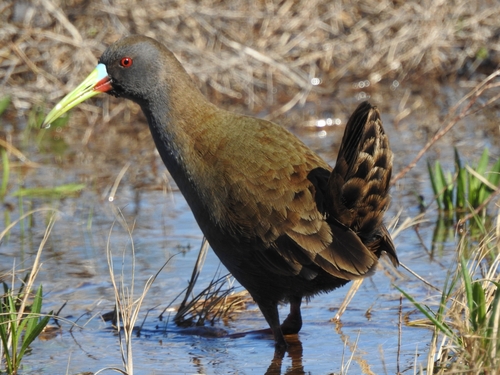 Plumbeous Rail
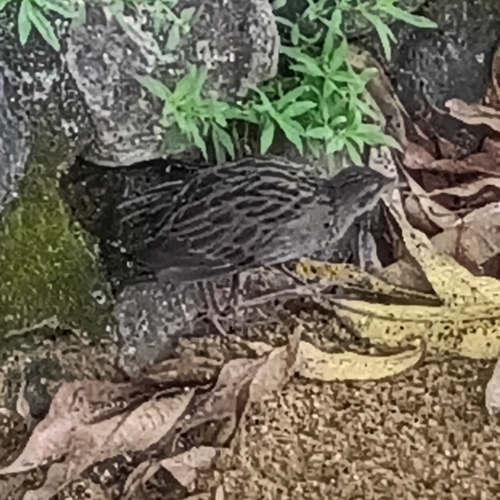 Ash-throated Crake
In short
The most reliable field mark to separate Plumbeous Rail from Ash-throated Crake is overall size and build: Plumbeous Rail is much larger and heavier, with a longer body and heavier bill, while Ash-throated Crake is notably smaller and more compact. In plumage, Plumbeous Rail shows plain gray underparts and a mostly plain face, contrasting with the Ash-throated Crake’s pale gray throat and breast, black upperparts with brown feather edges, and distinctive black-and-white barring on the flanks and undertail. Bill color also helps: Plumbeous Rail’s bill is green with a blue base and red lower mandible (except in some subspecies), while Ash-throated Crake’s is short, greenish, and lacks the bright color contrasts. Both species are secretive marsh birds, but their size and plumage differences are usually visible with good views.
Identification tips
- Size is a primary clue: Plumbeous Rail is much larger and heavier than Ash-throated Crake. If you see a rail that looks closer to a small chicken than a sparrow, it is likely Plumbeous Rail.
- Bill structure and color: Plumbeous Rail has a longer, heavier green bill with a blue base and red lower mandible (except in P. s. luridus). Ash-throated Crake’s bill is shorter, greenish, and lacks the strong color contrasts.
- Underparts pattern: Plumbeous Rail shows plain gray underparts with no barring, while Ash-throated Crake has a pale gray throat and breast, and bold black-and-white barring on the flanks and undertail. This barring is a key field mark for Ash-throated Crake.
- Upperparts: Plumbeous Rail (nominate) has mottled brown upperparts, but some subspecies are more olive-brown and lack mottling. Ash-throated Crake has black upperparts with brown feather edges, giving a darker and more patterned look.
- Face pattern: Plumbeous Rail has a plain gray face, while Ash-throated Crake’s face is not as plain, with a paler throat and breast that stand out against the darker upperparts.
- Leg color: Plumbeous Rail has red legs, while Ash-throated Crake’s legs are purplish brown. This can help if you get a clear look at the legs.
- Eye color: Plumbeous Rail has red eyes; Ash-throated Crake’s eye color is not specified in the notes, so this is only useful if you see a clear red eye (favoring Plumbeous Rail).
- Flight style: If flushed, Plumbeous Rail appears heavier and slower, while Ash-throated Crake is more fluttery and agile.
- Habitat context: In Chile, only Plumbeous Rail occurs. Elsewhere, both may be present, so rely on plumage and size.
- Subspecies variation: Be aware that some Plumbeous Rail subspecies lack upperpart mottling and have paler gray underparts, but they still lack the bold flank barring of Ash-throated Crake.
- Juvenile/immature birds: No distinctive juvenile wing or flight pattern marks are described for either species, so use overall size and flank barring for young birds as well.
- Sex differences: Both species have sexes alike in plumage, so do not rely on sex for identification.
- Voice: Not described in the notes, so do not use vocalizations for separation here.
- Bill color exceptions: Remember that P. s. luridus lacks the blue and red bill coloration, so in that subspecies, bill color is less helpful.
- Overall impression: If the bird looks large, plain, and gray below, think Plumbeous Rail; if it is small, patterned, and shows black-and-white flank barring, think Ash-throated Crake.
Size
Plumbeous Rail is substantially larger, measuring 30–38 cm in length and weighing 170–230 g, while Ash-throated Crake is much smaller at 21–24 cm and 90–120 g [wikipedia]. This size difference is usually obvious in the field if you see the birds side by side or have a good sense of scale. Plumbeous Rail appears longer-bodied and heavier, with a proportionally longer bill, while Ash-throated Crake is compact and lighter, with a noticeably shorter bill.
Plumage
- Juvenile/immature wing and flight pattern: No specific age-related upperwing or flight pattern marks are described for either species in the available notes, so focus is on adult and general plumage.
- Plumbeous Rail (adult): Shows mottled brown upperparts (nominate), plain gray face and underparts, and red eyes and legs. Bill is green with a sky blue base and bright red lower mandible (except in P. s. luridus, which lacks mottling and has paler gray underparts). Subspecies vary in the amount of olive-brown and gray, but all lack strong barring or bold patterning on the flanks.
- Ash-throated Crake (adult): Has black upperparts with brown feather edges, a pale gray throat, breast, and belly, and striking black-and-white bars on the flanks and undertail coverts. Bill is short and greenish, legs purplish brown. Subspecies M. a. typhoeca is smaller and paler, but the basic pattern remains.
- Key contrast: Plumbeous Rail is overall plainer, especially below, with no flank barring; Ash-throated Crake is more patterned, with obvious barring and a paler throat and breast.
Behaviour
Both species are secretive and prefer to stay hidden in dense marsh vegetation, but Plumbeous Rail, being larger, may appear more deliberate and less agile when moving through reeds. Ash-throated Crake, due to its smaller size, can move more quickly and nimbly through tight spaces. Both are more often heard than seen, but when flushed, Plumbeous Rail may appear heavier and slower in flight, while Ash-throated Crake is likely to make a shorter, more fluttery flight.
Habitat
Both species occupy marshes and wet grasslands, but their ranges only partially overlap. Plumbeous Rail is found in southern and western South America, including Argentina, Chile, and the Andes, while Ash-throated Crake is absent from Chile but widespread elsewhere in South America. Habitat preferences are similar, so context is only weakly diagnostic unless you are in Chile (where only Plumbeous Rail occurs).