

Plain-capped Starthroat vs Fiery-throated Hummingbird
Heliomaster constantii versus Panterpe insignis
Play a quiz with Plain-capped Starthroat and Fiery-throated Hummingbird
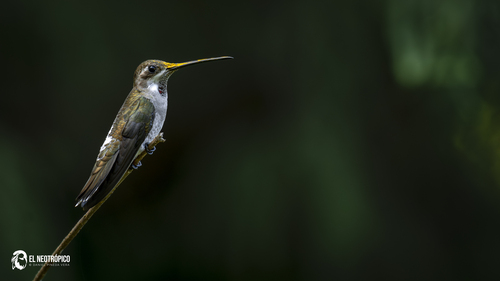 Plain-capped Starthroat
 Fiery-throated Hummingbird
In short
The most reliable field mark between Plain-capped Starthroat and Fiery-throated Hummingbird is the throat and underparts coloration: Plain-capped Starthroat shows a variable but always sharply defined metallic red or purplish gorget set against dull brownish-gray underparts, while Fiery-throated Hummingbird dazzles with a fiery, multi-hued throat (coppery orange center, golden green sides) and consistently bright green to blue-green underparts. Bill structure is also helpful: the starthroat’s bill is longer, almost straight, and entirely black, while the fiery-throated’s is shorter, slightly decurved, and has a pinkish base to the lower mandible. In flight or perched, the starthroat’s white rump streak and white facial markings contrast with the fiery-throated’s blue crown and overall darker face. Immature starthroats have a sooty brown throat with pale feather margins, while fiery-throated immatures resemble adults. Size and structure differences are subtle but present, with the starthroat being notably larger and heavier.
Identification tips
- Throat and underparts color (all ages): Plain-capped Starthroat has a sharply defined metallic red or purplish gorget (adults), or a sooty brown throat with pale feather margins (immatures), always set against dull brownish-gray underparts. Fiery-throated Hummingbird shows a fiery, multi-hued throat (coppery orange center, golden green sides) and bright green to blue-green underparts in all plumages.
- White rump streak (all ages): Starthroat has a bold white streak on the rump, visible in flight and often when perched; fiery-throated lacks this feature entirely.
- Facial markings: Starthroat shows a wide white moustache and a more prominent, elongated white streak behind the eye; fiery-throated has a small white spot behind the eye and a mostly black face.
- Crown color: Fiery-throated has a glittering royal blue crown, contrasting with its black face and nape; starthroat’s crown is less metallic and blends with the bronze green upperparts.
- Bill structure: Starthroat’s bill is long, almost straight, and entirely black; fiery-throated’s bill is shorter, slightly decurved, and has a pinkish base to the lower mandible (look for this in good light).
- Tail pattern: Starthroat’s tail is bronze green with blackish ends and white inner edges (especially visible when fanned); fiery-throated’s tail is blue-black with no white.
- Size and bulk: Starthroat is larger and heavier, with a longer bill and slightly bulkier look; fiery-throated is smaller and more compact, but this can be subtle unless both are seen together.
- Immature throat pattern: Young starthroats have a sooty brown throat with pale feather edges and lack metallic colors; fiery-throated immatures already show some iridescent throat coloration.
- Underparts contrast: Starthroat’s underparts are brownish-gray with a white belly and pale gray undertail coverts tipped white; fiery-throated’s underparts are bright green to blue-green, with a violet-blue breast patch and no white belly.
- Flank tufts: Starthroat has large white feather tufts on the flanks, which can be conspicuous when the bird is fluffed up; fiery-throated lacks these.
- Habitat and elevation: If you are in highland cloud forest or páramo above 1600 m in Costa Rica or Panama, fiery-throated is expected; starthroat is found at lower elevations and is absent from Panama.
- Behavior: Fiery-throated is aggressive, often chasing other hummingbirds; starthroat is less dominant and more solitary.
- Perching jizz: Starthroat often perches openly on exposed branches, showing off its long bill and white rump streak; fiery-throated is more likely to be seen at flowers or in the canopy.
- Vocalizations: If you hear a repeated nasal, squeaky 'kek...kek...', fiery-throated is likely; starthroat’s voice is not distinctive in this context.
- Pitfalls: Both species have a white spot behind the eye, but only starthroat has a bold white moustache and rump streak. The metallic throat of starthroat is always a single color patch, never the rainbow effect of fiery-throated. Immature starthroats may appear dull, but lack the green and blue hues of fiery-throated at any age.
Size
Plain-capped Starthroat is the larger and heavier species: 11–13 cm long and about 7.2–7.4 g in weight for both sexes. Fiery-throated Hummingbird is smaller and lighter, at 10.5–11 cm and 4.9–6.2 g. In the field, this size difference can be subtle unless both species are seen together, but the starthroat’s longer bill and slightly bulkier frame may stand out, especially when perched.
Plumage
Juvenile and immature birds are most reliably separated by throat pattern: young Plain-capped Starthroats have a dark sooty brown throat with grayish-white feather margins, lacking any metallic color, while Fiery-throated Hummingbirds (immature and adult) always show some degree of iridescent, multi-colored throat (coppery orange, golden green, blue-violet). In adults, the starthroat’s gorget is a sharply defined patch of metallic red to purplish red, set off by a sooty chin and brownish-gray underparts, with a bold white moustache and a wide white rump streak. The fiery-throated’s face is mostly black with a blue crown, and the underparts are consistently bright green to blue-green, with a violet-blue breast patch and no white rump streak. The starthroat’s tail is bronze green with blackish ends and white inner edges, while the fiery-throated’s tail is blue-black with no white. Both species have a white spot behind the eye, but it is more prominent and elongated in the starthroat.
Behaviour
Fiery-throated Hummingbird is notably aggressive and dominant, often defending feeding territories and chasing away other hummingbirds, including larger species. Plain-capped Starthroat is less aggressive in mixed-species flocks. Fiery-throateds are more likely to be seen at highland flower patches, often in the canopy or at forest edge, while starthroats are more often solitary or in loose association, perching conspicuously on open branches. Both species feed on nectar and small arthropods, but fiery-throateds may be observed feeding at deeper flowers, sometimes using holes made by other animals.
Habitat
Plain-capped Starthroat ranges from Mexico to Costa Rica, typically in lowland to mid-elevation habitats. Fiery-throated Hummingbird is restricted to highland forests and edges in Costa Rica and western Panama, usually above 1600 m and up to 3200 m. If you are in true cloud forest, elfin forest, or at the edge of páramo above 2000 m in Costa Rica or Panama, fiery-throated is far more likely. Starthroat is absent from these high elevations and is not found in Panama.
Voice
Fiery-throated Hummingbird gives a repeated nasal, squeaky 'kek...kek...' in fast series, and a complex, fast liquid call. Plain-capped Starthroat’s vocalizations are not described in the provided notes, so voice is not a reliable separator unless the fiery-throated’s distinctive calls are heard.
Plain-capped Starthroat · Fiery-throated Hummingbird · My Tricky Birds