

Pintado Petrel vs Great-winged Petrel
Daption capense versus Pterodroma macroptera
Play a quiz with Pintado Petrel and Great-winged Petrel
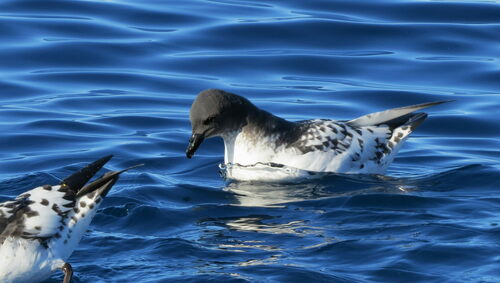 Pintado Petrel
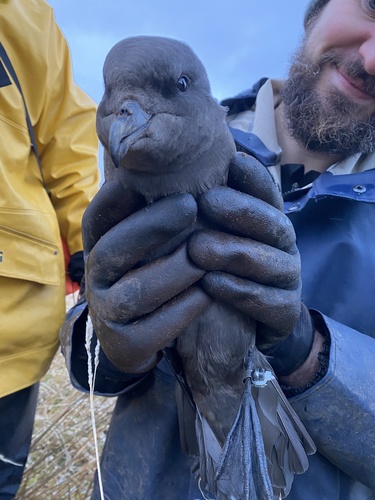 Great-winged Petrel
In short
The most reliable field mark between Pintado Petrel and Great-winged Petrel is the striking black-and-white speckled upperwing and back of the Pintado Petrel, versus the uniform dark brown plumage of the Great-winged Petrel. In flight, Pintado Petrel shows a white underwing with a bold black border, while Great-winged Petrel’s underwing is entirely dark. These differences are visible at all ages and in all seasons. Structurally, Great-winged Petrel is larger and bulkier, with a heavier, stubby bill. Even at a distance, the contrasting plumage patterns and size difference are usually clear with binoculars.
Identification tips
- Upperwing and back pattern: Pintado Petrel of all ages shows a black-and-white speckled pattern on the upperwings and back, unique among Southern Ocean petrels. Great-winged Petrel is uniformly dark brown above with no speckling.
- Underwing pattern: In flight, Pintado Petrel displays a white underwing with a bold black border, visible even at a distance. Great-winged Petrel’s underwing is entirely dark, with no white or contrasting border, at all ages.
- Head and neck: Pintado Petrel has a black head and neck contrasting with its white underparts, while Great-winged Petrel’s head is the same dark brown as the rest of the body, except for a small, sometimes-invisible white patch at the base of the bill.
- Bill shape: Great-winged Petrel has a thick, stubby, all-dark bill. Pintado Petrel’s bill is proportionally smaller and less robust, though this can be subtle at a distance.
- Body size: Great-winged Petrel is substantially larger and heavier than Pintado Petrel. When seen together or with other seabirds, the size difference is obvious.
- Flight style: Pintado Petrel is agile, often flying close to the water with quick, buoyant movements. Great-winged Petrel has a heavier, more bounding flight, appearing less agile.
- Tail pattern: Pintado Petrel’s tail is speckled with a black band, visible when banking or landing. Great-winged Petrel’s tail is uniformly dark, matching the rest of the plumage.
- Belly and breast: Pintado Petrel’s underparts are white, sharply contrasting with the dark upperparts. Great-winged Petrel is dark brown all over, with no white on the belly or breast.
- Habitat context: Pintado Petrel is more likely to be seen following ships and scavenging at sea. Great-winged Petrel is less attracted to ships and more often seen in remote pelagic waters.
- Association with other birds: Great-winged Petrel may associate with whales or other seabirds when feeding, especially at night. Pintado Petrel is more aggressive at feeding flocks and may spit stomach oil at competitors.
- Perched appearance: When seen on land or water, Great-winged Petrel looks bulkier and more robust, while Pintado Petrel appears more compact and patterned.
- White patch at bill base: Only Great-winged Petrel may show a small white patch at the base of the bill, but this is variable and not always visible; do not rely on it as a primary mark.
- No seasonal or sex differences: Both species show little to no seasonal or sexual variation in plumage relevant to field ID; the main differences are consistent year-round.
- Juvenile/immature confusion: There are no age-specific plumage pitfalls; both species look similar to adults from fledging onward, so age does not complicate separation.
- Common pitfalls: The main confusion arises when distant views obscure the speckled pattern of Pintado Petrel; in such cases, rely on underwing pattern and overall size.
Size
Great-winged Petrel is noticeably larger and heavier than Pintado Petrel. Adult Great-winged Petrel averages about 667 g in body mass and measures 42–45 cm in length, while Pintado Petrel averages 424 g and is 35–40 cm long. The wingspan of Pintado Petrel is 80–90 cm, while Great-winged Petrel is proportionally longer-winged and bulkier overall. This size difference is usually apparent when seen together or with other seabirds for scale.
Plumage
At all ages, Pintado Petrel is distinctive for its bold black-and-white speckled upperparts, including the back, upperwings, and tail, with a white belly and breast. The underwing is white with a strong black border, and the head and neck are black. These pied patterns are unique and visible in both juveniles and adults. In contrast, Great-winged Petrel is entirely dark brown except for a small, variable white patch at the base of the bill. Its underwing is uniformly dark, lacking any white or contrasting border. There are no age-specific upperwing or underwing patterns in Great-winged Petrel; both immatures and adults are similarly dark. The only pale area is the small white patch near the bill, which is subtle and not always visible at a distance.
Behaviour
Both species are pelagic and spend most of their lives at sea, but their flight styles differ. Pintado Petrel often appears more buoyant and agile, sometimes following ships and feeding aggressively at the surface, even spitting stomach oil at competitors. Great-winged Petrel has a heavier, more bounding flight and is less likely to follow ships. It often feeds at night and may associate with whales or other seabirds. When perched, Great-winged Petrel appears bulkier and more robust, while Pintado Petrel looks more compact and patterned.
Habitat
Both species occur in the Southern Ocean and can overlap at sea, but Pintado Petrel is more abundant and widespread, often seen following ships and scavenging. Great-winged Petrel breeds on remote islands between 30 and 50 degrees south and is less likely to be seen near ships. In coastal waters, Pintado Petrel is more likely, especially near the Cape of Good Hope and subantarctic islands. Great-winged Petrel is more strictly pelagic and rarely seen close to land except at breeding sites.