

Motmot

Pintado Petrel vs Antarctic Prion

Daption capense versus Pachyptila desolata

Play a quiz with Pintado Petrel and Antarctic Prion
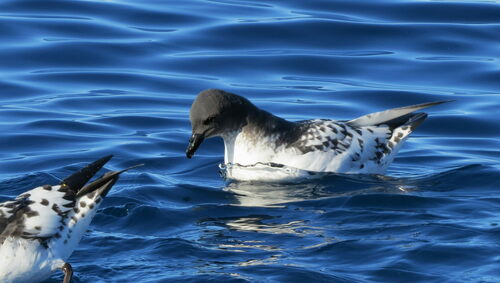
Pintado Petrel (Daption capense) Pintado Petrel
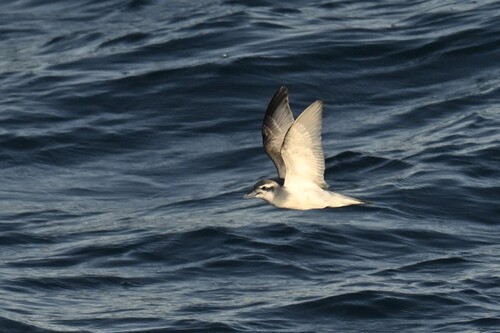
Antarctic Prion (Pachyptila desolata) Antarctic Prion

Media

Loading…

In short

The most reliable field mark between Pintado Petrel and Antarctic Prion is the bold, black-and-white speckled upperwing and back of the Pintado Petrel, contrasting with the Antarctic Prion's smooth blue-grey upperparts marked by a dark 'M' across the back and wings. In flight, Pintado Petrel shows a striking white underwing with a broad black border, while Antarctic Prion's underwing is plainer white without such a border. Pintado Petrel is also much heavier-bodied and has a black head and neck, unlike the prion's pale face with a white eyebrow. These differences are visible at all ages and are especially clear in flight.

Identification tips

  1. Upperwing pattern in flight: Pintado Petrel shows a bold, black-and-white speckled upperwing and back, visible at all ages. Antarctic Prion's upperwing is smooth blue-grey with a dark 'M' but never speckled.
  2. Underwing pattern: Pintado Petrel has a striking white underwing with a broad black border; Antarctic Prion's underwing is plain white, lacking a strong border.
  3. Head and face: Pintado Petrel has a black head and neck, contrasting sharply with its white underparts. Antarctic Prion has a pale face, white eyebrow, and no black on the head.
  4. Tail pattern: Pintado Petrel's tail is speckled with a black band; Antarctic Prion's tail is grey, wedge-shaped, with a black tip but not banded or speckled.
  5. Bill color and shape: Antarctic Prion has a blue-grey bill, while Pintado Petrel's bill is darker and less distinctive at a distance.
  6. Body size and shape: Pintado Petrel is much larger and bulkier, with a pigeon-like jizz. Antarctic Prion is smaller, more delicate, and slender.
  7. Flight style: Pintado Petrel appears heavier and more direct in flight; Antarctic Prion is lighter, more buoyant, and agile.
  8. Back pattern: The 'M' pattern across the back and wings is unique to Antarctic Prion and absent in Pintado Petrel.
  9. Greater covert color: Antarctic Prion has near-black greater coverts, but the effect is subtle compared to the bold speckling of Pintado Petrel.
  10. Behavior near ships: Pintado Petrel is often aggressive and follows ships closely, while Antarctic Prion is less likely to do so.
  11. Feeding behavior: Pintado Petrel may be seen diving or surface seizing larger prey and is aggressive at food sources; Antarctic Prion is more likely to be filtering zooplankton at the surface.
  12. Habitat context: If seen close to a ship or in a feeding frenzy, Pintado Petrel is more likely; Antarctic Prion is more typical in open ocean settings.
  13. No age-specific confusion: There are no described juvenile or immature-specific upperwing or flight marks that would cause confusion—adult patterns apply throughout the year.
  14. No significant seasonal or sex variation: Both species show little seasonal or sexual dimorphism in plumage, so these marks are reliable year-round.
  15. Plumage pitfalls: Do not confuse the prion's subtle dark 'M' and smooth blue-grey with the petrel's bold speckling; the difference is always visible with good binocular views.

Size

Pintado Petrel is significantly larger and bulkier, with a body mass of about 424 g and a length of 35–40 cm, compared to the Antarctic Prion's much lighter 156 g and shorter 27 cm length. The wingspan of Pintado Petrel (80–90 cm) also exceeds that of Antarctic Prion (61–66 cm). In the field, Pintado Petrel appears more robust and pigeon-like, while Antarctic Prion is noticeably more delicate and slender.

Plumage

For all ages, Pintado Petrel displays a unique black-and-white speckled pattern on its upperwings and back, with a black head and neck, white underparts, and a white underwing bordered broadly in black. The tail is speckled with a distinct black band. Antarctic Prion, regardless of age, has blue-grey upperparts with a characteristic dark 'M' running from the back onto the wings, a white face with a white eyebrow, and a blue-grey bill. Its underparts are clean white, and the underwing lacks the bold black border seen in Pintado Petrel. The prion's tail is grey, wedge-shaped, with a black tip, and the greater coverts on the wing are near black, but the overall effect is smooth and not speckled. There are no age-specific upperwing or flight marks described for either species that would override these adult patterns.

Behaviour

Both species are pelagic and spend most of their time at sea, but Pintado Petrel is known for its aggressive ship-following and will often approach boats to feed on scraps, sometimes spitting stomach oil at competitors. Antarctic Prion is more likely to be seen filtering zooplankton at the surface and is less aggressive around ships. In flight, Pintado Petrel appears heavier and more direct, while Antarctic Prion is lighter and more buoyant, with a gliding, agile flight style.

Habitat

Both species are Southern Ocean seabirds, but Pintado Petrel is especially abundant and often seen near ships, while Antarctic Prion is more strictly associated with open ocean and is less frequently encountered close to vessels or land except at breeding sites. Both may overlap at sea, but contextually, Pintado Petrel is more likely in areas with ship activity.

Submit a better description

Use the same sections as the comparison. Your text is published immediately.

The most reliable field mark between Pintado Petrel and Antarctic Prion is the bold, black-and-white speckled upperwing and back of the Pintado Petrel, contrasting with the Antarctic Prion's smooth blue-grey upperparts marked by a dark 'M' across the back and wings. In flight, Pintado Petrel shows a striking white underwing with a broad black border, while Antarctic Prion's underwing is plainer white without such a border. Pintado Petrel is also much heavier-bodied and has a black head and neck, unlike the prion's pale face with a white eyebrow. These differences are visible at all ages and are especially clear in flight.

  1. Upperwing pattern in flight: Pintado Petrel shows a bold, black-and-white speckled upperwing and back, visible at all ages. Antarctic Prion's upperwing is smooth blue-grey with a dark 'M' but never speckled.
  2. Underwing pattern: Pintado Petrel has a striking white underwing with a broad black border; Antarctic Prion's underwing is plain white, lacking a strong border.
  3. Head and face: Pintado Petrel has a black head and neck, contrasting sharply with its white underparts. Antarctic Prion has a pale face, white eyebrow, and no black on the head.
  4. Tail pattern: Pintado Petrel's tail is speckled with a black band; Antarctic Prion's tail is grey, wedge-shaped, with a black tip but not banded or speckled.
  5. Bill color and shape: Antarctic Prion has a blue-grey bill, while Pintado Petrel's bill is darker and less distinctive at a distance.
  6. Body size and shape: Pintado Petrel is much larger and bulkier, with a pigeon-like jizz. Antarctic Prion is smaller, more delicate, and slender.
  7. Flight style: Pintado Petrel appears heavier and more direct in flight; Antarctic Prion is lighter, more buoyant, and agile.
  8. Back pattern: The 'M' pattern across the back and wings is unique to Antarctic Prion and absent in Pintado Petrel.
  9. Greater covert color: Antarctic Prion has near-black greater coverts, but the effect is subtle compared to the bold speckling of Pintado Petrel.
  10. Behavior near ships: Pintado Petrel is often aggressive and follows ships closely, while Antarctic Prion is less likely to do so.
  11. Feeding behavior: Pintado Petrel may be seen diving or surface seizing larger prey and is aggressive at food sources; Antarctic Prion is more likely to be filtering zooplankton at the surface.
  12. Habitat context: If seen close to a ship or in a feeding frenzy, Pintado Petrel is more likely; Antarctic Prion is more typical in open ocean settings.
  13. No age-specific confusion: There are no described juvenile or immature-specific upperwing or flight marks that would cause confusion—adult patterns apply throughout the year.
  14. No significant seasonal or sex variation: Both species show little seasonal or sexual dimorphism in plumage, so these marks are reliable year-round.
  15. Plumage pitfalls: Do not confuse the prion's subtle dark 'M' and smooth blue-grey with the petrel's bold speckling; the difference is always visible with good binocular views.

Pintado Petrel is significantly larger and bulkier, with a body mass of about 424 g and a length of 35–40 cm, compared to the Antarctic Prion's much lighter 156 g and shorter 27 cm length. The wingspan of Pintado Petrel (80–90 cm) also exceeds that of Antarctic Prion (61–66 cm). In the field, Pintado Petrel appears more robust and pigeon-like, while Antarctic Prion is noticeably more delicate and slender.

For all ages, Pintado Petrel displays a unique black-and-white speckled pattern on its upperwings and back, with a black head and neck, white underparts, and a white underwing bordered broadly in black. The tail is speckled with a distinct black band. Antarctic Prion, regardless of age, has blue-grey upperparts with a characteristic dark 'M' running from the back onto the wings, a white face with a white eyebrow, and a blue-grey bill. Its underparts are clean white, and the underwing lacks the bold black border seen in Pintado Petrel. The prion's tail is grey, wedge-shaped, with a black tip, and the greater coverts on the wing are near black, but the overall effect is smooth and not speckled. There are no age-specific upperwing or flight marks described for either species that would override these adult patterns.

Both species are pelagic and spend most of their time at sea, but Pintado Petrel is known for its aggressive ship-following and will often approach boats to feed on scraps, sometimes spitting stomach oil at competitors. Antarctic Prion is more likely to be seen filtering zooplankton at the surface and is less aggressive around ships. In flight, Pintado Petrel appears heavier and more direct, while Antarctic Prion is lighter and more buoyant, with a gliding, agile flight style.

Both species are Southern Ocean seabirds, but Pintado Petrel is especially abundant and often seen near ships, while Antarctic Prion is more strictly associated with open ocean and is less frequently encountered close to vessels or land except at breeding sites. Both may overlap at sea, but contextually, Pintado Petrel is more likely in areas with ship activity.

Discard your changes?

You have unsaved edits. If you leave now, those changes will be lost.

Pintado Petrel · Antarctic Prion · My Tricky Birds