

Pin-tailed Whydah vs Shaft-tailed Whydah
Vidua macroura versus Vidua regia
Play a quiz with Pin-tailed Whydah and Shaft-tailed Whydah
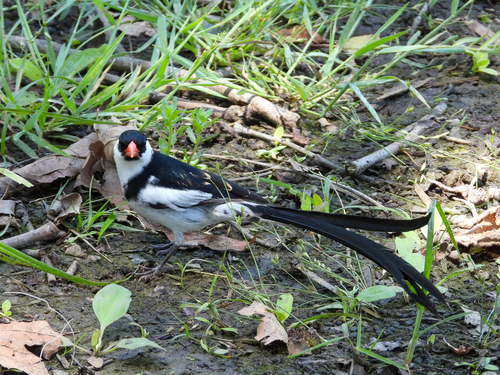 Pin-tailed Whydah
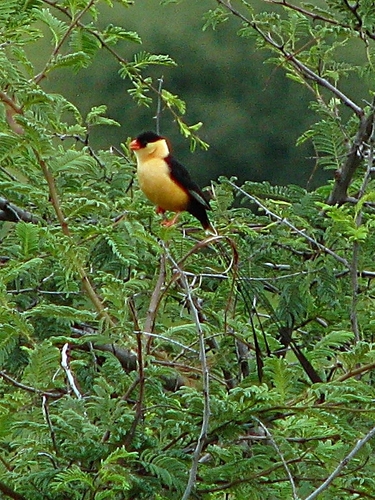 Shaft-tailed Whydah
In short
The most reliable field mark is the breeding male's tail: Pin-tailed Whydah males show an extremely long, straight, black tail with several thin streamers, while Shaft-tailed Whydah males have four elongated tail feathers with expanded tips, not as long or as straight. Outside the breeding season, both species lose their dramatic tails and become much trickier, with both sexes and immatures showing sparrow-like brown and buff plumage. At this stage, subtle differences in face pattern, underpart color, and bill color are key. Females and non-breeding males of both species are easily confused, but Pin-tailed Whydah usually keeps a red bill, while Shaft-tailed Whydah's bill color is less emphasized. In flight, look for tail shape and length in males, and overall color and face pattern in females and immatures.
Identification tips
- Breeding male tail shape: Pin-tailed Whydah males have an extremely long, straight, black tail (up to 20 cm), with multiple narrow streamers; Shaft-tailed Whydah males have four elongated tail feathers with expanded tips, not as long or as straight. This is the single best field mark in breeding season.
- Breeding male underparts: Pin-tailed Whydah males are white below and on the face (except crown); Shaft-tailed Whydah males have a golden or buff breast and underparts.
- Bill color: Pin-tailed Whydah (all ages except young immatures) shows a bright red bill; Shaft-tailed Whydah bill color is less distinctive and not described as red.
- Face pattern in females/immatures: Both have buff and black face patterns, but Pin-tailed Whydah is often more contrasting, especially with the red bill. Shaft-tailed Whydah is generally more olive-brown and less sharply marked.
- Non-breeding males: Both species lose their long tails and resemble females. Pin-tailed Whydah non-breeding males retain the red bill and a more contrasting face pattern; Shaft-tailed Whydah non-breeding males become olive-brown and less distinct.
- Immature bill color: Pin-tailed Whydah immatures have a duller, greyish bill (not bright red); Shaft-tailed Whydah immatures are not specifically described, but likely similar to females.
- Wing pattern: Pin-tailed Whydah males have dark brown wings with white patches (visible when perched); Shaft-tailed Whydah males' wings are not described as patterned.
- Flight silhouette: In flight, breeding Pin-tailed Whydah males show a long, trailing, straight tail; Shaft-tailed Whydah males' tail appears shorter and with expanded tips, not as streamer-like.
- Perched jizz: Breeding Pin-tailed Whydah males look top-heavy and elongated due to the tail; Shaft-tailed Whydah males are more compact with a shorter, paddle-tipped tail.
- Habitat context: Pin-tailed Whydah is more likely in disturbed areas, gardens, and introduced populations; Shaft-tailed Whydah is more restricted to southern African grasslands.
- Song: If heard, Pin-tailed Whydah's rapid squeaking and churring is distinctive; Shaft-tailed Whydah's song is not described, so absence of this song may suggest Shaft-tailed.
- Seasonal timing: Only breeding males show the long tails; outside breeding season, both sexes and immatures are very similar and require close scrutiny of bill color and face pattern.
- Aggressive behavior: Both species can be territorial and aggressive, especially males during breeding season, so behavior alone is not a reliable separator.
- Brood parasite hosts: Pin-tailed Whydah parasitizes a range of waxbills; Shaft-tailed Whydah is more specific to violet-eared waxbill, but this is not a field mark unless host species are observed together.
- Pitfall: Females and non-breeding males of both species are very similar and often only separable by subtle bill and face pattern differences; always check for red bill (Pin-tailed) and golden underparts (Shaft-tailed breeding male) when possible.
Size
Both species are very similar in size, with Pin-tailed Whydah averaging about 15.8 g and Shaft-tailed Whydah about 14.4 g [wikidata]. In the hand or at close range, this difference is negligible. The Pin-tailed Whydah breeding male appears much larger due to the extremely long tail, but body size is nearly identical.
Plumage
- Breeding males: Pin-tailed Whydah males have a strikingly long, straight, black tail (up to 20 cm), black crown and back, white underparts and head (except crown), and a bright red bill. Shaft-tailed Whydah males have a black crown and upperparts, but the underparts are golden or buff, and the tail consists of four elongated black feathers with expanded tips, not as long or as straight as Pin-tailed's.
- Females and non-breeding males: Both are brown and streaky above, pale below, with buff and black face pattern. Pin-tailed Whydah females and immatures have a red bill (immatures duller, more greyish), while Shaft-tailed Whydah females and non-breeding males are olive-brown with less distinctive bill color.
- Immatures: Both resemble females, but Pin-tailed Whydah immatures are plainer and have a greyish bill. No distinctive upperwing pattern is noted for either species at any age.
- Wing pattern: Pin-tailed Whydah males have dark brown wings with white patches (visible in perched birds), which are not described for Shaft-tailed Whydah.
Behaviour
Both species are brood parasites, laying eggs in the nests of estrildid finches (Pin-tailed especially waxbills, Shaft-tailed specifically violet-eared waxbill). Pin-tailed Whydah males perform elaborate hovering courtship flights to display their tails, while Shaft-tailed Whydah males' display is less described but also involves showing off the tail. Both feed mainly on seeds and are often seen in open areas or near human habitation. Both can be quite aggressive and territorial during breeding season.
Habitat
Both species favor open habitats such as grasslands and savannahs. Pin-tailed Whydah is widespread across sub-Saharan Africa and is also found in parks, gardens, and even introduced populations outside Africa. Shaft-tailed Whydah is more restricted to southern Africa, from southern Angola to southern Mozambique. Both may occur together in parts of southern Africa, but Pin-tailed is more likely in disturbed or urban settings.
Voice
Pin-tailed Whydah's song is a rapid series of squeaks and churrs, usually delivered from a high perch. Shaft-tailed Whydah's vocalizations are not described in the available notes, so song is not a reliable separator unless the Pin-tailed's distinctive song is heard.