

Pin-tailed Sandgrouse vs Great Bustard
Pterocles alchata versus Otis tarda
Play a quiz with Pin-tailed Sandgrouse and Great Bustard
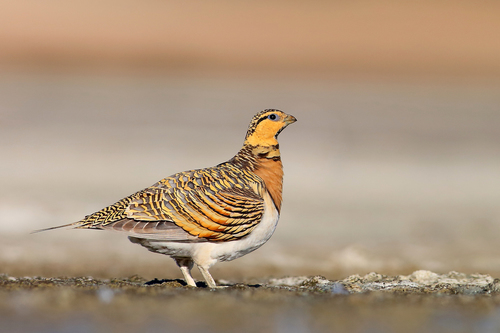 Pin-tailed Sandgrouse
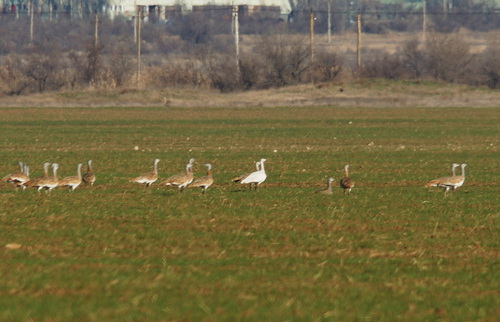 Great Bustard
In short
The most reliable field mark to separate Pin-tailed Sandgrouse from Great Bustard is overall structure and flight appearance: sandgrouse are compact, pigeon-headed birds with long pointed wings and a very long, pin-shaped central tail, while bustards are massive, heavy-bodied birds with long legs, thick necks, and broad wings showing extensive white in flight. In all plumages, Pin-tailed Sandgrouse show bright white underwings and underparts with a long, pointed tail, while Great Bustard is much larger with a bulkier build, a grey neck, and a mostly white wing with brown edges. Juvenile and female bustards can be confusing at a distance, but the size, shape, and flight style are always different. Voice, habitat, and flocking behavior also help in the field.
Identification tips
- Size and bulk: Great Bustard is vastly larger and heavier than Pin-tailed Sandgrouse; even distant birds show this difference. Bustards have a long, thick neck and long legs, while sandgrouse are compact with a small head and short neck.
- Flight silhouette: Sandgrouse have long, pointed wings and a very long, pin-shaped central tail; bustards have broad, rounded wings and a short, fan-shaped tail. Bustards' flight is slow and heavy, sandgrouse are fast and direct.
- Underwing and underpart color: All ages of Pin-tailed Sandgrouse show bright white underwings and underparts in flight; Great Bustard has mostly white wings, but the underparts are white only in adults, and the wing shows brown edges and a dark upperwing streak.
- Tail shape: The sandgrouse's long, pin-shaped central tail feathers are unique and visible in flight and at rest, especially in males. Bustards have a short, broad tail with no streamers.
- Head and neck: Sandgrouse have a pigeon-like head and neck, often appearing small-headed; bustards have a thick, long neck and a large head, especially in males.
- Plumage details (male sandgrouse): Breeding male sandgrouse have a yellowish-green head and upperparts, chestnut breast band, and a barred tail; bustard males have a grey neck, chestnut breast sides, and long white neck bristles in display.
- Plumage details (female/immature sandgrouse): Female sandgrouse are duller, with golden-buff cheeks and neck, and finer barring, but still show the long tail and white underwings. Female bustards are buff and brown, with no long tail or green/yellow tones.
- Juvenile confusion: Juvenile bustards are sepia with buffy streaks and much larger; sandgrouse juveniles are not described in detail, but always show the compact structure and long tail.
- Flocking and behavior: Sandgrouse are gregarious, often seen in tight flocks flying fast and low; bustards are more solitary or in loose groups, walking upright and flying only when disturbed.
- Habitat: Sandgrouse prefer dry, open, treeless plains; bustards are more often in grasslands or farmland, sometimes with denser vegetation.
- Vocalization: Loud, repeated calls in flight are typical of sandgrouse; bustards are mostly silent.
- Display: Only bustards display with elaborate postures, puffed-up throat, and long white neck bristles; sandgrouse do not display in this way.
- Legs: Bustards' long legs are visible when walking or standing; sandgrouse have short legs, usually hidden by plumage.
- Bill: Bustards have a strong, straight bill; sandgrouse have a small, pigeon-like bill.
- Seasonal variation: Male sandgrouse are brightest in breeding season, but structural differences are always reliable.
Size
Pin-tailed Sandgrouse is a medium-large bird for its family, with a body mass around 237.5 g [wikidata], but it is dwarfed by the Great Bustard, which is one of the heaviest flying birds (adult males can exceed 10 kg, though not specified here). In the field, bustards are much larger, with a long, thick neck and long legs visible both on the ground and in flight. Sandgrouse are compact, with a small head and short neck, and never show the bulk or height of a bustard. Even at a distance, the bustard's size and upright stance are distinctive.
Plumage
Juvenile and immature plumages are not described in detail for sandgrouse, but all ages in flight show bright white underwings and underparts, with a long, pin-shaped central tail. Adult males in breeding plumage have a yellowish-green head and upperparts, chestnut breast band, and a barred tail; females are duller and more camouflaged, with finer barring and a shorter tail, but still show the long, pointed tail and white underwings. Great Bustard adults (especially males) are brown above with black barring, white below, and a grey neck; in flight, the broad wings are mostly white with brown along the edges and a dark streak on the upperwing. Females are smaller and less colorful, with buff and brown tones, but still show the same wing pattern. In display, male bustards show flamboyant white plumage and long white neck bristles, which sandgrouse never have. Juvenile bustards are sepia with buffy streaks for camouflage, but still much larger and differently shaped than sandgrouse.
Behaviour
Pin-tailed Sandgrouse are gregarious, often seen in flocks flying fast and directly to watering holes at dawn, with rapid, pointed-wing flight and a tendency to stay close to the ground. They nest in open, dry plains and are usually silent on the ground. Great Bustards are more solitary or in loose groups, especially outside the breeding season; males display on leks with elaborate postures. Bustards walk slowly with an upright stance, rarely fly unless disturbed, and their flight is heavy, with slow, deep wingbeats and broad wings. Sandgrouse are rarely seen walking for long distances and are much more aerial in their habits.
Habitat
Both species prefer open habitats, but Pin-tailed Sandgrouse are found on dry, open, treeless plains, often in arid or semi-arid regions, while Great Bustards breed in open grasslands and farmland, sometimes with denser grassy vegetation for nesting. Bustards may be found in more temperate or agricultural landscapes, while sandgrouse are more typical of steppe, semi-desert, or dry plains.
Voice
Pin-tailed Sandgrouse gives a loud, repeated "kattar-kattar" call in flight, along with nasal "ga-ga-ga" and low "gang gang" notes, especially when flying to water. They are usually silent on the ground. Great Bustard is generally silent, especially compared to sandgrouse; males may make low booming or grunting sounds during display, but these are rarely heard by casual observers. In most field situations, a flock making loud calls in flight is much more likely to be sandgrouse.