

Pin-striped Tit-Babbler vs Moustached Babbler
Mixornis gularis versus Malacopteron magnirostre
Play a quiz with Pin-striped Tit-Babbler and Moustached Babbler
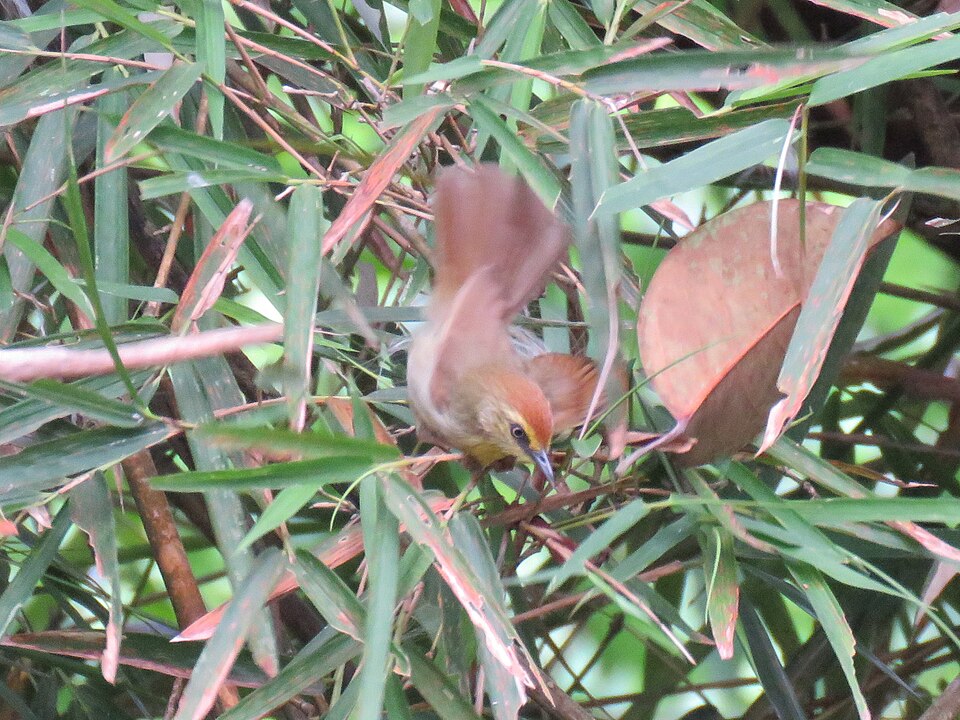 Pin-striped Tit-Babbler
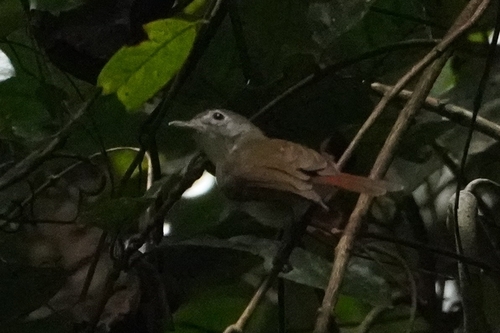 Moustached Babbler
In short
The most reliable way to separate Pin-striped Tit-Babbler from Moustached Babbler is by focusing on the Pin-striped’s bright yellowish supercilium and rufous crown, which contrast with the Moustached Babbler’s duller, olive-brown crown and lack of strong facial color. The Pin-striped Tit-Babbler also shows a yellowish, brown-streaked throat, while the Moustached Babbler has a whitish underpart and a subtle grey loral and moustachial stripe. Structure and size differ as well: Pin-striped is smaller and lighter, with a more active, creeping behavior low in vegetation. Both species can be confusing in poor light or at a distance, but careful attention to head and throat pattern is usually decisive.
Identification tips
- Supercilium and crown color: Pin-striped Tit-Babbler shows a bright yellowish supercilium and a rufous crown—these are the most visible and reliable field marks at any age. Moustached Babbler lacks both, with an olive-brown crown and no strong supercilium.
- Throat and underparts: Pin-striped has a yellowish throat with brown streaks, blending into yellowish underparts. Moustached Babbler is whitish below, with no yellow tones and only a subtle grey moustachial stripe.
- Facial pattern: Moustached Babbler has a grey loral stripe and a faint grey moustachial stripe, but these are much less conspicuous than the Pin-striped’s facial markings. In poor light, the lack of yellow and rufous is a clue for Moustached.
- Size and structure: Pin-striped is smaller (12 g) and more compact, while Moustached Babbler is larger (16–25 g, 18 cm) and appears bulkier with a proportionally bigger bill. This can be useful when both species are seen together or with known reference species.
- Behavior: Pin-striped Tit-Babbler is very active, often seen in small, noisy flocks, creeping through low vegetation. Moustached Babbler is more likely to be solitary or in pairs and moves more deliberately.
- Habitat: Pin-striped prefers edges, secondary growth, gardens, and scrubby areas. Moustached Babbler is more typical of denser, less disturbed forest. Context can help, but both can overlap in some areas.
- Voice: If you hear a repeated 'chonk-chonk-chonk' call, it is Pin-striped Tit-Babbler. Moustached Babbler’s vocalizations are not described here, so absence of this call is not diagnostic.
- No age-specific wing pattern: Neither species has a distinctive juvenile or immature wing pattern described, so do not rely on flight marks for separation.
- Plumage pitfalls: In dull light or at distance, Pin-striped’s yellow and rufous may appear muted, risking confusion with the plainer Moustached. Always look for the supercilium and throat color.
- Group size: Multiple birds together, especially moving rapidly through low vegetation, points to Pin-striped. Solitary or paired birds in dense forest may be Moustached.
- Bill size: Moustached Babbler’s bill is relatively larger and heavier, but this is subtle and best used as supporting evidence.
- Underpart color: If the bird appears clearly whitish below with no yellow wash, favor Moustached. Any yellowish or streaked throat suggests Pin-striped.
- Crown color: Rufous or reddish tones on the crown are only found in Pin-striped.
- Supercilium strength: A strong, bright supercilium is a Pin-striped feature; a weak or absent supercilium suggests Moustached.
- Contextual clues: In gardens, parks, or scrubby edges, Pin-striped is more likely. In mature, undisturbed forest, check carefully for Moustached, especially if the bird is larger and plainer.
Size
Pin-striped Tit-Babbler is distinctly smaller and lighter, with a body mass of about 12 g [wikidata]. Moustached Babbler is larger, measuring about 18 cm in length and weighing 16–25 g [wikipedia]. In the field, Pin-striped often appears more delicate and compact, while Moustached Babbler looks bulkier and longer-bodied, with a proportionally larger bill (as reflected in its scientific name).
Plumage
No age-specific wing or flight pattern marks are described for either species, so focus on head and underpart coloration. Adult Pin-striped Tit-Babbler shows a striking yellowish supercilium (eyebrow) and a rufous crown, with a yellowish throat streaked brown. Its underparts are yellowish, blending into the breast. In contrast, adult Moustached Babbler is dull brown above and whitish below, with an olive-brown crown, a greyish loral stripe (between eye and bill), and a subtle grey moustachial stripe (along the lower face). The Moustached lacks the Pin-striped’s strong yellow and rufous tones, instead appearing plainer and more muted overall. No distinctive age- or season-specific differences are noted for either species, so these contrasts hold for all plumages described.
Behaviour
Pin-striped Tit-Babbler is highly active, often seen creeping and clambering through low vegetation in small, noisy flocks. It tends to stay close to the ground or in dense shrubbery, rarely venturing high. Moustached Babbler is less described in terms of behavior here, but as a ground babbler, it is likely more terrestrial, moving through lower and mid-levels of forest undergrowth, and may be less gregarious than Pin-striped. In the field, Pin-striped’s constant movement and flocking can be a clue, especially if multiple birds are seen together.
Habitat
Both species occur in South and Southeast Asia, but Pin-striped Tit-Babbler is particularly associated with low, dense vegetation and edge habitats, often in secondary growth, gardens, and scrub. Moustached Babbler, while not detailed here, is generally a forest species, preferring denser woodland and less disturbed areas. If seen in very open or disturbed habitats, Pin-striped is more likely; in mature forest, both are possible, but Moustached may be more expected.
Voice
Pin-striped Tit-Babbler gives a loud, repeated 'chonk-chonk-chonk-chonk-chonk' call, somewhat reminiscent of a common tailorbird [wikipedia]. No vocal description is provided for Moustached Babbler here, so voice is only diagnostic if Pin-striped’s distinctive call is heard.
Pin-striped Tit-Babbler · Moustached Babbler · My Tricky Birds