

Pied Imperial-Pigeon vs Yellowish Imperial-Pigeon
Ducula bicolor versus Ducula subflavescens
Play a quiz with Pied Imperial-Pigeon and Yellowish Imperial-Pigeon
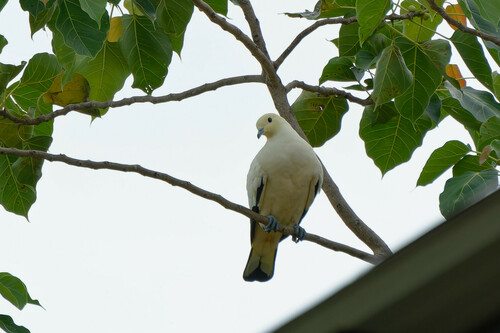 Pied Imperial-Pigeon
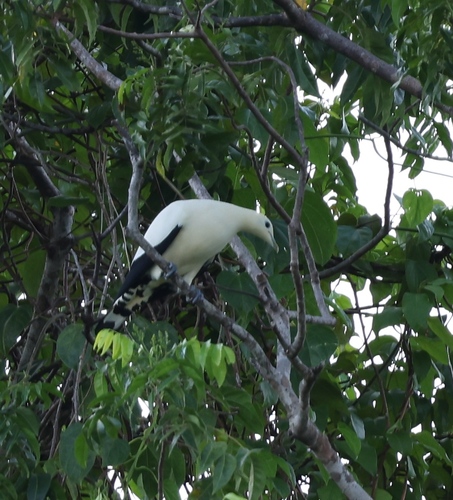 Yellowish Imperial-Pigeon
In short
The most reliable field mark to separate Pied Imperial-Pigeon from Yellowish Imperial-Pigeon is the overall plumage tone: Pied Imperial-Pigeon is clean white, while Yellowish Imperial-Pigeon shows a distinct yellowish wash throughout its plumage. Both are large, pale pigeons, but the bill color and undertail pattern also help: Pied has a narrowly dark-tipped bluish bill and plain white undertail coverts, while Yellowish has a bluish-based bill (with yellowish tip) and may show more yellowish tones. Range is a strong clue—Yellowish is endemic to the Bismarck Archipelago, while Pied is widespread across Southeast Asia and nearby islands. Immature/juvenile-specific wing or flight patterns are not described as diagnostic between these two, so focus on overall color and bill details.
Identification tips
- Overall plumage tone: Pied Imperial-Pigeon is clean, bright white in all ages, while Yellowish Imperial-Pigeon has a clear yellowish or creamy wash across the plumage. This is the single most reliable field mark.
- Bill color: Pied has a bluish bill with a narrow dark tip; Yellowish has a bluish base but a yellowish tip. This is subtle but can be seen at close range.
- Undertail coverts and thighs: Pied shows plain white undertail coverts and thighs (sometimes with a small dark spot at the undertail tip), while Yellowish is not described as having any spotting or obvious marks here, but the yellowish wash may extend to these areas.
- Range and location: If you are in the Bismarck Archipelago, Yellowish is the expected species; elsewhere in Southeast Asia, Pied is far more likely.
- Yellowish tinge: While some Pied Imperial-Pigeons can appear slightly yellowish, this is rare and never as pronounced as in Yellowish Imperial-Pigeon. If the yellow tone is obvious, favor Yellowish.
- Remiges (flight feathers): Neither species shows the silvery-grey remiges of Silver-tipped Imperial-Pigeon, so this is not a point of confusion here.
- Greenish/yellowish bill: If you see a greenish-yellow bill, consider Torresian Imperial-Pigeon, not either of these two.
- Juvenile/immature wing pattern: No distinctive juvenile or immature upperwing or flight pattern is described for either species, so do not rely on this feature.
- Perched vs. flying: Both species look similar in flight and when perched; the yellowish wash of Yellowish is visible in both situations.
- Sex and age: No sexual dimorphism or age-related plumage differences are described that would affect field ID between these two.
- Sympatry: These species do not overlap in range except possibly in extreme western Bismarcks, so geographic context is very helpful.
- Confusion with other imperial pigeons: If you see black-spotted undertail coverts or silvery remiges, consider other species (e.g., Silver-tipped, Torresian), not these two.
- Lighting conditions: Be aware that strong sunlight or shade can affect the perceived yellowish tone, but the difference is usually clear in good light.
- Bill detail: Use bill color only if you have a good view; otherwise, rely on overall color and location.
- Habitat: Both can be found in forest and woodland, but Pied is more likely in mangroves and plantations outside the Bismarcks.
Size
Both species are relatively large imperial pigeons. The Pied Imperial-Pigeon has a documented average body mass of 456 g [wikidata], while no direct measurement is available for Yellowish Imperial-Pigeon, but it is described as similarly large. Size alone is not a reliable separator in the field, as both are robust and similar in bulk.
Plumage
No age-specific upperwing or flight pattern differences are described between these two species, so focus on overall coloration and soft part details. Adult Pied Imperial-Pigeon is strikingly white overall, with plain white thighs and undertail coverts (sometimes a small dark spot at the undertail tip), and a narrowly dark-tipped bluish bill. Yellowish Imperial-Pigeon, in all plumages, is distinctly suffused with a yellowish or creamy wash across the body and wings—much more so than the rare yellowish-tinged Pied. Its bill is bluish at the base and yellowish at the tip. Undertail coverts and thighs are not described as spotted in Yellowish, so the main difference is the yellowish overall tone. Both species lack the silvery-grey remiges of Silver-tipped Imperial-Pigeon and the greenish-yellow bill of Torresian. If you see a bird with a strong yellowish tint, especially in the Bismarcks, it is Yellowish Imperial-Pigeon; if it is crisp white, it is Pied.
Behaviour
Both species are typical imperial pigeons, usually seen perched high in trees or flying between forest patches. No behavioral differences are described that would reliably separate them in the field.
Habitat
Pied Imperial-Pigeon occupies a wide range across Southeast Asia, including small islands, coastal forests, mangroves, plantations, and scrub from Myanmar and Thailand through Indonesia to the Philippines and the Bird's Head Peninsula of New Guinea. Yellowish Imperial-Pigeon is restricted to forest and woodland in the Bismarck Archipelago. Thus, location is a strong clue: birds in the Bismarcks are likely Yellowish, while those elsewhere are almost certainly Pied.
Pied Imperial-Pigeon · Yellowish Imperial-Pigeon · My Tricky Birds