

Pectoral Sandpiper vs Western Sandpiper
Calidris melanotos versus Calidris mauri
Play a quiz with Pectoral Sandpiper and Western Sandpiper
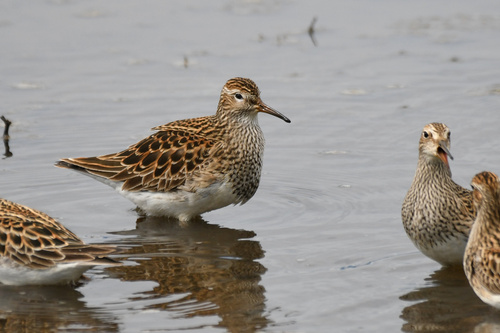 Pectoral Sandpiper
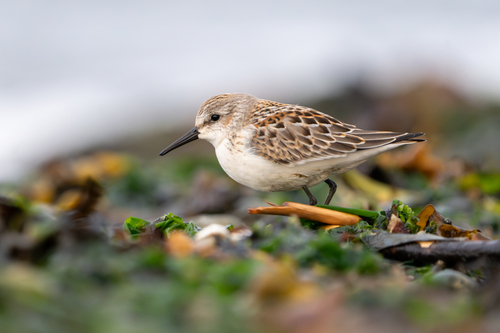 Western Sandpiper
In short
The most reliable way to separate Pectoral Sandpiper from Western Sandpiper is by size and structure: Pectoral is much larger and bulkier, with a longer neck and legs, and a noticeably heavier body. In all plumages, Pectoral Sandpiper stands out for its sharply defined, dark breast band with a crisp lower edge, while Western Sandpiper is smaller, more compact, and lacks this strong breast demarcation. Bill shape and leg color also help: Pectoral has a longer, olive-based bill with a dark tip and yellowish legs, while Western has a short, thin, all-dark bill and black legs. Juvenile and non-breeding birds can be tricky, but the strong breast band of Pectoral is a consistent field mark. Both species can occur together on migration, so careful attention to structure and plumage is essential.
Identification tips
- Size and structure: Pectoral Sandpiper is much larger and heavier than Western Sandpiper; look for a longer neck, longer legs, and a bulkier build. Western is compact and delicate. This is reliable at close range or in mixed flocks.
- Breast band: Pectoral Sandpiper always shows a sharply defined, dark breast band with a crisp lower edge and white belly—this is the single best field mark in all ages and seasons. Western Sandpiper lacks this strong demarcation; its breast is plain or only lightly marked.
- Bill shape and color: Pectoral has a medium-long, olive-based bill with a dark tip; Western has a short, thin, all-dark bill that is finer at the tip. Bill length and thickness are best judged when birds are side by side.
- Leg color: Pectoral Sandpiper has yellowish legs, while Western Sandpiper's legs are black. This can be hard to see in muddy conditions or poor light.
- Crown and supercilium: Western Sandpiper in breeding plumage shows a reddish-brown crown and a more prominent supercilium. Pectoral's crown is browner and less rufous, with a weaker supercilium.
- Juvenile upperparts: Juvenile Pectoral Sandpipers are more brightly patterned above, with rufous tones and white mantle stripes. Juvenile Westerns are plainer above.
- Winter plumage: Both species become plainer in winter, but Pectoral retains its strong breast band, while Western becomes plain grey above and white below, making it even less marked on the breast.
- Flight views: No distinctive upperwing pattern separates these species; rely on size and breast band even in flight.
- Posture: Pectoral often appears more upright and elongated, especially when alert. Western is more compact and horizontal.
- Habitat context: If seen on inland freshwater pools, Pectoral is more likely; Western is more common on coastal mudflats, but both can overlap.
- Foraging behavior: Both pick at surface invertebrates, but Pectoral may probe more and move more deliberately.
- Courtship display: Only male Pectoral Sandpiper puffs up its breast in display; not relevant outside breeding grounds.
- Flock composition: In mixed flocks, Pectoral will stand out as the largest 'peep' by a wide margin.
- Voice: Not described in sources; do not rely on vocalizations for separation here.
- Pitfalls: In dull light or at distance, Western can look larger than it is, and Pectoral's breast band may be obscured by mud or posture—use multiple marks where possible.
Size
Pectoral Sandpiper is substantially larger and heavier than Western Sandpiper. Pectoral averages about 81.5 g in body mass, with a length of 19–23 cm and a wingspan of 37–46 cm [wikidata, wikipedia]. Western Sandpiper is much smaller, averaging 29.5 g, with a length of 14–17 cm and a wingspan of 35–37 cm [wikidata, wikipedia]. In the field, Pectoral appears longer-necked, longer-legged, and more robust overall, while Western is compact and delicate.
Plumage
Juvenile and non-breeding Pectoral Sandpipers show a distinctive, sharply demarcated dark breast band with a clear lower edge, contrasting with a white belly—this is visible in all ages and seasons and is the single most diagnostic plumage feature. Juvenile Pectorals are also more brightly patterned above, with rufous tones and white mantle stripes. Western Sandpiper, in contrast, lacks a strong breast band; adults and juveniles are brown above and white below, with a reddish-brown crown in breeding plumage, but in winter both species can appear plain grey. Westerns have dark legs and a short, thin, all-dark bill, while Pectoral has yellowish legs and an olive-based bill with a dark tip. The supercilium (eyebrow) is weaker in Pectoral, and the crown is browner and less rufous compared to Western. No distinctive upperwing pattern is described for either species in flight, so focus on body and head pattern.
Behaviour
Both species forage on mudflats and grasslands, picking at invertebrates by sight and sometimes probing. Pectoral Sandpiper may appear more upright and deliberate in posture due to its longer legs and neck, while Western Sandpiper is more compact and may move quickly with a lower profile. Courtship display is only described for male Pectoral Sandpiper, involving puffing up the breast.
Habitat
Both species are migratory shorebirds that can overlap on migration. Pectoral Sandpiper breeds in Arctic boggy tundra of North America and Asia and winters in South America and Oceania, often found in freshwater habitats on migration and winter. Western Sandpiper breeds in the Arctic and migrates along the Pacific coast, wintering from the southern US to South America. Both use mudflats and grasslands, but Pectoral is more likely to be found inland on freshwater pools, while Western often prefers coastal mudflats.