

Patagonian Canastero vs Bay-capped Wren-Spinetail
Pseudasthenes patagonica versus Spartonoica maluroides
Play a quiz with Patagonian Canastero and Bay-capped Wren-Spinetail
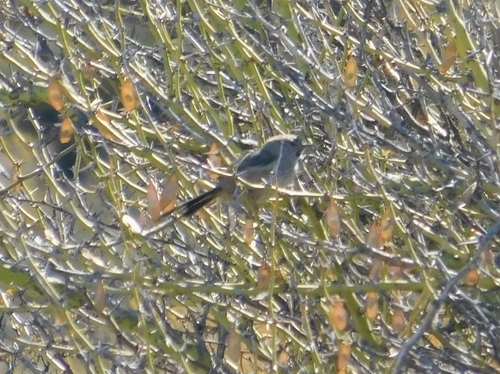 Patagonian Canastero
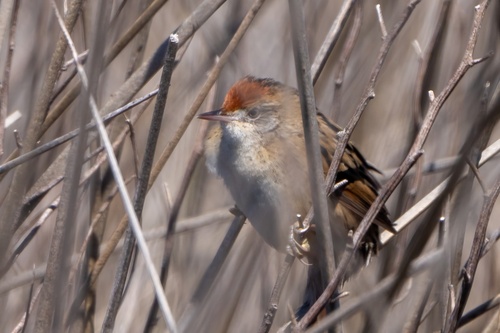 Bay-capped Wren-Spinetail
In short
The most reliable field mark to separate Patagonian Canastero from Bay-capped Wren-Spinetail is the head pattern: the canastero has a plain gray-brown crown and face with only a faint pale supercilium, while the wren-spinetail shows a rich rufous crown and a strong whitish supercilium on a sandy brown face. In addition, the wren-spinetail’s upperparts are boldly streaked black on the nape and upper back, and its tail is more graduated and pointed. Both species are similar in size, but the canastero is slightly heavier and stockier. The canastero prefers arid scrub, while the wren-spinetail is restricted to marshy reedbeds. In flight or perched, focus on crown color, supercilium strength, and tail shape for the quickest separation.
Identification tips
- Crown color: Patagonian Canastero has a plain light gray-brown crown; Bay-capped Wren-Spinetail has a rich rufous crown. This is the quickest visual cue, especially on perched birds.
- Supercilium: The canastero’s supercilium is faint and pale; the wren-spinetail’s is bold and whitish, standing out clearly against the sandy brown face.
- Face pattern: Canastero’s face is light grayish brown with only subtle contrast; wren-spinetail’s face is sandy brown with a strong supercilium and more contrast.
- Upperparts: Canastero is plain gray-brown above; wren-spinetail has bold black streaks on the nape and upper back, which are visible at close range or in good light.
- Tail shape: Canastero’s tail is dark gray-brown with chestnut outer feathers and is not especially graduated; wren-spinetail’s tail is brown, distinctly graduated, and pointed, with some black on the central feathers. This tail shape is especially noticeable when the bird fans or flicks its tail.
- Underparts: Canastero is pale grayish to tawny below, with black flecks and streaks on the throat; wren-spinetail is whitish with a buff or cinnamon wash on the breast, sides, and flanks, and lacks throat streaking.
- Wing coloration: Canastero’s wings are brown with rufescent edges; wren-spinetail’s wings are brown with cinnamon at the base of the flight feathers. This is subtle and best seen in good light.
- Bill and legs: Wren-spinetail has a blackish maxilla and paler mandible, with light tan legs and feet; canastero’s bill and leg colors are not described as distinctive in these notes.
- Habitat: If the bird is in dry scrub or open country, it is almost certainly a canastero. If in a reedbed, sedge marsh, or wetland, it is a wren-spinetail.
- Behavior: Wren-spinetail is more likely to be seen creeping through dense marsh vegetation, while canastero is more likely to perch on bushes or forage on the ground in open areas.
- Size and shape: Canastero is slightly larger and bulkier, but this is subtle and not always reliable in the field.
- Vocalization: If you hear a long, grasshopper-like buzz, it is the wren-spinetail. The canastero’s voice is not described here.
- Geographic range: Both occur in Argentina, but only the wren-spinetail is found in Brazil, Paraguay, and Uruguay. Range alone is not diagnostic within Argentina.
- Sex and age: Both sexes are similar in each species, and no age-specific or seasonal plumage differences are noted, so all field marks above apply year-round and to all ages.
- Common pitfalls: A dull or backlit wren-spinetail may appear plainer, but the rufous crown and bold supercilium usually remain visible. Canastero never shows a rufous crown or strong supercilium. Always check habitat and head pattern first.
Size
Patagonian Canastero is slightly larger and heavier (16 g vs 11 g) and measures 14–15 cm in length, compared to the wren-spinetail’s 13–14.5 cm. The canastero has a more robust, stockier build, while the wren-spinetail is lighter and more delicate overall. This size difference is subtle in the field, but the canastero may appear bulkier, especially when perched.
Plumage
No age-specific wing or flight pattern marks are described for either species, so focus on adult plumage. Patagonian Canastero adults are overall pale gray-brown above, with a plain crown and only a faint pale supercilium. The wings are brown with slightly rufous edges, and the tail is dark gray-brown with chestnut on the outer feathers. Underparts are pale grayish to tawny, with the throat showing black flecks and streaks. In contrast, Bay-capped Wren-Spinetail adults have a striking rufous crown, a bold whitish supercilium on a sandy brown face, and upperparts that are sandy to olive-brown with strong black streaks on the nape and upper back. Their wings are brown with cinnamon at the base of the flight feathers, and the tail is brown, graduated, and pointed, with some black on the central feathers. Underparts are whitish with a buff or cinnamon tinge. Both sexes are similar in each species, and no seasonal or age-related differences are noted.
Behaviour
Patagonian Canastero is typically found in arid scrub, moving through low vegetation, while Bay-capped Wren-Spinetail is almost always in dense marshes, foraging alone among reeds and sedges. The wren-spinetail’s behavior is more skulking and tied to wetland vegetation, and it may be seen clambering through reeds or sedges, rarely venturing into open ground. The canastero is more likely to be seen in drier, open habitats, often perching atop bushes or foraging on the ground.
Habitat
Habitat is a strong separator: Patagonian Canastero is endemic to Argentina and found in arid scrub and dry open country. Bay-capped Wren-Spinetail is found in Argentina, Brazil, Paraguay, and Uruguay, but only in reedbeds and sedge marshes—freshwater, brackish, or saltwater—never in dry scrub. If the bird is in a wetland, especially among reeds or sedges, it is almost certainly a wren-spinetail; if in dry, open, or scrubby habitat, it is a canastero.
Voice
The wren-spinetail’s song is described as a long, grasshopper-like buzz. No vocal description is provided for the canastero in these notes, so voice is only diagnostic if the buzzing song is heard, in which case it points to the wren-spinetail.
Patagonian Canastero · Bay-capped Wren-Spinetail · My Tricky Birds