

Palm Warbler vs Prairie Warbler
Setophaga palmarum versus Setophaga discolor
Play a quiz with Palm Warbler and Prairie Warbler
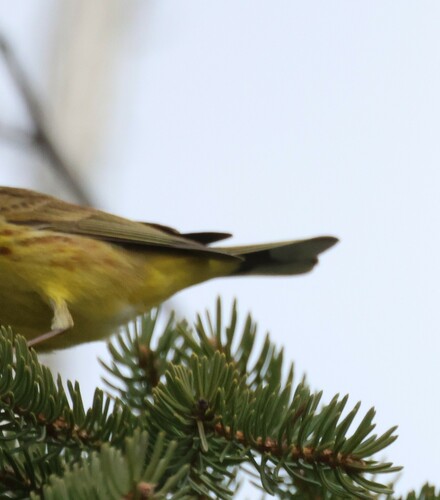 Palm Warbler
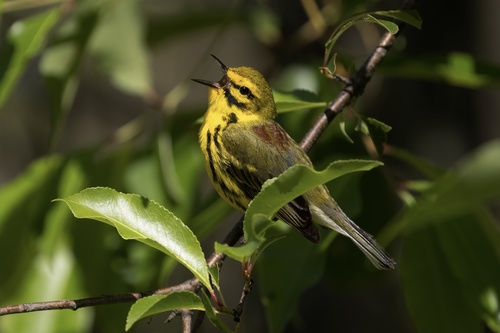 Prairie Warbler
In short
The most reliable field mark to separate Palm Warbler from Prairie Warbler is the Palm Warbler’s constant tail bobbing, which is even more pronounced than in Prairie Warbler. In plumage, Prairie Warbler shows a bold black eye line and a distinctive semicircular black arc under the eye, while Palm Warbler lacks these facial marks but may show a rusty cap in breeding plumage. Both species are small, yellowish warblers that frequently pump their tails, but Palm Warbler is slightly heavier and forages more on the ground. Be especially careful with duller immatures and females, where streaking and color intensity can overlap.
Identification tips
- Tail bobbing: Palm Warbler bobs its tail nearly constantly, even when still; Prairie Warbler also wags its tail, but less persistently. Use this behavior as a primary field clue, especially on the ground.
- Facial pattern: Prairie Warbler has a bold black eye line and a semicircular black arc below the eye, giving a 'tired' look. Palm Warbler lacks these facial marks but may show a rusty cap (especially in breeding males of the eastern subspecies).
- Cap color: Breeding Palm Warblers often show a rusty or rufous cap, especially in the eastern subspecies; Prairie Warbler never shows this feature.
- Underpart streaking: Both species have yellow underparts with streaks, but Prairie Warbler’s streaks are concentrated on the flanks and are usually darker and more defined in males. Palm Warbler’s streaking is variable, with eastern birds showing bold rufous streaks, western birds much duller.
- Wing bars: Prairie Warbler always shows two faint wing bars; Palm Warbler’s wing bars are less distinct and not a strong field mark.
- Tail pattern in flight: Prairie Warbler has large white tail spots visible in flight and when fanned; Palm Warbler lacks these white tail spots.
- Back color: Prairie Warbler males have olive backs with chestnut streaks; Palm Warbler’s back is brownish-olive (eastern) or grayish-brown (western), without chestnut streaks.
- Ground foraging: Palm Warbler is frequently seen foraging on the ground; Prairie Warbler is more often in shrubs and low trees.
- Habitat: In migration and winter, Palm Warbler is common in open, weedy, or grassy areas, including lawns and fields. Prairie Warbler prefers brushy or shrubby habitats and is less likely to be seen in open ground.
- Subspecies variation: Be aware that western Palm Warblers are duller and less yellow, which can overlap with dull Prairie Warblers, especially immatures and females. In these cases, rely on facial pattern and tail behavior.
- Sex/age pitfalls: Female and immature Prairie Warblers are duller, with fainter streaks and less contrast, but still show the facial arc and eye line. Immature Palm Warblers may lack a strong cap but still do not show the Prairie’s facial pattern.
- Size: Palm Warbler is slightly heavier and longer, but this is not a reliable field mark due to overlap.
- Voice: If heard, Palm Warbler’s song is a buzzy trill; Prairie Warbler’s vocalizations are not described here, so do not rely on song for separation unless known from other sources.
- Seasonal context: Palm Warbler is an early migrant and can be found in coastal areas in winter; Prairie Warbler is more restricted to breeding and migration periods in shrubby habitats.
- Jizz: Palm Warbler often appears more horizontal and walks or hops on the ground; Prairie Warbler is more upright and active in low vegetation.
Size
Palm Warbler is slightly larger and heavier, with a length of 12–14 cm and weight 8.5–14.2 g, compared to Prairie Warbler’s 11–13 cm and about 7.5 g. The difference is subtle and not usually diagnostic in the field, but Palm Warbler may appear a bit bulkier, especially on the ground. Both are small warblers, and size overlap is considerable.
Plumage
Immature and female Prairie Warblers are duller, with fainter streaks and less contrast, but still show the key facial pattern: a black eye line and a semicircular black arc below the eye. Adult males have olive backs with chestnut streaks and yellow underparts with dark flank streaks. Prairie Warbler always has two faint wing bars and large white tail spots. Palm Warbler, in breeding plumage, shows a rusty cap (especially in the eastern subspecies), yellow underparts (more extensive in the eastern form), and less facial contrast—no black arc or strong eye line. Western Palm Warblers are duller, with gray-brown upperparts and less yellow below. Both species have yellow underparts with streaking, but the facial pattern is the most reliable difference. In flight, Prairie Warbler’s white tail spots are prominent; Palm Warbler lacks this feature.
Behaviour
Both species pump or wag their tails, but Palm Warbler does so nearly constantly and more vigorously, even when foraging on the ground. Prairie Warbler also wags its tail, but less persistently. Palm Warbler is much more likely to be seen walking or hopping on the ground, while Prairie Warbler is more arboreal and forages in shrubs and low trees.
Habitat
Palm Warbler is often found in open areas, bogs, and edges, and is unique among warblers for its frequent ground foraging. During migration and winter, it can be found in a wide range of open habitats, including weedy fields, coastal scrub, and even lawns. Prairie Warbler prefers brushy fields, young second growth, and open woodlands, especially with scattered shrubs or small trees. Overlap can occur in migration, but Prairie Warbler is less likely to be seen on the ground.
Voice
Palm Warbler’s song is a monotonous buzzy trill, and its call is a sharp 'chek.' Prairie Warbler’s song and calls are not described in the provided notes, so vocalizations are not a reliable separator based on this information.