

Motmot

Pallid Swift vs Forbes-Watson's Swift

Apus pallidus versus Apus berliozi

Play a quiz with Pallid Swift and Forbes-Watson's Swift
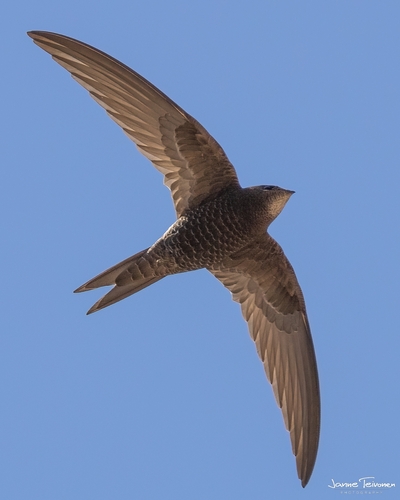
Pallid Swift (Apus pallidus) Pallid Swift
Forbes-Watson's Swift (Apus berliozi) Forbes-Watson's Swift

Media

Loading…

In short

Pallid Swift and Forbes-Watson's Swift are extremely similar in the field, with nearly identical structure and flight style, making separation challenging even for experienced observers. The most reliable mark for Pallid Swift is its overall paler, browner appearance, especially the contrast between its slightly paler flight feathers, underparts, and rump compared to the darker body, plus a large white throat patch that can be visible at a distance. Forbes-Watson's Swift lacks detailed published field marks for separation, but is generally darker and less contrasting than Pallid Swift. Both species have long, swept-back wings and a short forked tail, and are best separated with close, prolonged views. Age-specific wing pattern differences are not documented between these two, so focus on subtle plumage contrasts and overall tone.

Identification tips

  1. Overall Tone: Pallid Swift is noticeably paler and browner than Forbes-Watson's Swift, which appears darker and more uniform. This is most apparent in good light and at close range.
  2. Throat Patch: Look for a large white throat patch on Pallid Swift, often visible even at a distance. Forbes-Watson's Swift does not show such a prominent pale throat.
  3. Contrast in Flight Feathers and Rump: Pallid Swift shows slightly paler flight feathers and rump, creating a subtle contrast with the rest of the body. Forbes-Watson's Swift is more uniform, lacking this contrast.
  4. Scaly Belly: The belly of Pallid Swift often appears scaly due to pale feather edges. This feature is not noted for Forbes-Watson's Swift.
  5. Structural Similarity: Both species have long, swept-back wings and a short forked tail. Structure is not helpful for separation.
  6. No Age-Specific Wing Pattern: There are no documented differences in juvenile or immature wing patterns between these two species. All ages look structurally and pattern-wise similar, so focus on overall tone and contrast.
  7. Flight Style: Both species share the same fast, agile, boomerang-winged flight. Do not rely on flight action for separation.
  8. Voice: Calls are similar and not reliably separable in the field.
  9. Habitat Context: If seen outside the known breeding or wintering range of Forbes-Watson's Swift (e.g., away from coastal Somalia, southern Arabia, or Socotra), Pallid Swift is more likely. However, range overlap and vagrancy are possible, so do not use habitat as the sole criterion.
  10. Lighting Conditions: Subtle plumage contrasts are most apparent in strong, direct light. Overcast or backlit conditions may obscure the paler tones of Pallid Swift, making separation more difficult.
  11. Flock Composition: If seen in a mixed swift flock, compare individuals directly for paler, browner birds with a white throat patch (Pallid Swift) versus darker, more uniform birds (potential Forbes-Watson's Swift).
  12. Beware of Wear and Fading: Faded or worn Pallid Swifts may appear darker, while fresh Forbes-Watson's Swifts may show slightly more contrast, increasing confusion.
  13. Photographic Review: If possible, review photos for subtle contrasts in throat, rump, and underpart scaling, as these are the most reliable marks.
  14. Do Not Rely on Size: The small difference in body mass is not visible in the field and should not be used for identification.
  15. Accept Uncertainty: In poor light, distant views, or rapid flight, separating these two may be impossible. Prioritize clear, well-lit views of the throat and underparts for the best chance of a correct ID.

Size

Pallid Swift is marginally heavier (41.3g vs 38.0g) but both are very similar in size and structure, with no practical difference in the field. Both species are medium-sized swifts with long, crescent-shaped wings and short forked tails. Any perceived size difference is likely to be negligible and unreliable for identification.

Plumage

No age-specific wing pattern or juvenile marks are documented for either species, so all ages must be separated by overall coloration and contrast. Pallid Swift shows a noticeably paler, browner tone overall, with a large white throat patch that stands out, especially in good light. Its flight feathers, underparts, and rump are slightly paler than the rest of the body, creating a subtle but real contrast. The belly often appears scaly due to feather edges. Forbes-Watson's Swift, by contrast, is generally darker and more uniform, lacking the strong pale contrasts and scaly belly of Pallid Swift. Both species share the same basic swift structure and lack obvious wing or tail pattern differences in any plumage.

Behaviour

Both species are highly aerial, rarely perching except to cling to vertical surfaces. Their flight is fast and agile, with long, swept-back wings giving a boomerang or crescent shape. There is no documented difference in flight style or behavior between Pallid Swift and Forbes-Watson's Swift. Both feed on insects caught in flight and drink on the wing.

Habitat

Habitat is not a reliable separator where ranges overlap, but Forbes-Watson's Swift is more restricted geographically, breeding along coastal Somalia, southern Arabian Peninsula, and Socotra, and wintering as far south as Mozambique. Pallid Swift has a broader range and is not as closely tied to these coastal regions. However, in areas of potential overlap, habitat alone is not diagnostic.

Voice

Both species have loud, dry screaming calls typical of swifts. Pallid Swift's call is described as a loud, dry scream, possibly more disyllabic than Common Swift, but there is no published description distinguishing the calls of Forbes-Watson's Swift from Pallid Swift. Voice is not a reliable field separator between these two.

Submit a better description

Use the same sections as the comparison. Your text is published immediately.

Pallid Swift and Forbes-Watson's Swift are extremely similar in the field, with nearly identical structure and flight style, making separation challenging even for experienced observers. The most reliable mark for Pallid Swift is its overall paler, browner appearance, especially the contrast between its slightly paler flight feathers, underparts, and rump compared to the darker body, plus a large white throat patch that can be visible at a distance. Forbes-Watson's Swift lacks detailed published field marks for separation, but is generally darker and less contrasting than Pallid Swift. Both species have long, swept-back wings and a short forked tail, and are best separated with close, prolonged views. Age-specific wing pattern differences are not documented between these two, so focus on subtle plumage contrasts and overall tone.

  1. Overall Tone: Pallid Swift is noticeably paler and browner than Forbes-Watson's Swift, which appears darker and more uniform. This is most apparent in good light and at close range.
  2. Throat Patch: Look for a large white throat patch on Pallid Swift, often visible even at a distance. Forbes-Watson's Swift does not show such a prominent pale throat.
  3. Contrast in Flight Feathers and Rump: Pallid Swift shows slightly paler flight feathers and rump, creating a subtle contrast with the rest of the body. Forbes-Watson's Swift is more uniform, lacking this contrast.
  4. Scaly Belly: The belly of Pallid Swift often appears scaly due to pale feather edges. This feature is not noted for Forbes-Watson's Swift.
  5. Structural Similarity: Both species have long, swept-back wings and a short forked tail. Structure is not helpful for separation.
  6. No Age-Specific Wing Pattern: There are no documented differences in juvenile or immature wing patterns between these two species. All ages look structurally and pattern-wise similar, so focus on overall tone and contrast.
  7. Flight Style: Both species share the same fast, agile, boomerang-winged flight. Do not rely on flight action for separation.
  8. Voice: Calls are similar and not reliably separable in the field.
  9. Habitat Context: If seen outside the known breeding or wintering range of Forbes-Watson's Swift (e.g., away from coastal Somalia, southern Arabia, or Socotra), Pallid Swift is more likely. However, range overlap and vagrancy are possible, so do not use habitat as the sole criterion.
  10. Lighting Conditions: Subtle plumage contrasts are most apparent in strong, direct light. Overcast or backlit conditions may obscure the paler tones of Pallid Swift, making separation more difficult.
  11. Flock Composition: If seen in a mixed swift flock, compare individuals directly for paler, browner birds with a white throat patch (Pallid Swift) versus darker, more uniform birds (potential Forbes-Watson's Swift).
  12. Beware of Wear and Fading: Faded or worn Pallid Swifts may appear darker, while fresh Forbes-Watson's Swifts may show slightly more contrast, increasing confusion.
  13. Photographic Review: If possible, review photos for subtle contrasts in throat, rump, and underpart scaling, as these are the most reliable marks.
  14. Do Not Rely on Size: The small difference in body mass is not visible in the field and should not be used for identification.
  15. Accept Uncertainty: In poor light, distant views, or rapid flight, separating these two may be impossible. Prioritize clear, well-lit views of the throat and underparts for the best chance of a correct ID.

Pallid Swift is marginally heavier (41.3g vs 38.0g) but both are very similar in size and structure, with no practical difference in the field. Both species are medium-sized swifts with long, crescent-shaped wings and short forked tails. Any perceived size difference is likely to be negligible and unreliable for identification.

No age-specific wing pattern or juvenile marks are documented for either species, so all ages must be separated by overall coloration and contrast. Pallid Swift shows a noticeably paler, browner tone overall, with a large white throat patch that stands out, especially in good light. Its flight feathers, underparts, and rump are slightly paler than the rest of the body, creating a subtle but real contrast. The belly often appears scaly due to feather edges. Forbes-Watson's Swift, by contrast, is generally darker and more uniform, lacking the strong pale contrasts and scaly belly of Pallid Swift. Both species share the same basic swift structure and lack obvious wing or tail pattern differences in any plumage.

Both species are highly aerial, rarely perching except to cling to vertical surfaces. Their flight is fast and agile, with long, swept-back wings giving a boomerang or crescent shape. There is no documented difference in flight style or behavior between Pallid Swift and Forbes-Watson's Swift. Both feed on insects caught in flight and drink on the wing.

Habitat is not a reliable separator where ranges overlap, but Forbes-Watson's Swift is more restricted geographically, breeding along coastal Somalia, southern Arabian Peninsula, and Socotra, and wintering as far south as Mozambique. Pallid Swift has a broader range and is not as closely tied to these coastal regions. However, in areas of potential overlap, habitat alone is not diagnostic.

Both species have loud, dry screaming calls typical of swifts. Pallid Swift's call is described as a loud, dry scream, possibly more disyllabic than Common Swift, but there is no published description distinguishing the calls of Forbes-Watson's Swift from Pallid Swift. Voice is not a reliable field separator between these two.

Discard your changes?

You have unsaved edits. If you leave now, those changes will be lost.

Pallid Swift · Forbes-Watson's Swift · My Tricky Birds