

Pallas's Warbler vs Radde's Warbler
Phylloscopus proregulus versus Phylloscopus schwarzi
Play a quiz with Pallas's Warbler and Radde's Warbler
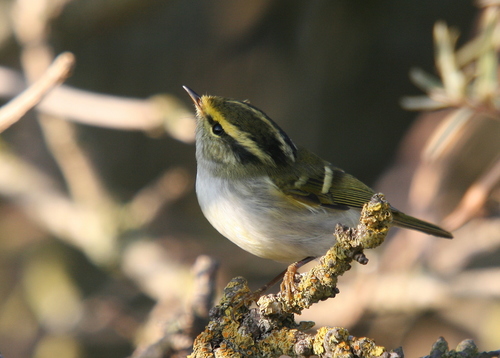 Pallas's Warbler
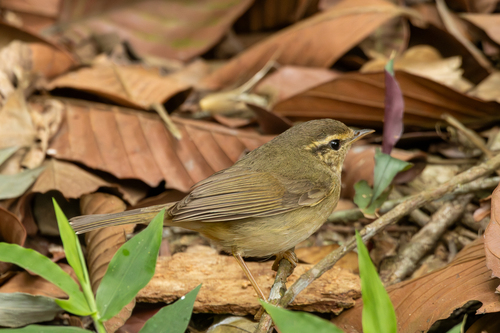 Radde's Warbler
In short
The most reliable field mark to separate Pallas's Warbler from Radde's Warbler is the combination of Pallas's vivid yellow rump, double yellow wingbars, and bold yellow supercilium and crown stripe, which are absent in Radde's. Radde's Warbler is larger, with a plain brown back, buff underparts, and a long, pale supercilium but lacks any yellow in the plumage. Juvenile and non-breeding Pallas's can be duller but still show the key wingbars and supercilium, while Radde's juveniles are yellower below but never show wingbars or yellow rumps. Structurally, Radde's is bulkier, with a thicker bill and larger feet, and often appears more terrestrial. Voice and habitat can help but are less reliable than plumage and structure.
Identification tips
- Yellow rump (Pallas's only): If you see a flash of lemon-yellow at the base of the tail, especially when the bird is hovering or flicking its tail, it's Pallas's Warbler. Radde's never shows a yellow rump.
- Double yellow wingbars (Pallas's only): Pallas's always shows two bright yellow wingbars on the coverts, visible in all ages and seasons. Radde's Warbler never has wingbars—its wings are plain brown.
- Yellow supercilium and crown stripe (Pallas's): Pallas's has a bold yellow supercilium and a central yellow crown stripe, forming a striking head pattern. Radde's has a long, pale (whitish) supercilium but no crown stripe; its supercilium is less contrasting against the brown head.
- Upperparts color: Pallas's is greenish above, Radde's is plain brown. In dull light, Pallas's may look less green, but the wingbars and supercilium remain diagnostic.
- Underparts: Pallas's is white below, Radde's is buff. Juvenile Radde's can be yellower below, but never white.
- Bill and legs: Radde's has a thicker, more pointed bill and paler legs; Pallas's bill is finer and darker, with yellowish edges. These are subtle in the field but can help with close views.
- Size and structure: Pallas's is tiny, with a large head and short tail, while Radde's is much larger, chunkier, and longer-tailed. If you see both together, the difference is clear; alone, use other marks.
- Feet: Radde's has large, strong feet, reflecting its terrestrial habits. Pallas's feet are more delicate.
- Behavior: Pallas's is restless, often high in trees, sometimes hovering; Radde's is more terrestrial, moving slowly in dense low cover or on the ground.
- Juvenile confusion: Juvenile Pallas's is duller but still shows wingbars and supercilium; juvenile Radde's is yellower below but never has wingbars or yellow crown/rump.
- Flight views: In flight, look for the yellow rump and wingbars of Pallas's. Radde's in flight looks plain brown with no contrasting marks.
- Call: Pallas's gives a soft 'dju-ee'; Radde's a soft 'chick'. Calls are helpful if heard well, but both are quiet and can be missed.
- Habitat: Pallas's prefers higher perches in trees, Radde's is usually low or on the ground. This can help in dense cover.
- Season: Most Pallas's in Europe are first-year birds in autumn, often brighter and with clear wingbars. Radde's is rarer but can occur in similar times and places.
- Sex: Both species are sexually monomorphic—males and females look alike, so do not use sex as a field mark.
Size
Pallas's Warbler is much smaller and lighter, with an average body mass of 6.0 g compared to Radde's Warbler's 11.5 g [wikidata]. In the field, Pallas's looks tiny and delicate, with a large head and short tail, while Radde's is closer in size to a Willow Warbler, appearing chunkier and longer-bodied. The difference is often obvious if both are seen in quick succession, but can be subtle when seen alone.
Plumage
Juvenile and adult Pallas's Warbler always show prominent double yellow wingbars, a bold yellow supercilium, a central yellow crown stripe, and a lemon-yellow rump (though the rump can be hidden unless the bird is hovering or flicking its tail). Non-breeding and juvenile Pallas's are brighter green above and have broader, brighter feather fringes, but still retain the wingbars and supercilium; juveniles may have a brownish tinge above and duller supercilium, but the pattern remains. Radde's Warbler, in all ages, lacks wingbars and yellow in the plumage. It has a plain, unstreaked brown back, buff underparts, and a very long, pale (whitish) supercilium. Juvenile Radde's are yellower below but still lack any wingbars or yellow crown/rump. The bill of Radde's is thicker and the legs paler than similar warblers, but these are less obvious than the plumage contrasts.
Behaviour
Pallas's Warbler is highly active, often feeding high in trees, hovering or flicking its wings and tail, which can expose the yellow rump. Radde's Warbler is more terrestrial, often seen low in dense vegetation or on the ground, moving with a heavier, more deliberate manner. Its large feet reflect this ground-foraging tendency. Pallas's often appears restless and energetic, while Radde's is more methodical and less likely to hover.
Habitat
Both species are migratory and can overlap in range during migration, but Pallas's Warbler breeds in mountain forests from southern Siberia to northeast China, while Radde's Warbler breeds in Siberia and winters in Southeast Asia. In Europe, Pallas's is a regular autumn vagrant, especially as a first-year bird, while Radde's is rarer but can occur in similar habitats. Pallas's is more likely to be found higher in trees, while Radde's prefers dense, low vegetation or the ground.
Voice
Pallas's Warbler gives a short, soft 'dju-ee' call and a strong, prolonged song with a mix of whistles and trills, sometimes reminiscent of a canary. Radde's Warbler has a soft 'chick' call. Song is rarely heard on migration or in winter, so calls are more useful, but both are rather soft and can be easily missed. Vocalizations are not the most reliable separation feature unless heard well.