

Pale-winged Starling vs Black-bellied Starling
Onychognathus nabouroup versus Notopholia corusca
Play a quiz with Pale-winged Starling and Black-bellied Starling
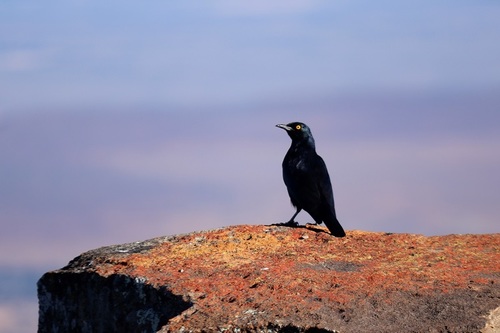 Pale-winged Starling
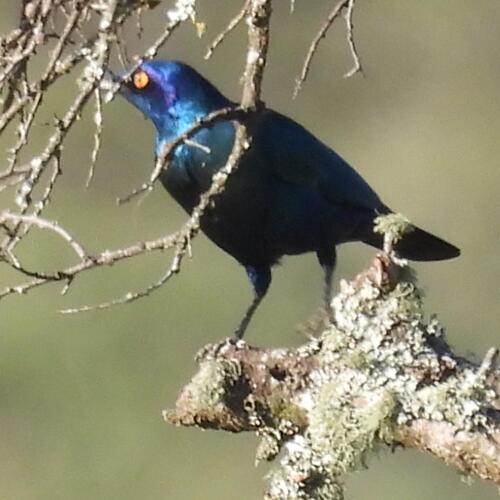 Black-bellied Starling
In short
The most reliable field mark between Pale-winged Starling and Black-bellied Starling is the pale panel on the folded and outstretched wing of Pale-winged Starling, which is absent in Black-bellied Starling. If you see a starling with a distinctly pale or silvery wing patch in flight or at rest, it's Pale-winged; Black-bellied is overall much darker and lacks this contrast. Both species overlap in parts of southern Africa, so context alone is not enough. Juvenile and adult birds show the same key wing difference, making this mark dependable year-round. Structure and size are similar, so focus on wing pattern and overall coloration.
Identification tips
- Pale wing panel (all ages): Pale-winged Starling always shows a pale or silvery wing patch, visible both at rest and in flight. This is the single most reliable field mark.
- Uniformly dark wings (all ages): Black-bellied Starling lacks any pale panel on the wing; its wings are glossy and dark throughout.
- Overall coloration: Pale-winged Starling may appear slightly lighter overall due to the pale wing patch, while Black-bellied is consistently dark, especially on the belly and wings.
- No age-specific pitfalls: Both species maintain their key wing pattern from juvenile through adult plumage, so age is not a confounding factor for this mark.
- Perched views: Even when perched, the pale panel on Pale-winged Starling's wing is usually visible. If you see a starling with a pale patch on the folded wing, it's not Black-bellied.
- Flight views: In flight, the pale panel on Pale-winged Starling is even more obvious; Black-bellied Starling's wings remain dark.
- Iris color: Black-bellied Starling's iris can change color with mood or behavior, but this is subtle and not a reliable field mark for separation.
- Size and structure: Both are medium-sized, robust starlings. Do not rely on size or shape for separation.
- Habitat overlap: Both species can occur in the same region, especially in South Africa. Do not use location as the primary separator.
- Belly color: Black-bellied Starling is named for its dark belly, but this is not as diagnostic as the wing panel difference.
- No strong seasonal or sex differences: The key field marks do not change with season or sex in either species.
- Diet and behavior: Both are omnivorous and show similar feeding habits; this does not help with identification.
- If in doubt, focus on the wing: The presence or absence of the pale wing panel is the fastest and most reliable way to separate these two species in any context.
Size
Pale-winged Starling is a robust starling with a body mass of about 103 g [wikidata]. No direct mass data is available for Black-bellied Starling, but both are medium-sized starlings and likely to overlap in size in the field. Size alone is not a reliable separator between these two species.
Plumage
The standout plumage difference is the pale or silvery panel on the wings of Pale-winged Starling, visible both when perched and in flight, across all ages. This pale wing area contrasts strongly with the otherwise dark plumage. Black-bellied Starling, in contrast, is uniformly dark with no pale wing patch; its plumage is glossy and dark overall, including the wings and belly. There is no mention of age-specific wing pattern changes in either species, so this mark is reliable for juveniles and adults alike. If you see a starling with a distinctly pale or silvery wing patch, it's Pale-winged; if the wings are uniformly dark, it's Black-bellied.
Behaviour
Both species are generalist omnivores and are likely to be seen foraging for fruit and insects. There is no diagnostic behavioral difference noted between the two, so behavior should not be used for separation in the field.
Habitat
Both species occur in southern Africa, with Pale-winged Starling found in Angola, Botswana, Namibia, and South Africa, and Black-bellied Starling in Eswatini, Kenya, Mozambique, Somalia, South Africa, Tanzania, and Zimbabwe [wikipedia]. Their ranges overlap in South Africa and adjacent regions. Habitat preference is not described as a strong separator, so do not rely on location alone.
Pale-winged Starling · Black-bellied Starling · My Tricky Birds