
Motmot

Pale-vented Pigeon vs Roadside Hawk

Patagioenas cayennensis versus Rupornis magnirostris

Play a quiz with Pale-vented Pigeon and Roadside Hawk
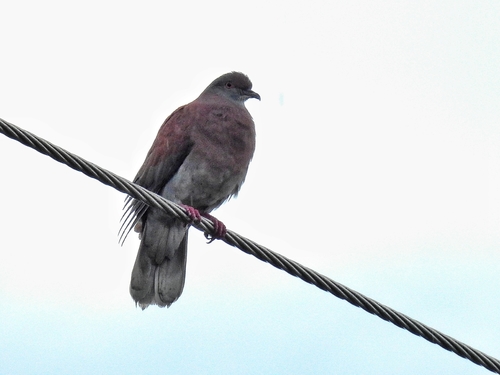
Pale-vented Pigeon (Patagioenas cayennensis) Pale-vented Pigeon
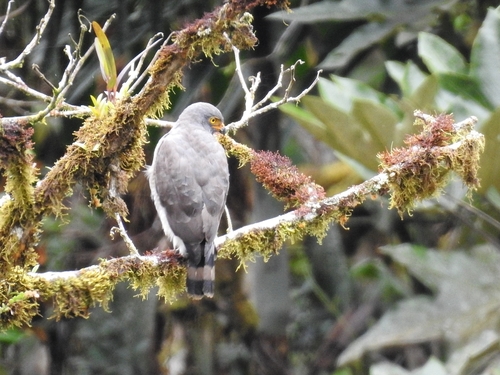
Roadside Hawk (Rupornis magnirostris) Roadside Hawk

Media

Loading…

In short

The most reliable field mark to separate Pale-vented Pigeon from Roadside Hawk is overall structure and flight style: the pigeon is a large, heavy-bodied bird with broad wings and a short tail, while the hawk is slimmer, with a relatively long tail and short, rounded wings. In flight, the hawk often soars and shows a barred tail and underparts, while the pigeon flies with strong, direct wingbeats and lacks any barring. Adult plumage is also distinctive: the pigeon is mostly dull purple and grey with a pale vent, while the hawk is brown or grey with prominent barring below. Immature pigeons are very dull and brownish, but still lack the hawk's barred underparts and tail. Vocalizations are completely different, and the hawk's behavior is more predatory and conspicuous. These two species are unlikely to be confused at close range, but distant or backlit views, especially of perched birds, can cause confusion due to similar size and upright posture.

Identification tips

  1. Flight profile: Roadside Hawk has a long tail and short, rounded wings, often seen soaring or gliding with wings flat; Pale-vented Pigeon has broader wings and a shorter tail, flying with strong, direct wingbeats. This is reliable for all ages.
  2. Underpart barring: Roadside Hawk (all ages) shows brown and white barring on the lower breast and belly; Pale-vented Pigeon (all ages) has plain, unbarred underparts—pale grey or white in adults, dull grey-brown in immatures.
  3. Tail pattern: Hawk's tail is distinctly barred with 4–5 grey bands, visible both perched and in flight; pigeon's tail is plain dark grey.
  4. Bill shape: Hawk has a large, hooked bill (adapted for predation); pigeon has a straight, black bill (adapted for fruit/seed eating). This is visible at moderate range.
  5. Eye color: Adult hawks have whitish or yellow eyes; pigeons have red eyes and red eyering (adults). Immature pigeons are duller, but still lack yellow eyes.
  6. Leg color: Pigeon has red legs; hawk's leg color is not described as diagnostic, but is not red.
  7. Plumage gloss: Adult pigeons show coppery gloss on the nape; hawks never do. Immature pigeons lack gloss and are overall duller, but still lack barring.
  8. Rufous in wing: Hawk may show a touch of rufous on the wings in flight, especially in some subspecies; pigeon never shows rufous.
  9. Perched posture: Hawk perches upright, often in exposed locations; pigeon is bulkier and more horizontal, usually in more concealed spots.
  10. Behavior: Hawk is predatory, often seen hunting or soaring; pigeon is more likely to be seen feeding quietly or flying between trees.
  11. Vocalization: Hawk's call is a sharp, high-pitched squeak; pigeon's is a soft kuk kuk croo-ooos. Calls are not similar.
  12. Habitat: Hawk is common in very open areas, roadsides, and urban parks; pigeon prefers forest edges, riverbanks, and areas with more tree cover.
  13. Sex/age confusion: Female hawks are larger, but both sexes show same plumage; immature pigeons are dull grey-brown, but still lack any barring or rufous, and are bulkier than hawks.
  14. Flock size: Pigeon may be in small flocks, especially at water; hawk is usually solitary.
  15. Common pitfalls: Distant perched birds can look similar in size and posture, but tail pattern and underpart barring are reliable at any range. Immature pigeons are dull, but never show barring or rufous.

Size

Pale-vented Pigeon is a large pigeon, 30–32 cm long and weighing 230–250 g [wikipedia]. Roadside Hawk is slightly longer (31–41 cm) and heavier (250–300 g), but the difference is subtle and not always apparent in the field [wikipedia]. The hawk is more slender, with a longer tail and shorter wings relative to its body, while the pigeon is bulkier and more barrel-chested. Sexes are similar in both, though female hawks are about 20% larger than males; this is not usually obvious unless birds are side by side.

Plumage

Juvenile and immature Pale-vented Pigeons are very dull, greyish-brown overall, lacking any barring or strong contrast, and show a uniform appearance above and below. Adults have a dull purple head, breast, and upperparts with copper gloss on the nape, pale grey (or white in some southern birds) lower underparts, and a dark grey tail and lower back. The vent is pale, as the name suggests. In contrast, Roadside Hawk of all ages shows barred brown and white underparts and a tail with four or five grey bars, which are visible both perched and in flight. The hawk's upperparts are brown or grey, sometimes with a rufous tinge on the wings, especially in flight. The hawk's eyes are whitish or yellow, while the pigeon's are red. The hawk's bill is relatively large and hooked, while the pigeon's is straight and black. The hawk's plumage is variable by subspecies, but the combination of barred underparts and tail is consistent.

Behaviour

Pale-vented Pigeon is usually solitary or in small flocks, feeding quietly on fruit and seeds, often at forest edges or riverbanks. Its flight is strong, direct, and high, with regular wingbeats and occasional sharp flicks. It may perform a display flight with a semi-circular glide. Roadside Hawk is much more conspicuous, frequently perching in the open, often on wires or exposed branches, and is highly vocal. It hunts from a perch, dropping on prey, and often soars on thermals with wings held flat. The hawk does not hover. The pigeon's behavior is more secretive and less predatory.

Habitat

Both species occur in partially open areas with trees, but their microhabitat preferences differ. Pale-vented Pigeon is common at forest edges, riverbanks, and open woodlands, usually avoiding very open country. Roadside Hawk is often the most common raptor in its range, found in a wide variety of open and semi-open habitats, including roadsides (as the name suggests), savannas, and even urban parks. The hawk is more likely to be seen in very open areas or perched in exposed locations, while the pigeon prefers areas with more cover.

Voice

Pale-vented Pigeon gives a soft, rhythmic kuk kuk croo-ooos, with the initial kuk being distinctive for its group. Roadside Hawk has a very high-pitched, piercing squeak, which is much sharper and more raptor-like than the pigeon's cooing. The calls are not likely to be confused by ear.

Submit a better description

Use the same sections as the comparison. Your text is published immediately.

The most reliable field mark to separate Pale-vented Pigeon from Roadside Hawk is overall structure and flight style: the pigeon is a large, heavy-bodied bird with broad wings and a short tail, while the hawk is slimmer, with a relatively long tail and short, rounded wings. In flight, the hawk often soars and shows a barred tail and underparts, while the pigeon flies with strong, direct wingbeats and lacks any barring. Adult plumage is also distinctive: the pigeon is mostly dull purple and grey with a pale vent, while the hawk is brown or grey with prominent barring below. Immature pigeons are very dull and brownish, but still lack the hawk's barred underparts and tail. Vocalizations are completely different, and the hawk's behavior is more predatory and conspicuous. These two species are unlikely to be confused at close range, but distant or backlit views, especially of perched birds, can cause confusion due to similar size and upright posture.

  1. Flight profile: Roadside Hawk has a long tail and short, rounded wings, often seen soaring or gliding with wings flat; Pale-vented Pigeon has broader wings and a shorter tail, flying with strong, direct wingbeats. This is reliable for all ages.
  2. Underpart barring: Roadside Hawk (all ages) shows brown and white barring on the lower breast and belly; Pale-vented Pigeon (all ages) has plain, unbarred underparts—pale grey or white in adults, dull grey-brown in immatures.
  3. Tail pattern: Hawk's tail is distinctly barred with 4–5 grey bands, visible both perched and in flight; pigeon's tail is plain dark grey.
  4. Bill shape: Hawk has a large, hooked bill (adapted for predation); pigeon has a straight, black bill (adapted for fruit/seed eating). This is visible at moderate range.
  5. Eye color: Adult hawks have whitish or yellow eyes; pigeons have red eyes and red eyering (adults). Immature pigeons are duller, but still lack yellow eyes.
  6. Leg color: Pigeon has red legs; hawk's leg color is not described as diagnostic, but is not red.
  7. Plumage gloss: Adult pigeons show coppery gloss on the nape; hawks never do. Immature pigeons lack gloss and are overall duller, but still lack barring.
  8. Rufous in wing: Hawk may show a touch of rufous on the wings in flight, especially in some subspecies; pigeon never shows rufous.
  9. Perched posture: Hawk perches upright, often in exposed locations; pigeon is bulkier and more horizontal, usually in more concealed spots.
  10. Behavior: Hawk is predatory, often seen hunting or soaring; pigeon is more likely to be seen feeding quietly or flying between trees.
  11. Vocalization: Hawk's call is a sharp, high-pitched squeak; pigeon's is a soft kuk kuk croo-ooos. Calls are not similar.
  12. Habitat: Hawk is common in very open areas, roadsides, and urban parks; pigeon prefers forest edges, riverbanks, and areas with more tree cover.
  13. Sex/age confusion: Female hawks are larger, but both sexes show same plumage; immature pigeons are dull grey-brown, but still lack any barring or rufous, and are bulkier than hawks.
  14. Flock size: Pigeon may be in small flocks, especially at water; hawk is usually solitary.
  15. Common pitfalls: Distant perched birds can look similar in size and posture, but tail pattern and underpart barring are reliable at any range. Immature pigeons are dull, but never show barring or rufous.

Pale-vented Pigeon is a large pigeon, 30–32 cm long and weighing 230–250 g [wikipedia]. Roadside Hawk is slightly longer (31–41 cm) and heavier (250–300 g), but the difference is subtle and not always apparent in the field [wikipedia]. The hawk is more slender, with a longer tail and shorter wings relative to its body, while the pigeon is bulkier and more barrel-chested. Sexes are similar in both, though female hawks are about 20% larger than males; this is not usually obvious unless birds are side by side.

Juvenile and immature Pale-vented Pigeons are very dull, greyish-brown overall, lacking any barring or strong contrast, and show a uniform appearance above and below. Adults have a dull purple head, breast, and upperparts with copper gloss on the nape, pale grey (or white in some southern birds) lower underparts, and a dark grey tail and lower back. The vent is pale, as the name suggests. In contrast, Roadside Hawk of all ages shows barred brown and white underparts and a tail with four or five grey bars, which are visible both perched and in flight. The hawk's upperparts are brown or grey, sometimes with a rufous tinge on the wings, especially in flight. The hawk's eyes are whitish or yellow, while the pigeon's are red. The hawk's bill is relatively large and hooked, while the pigeon's is straight and black. The hawk's plumage is variable by subspecies, but the combination of barred underparts and tail is consistent.

Pale-vented Pigeon is usually solitary or in small flocks, feeding quietly on fruit and seeds, often at forest edges or riverbanks. Its flight is strong, direct, and high, with regular wingbeats and occasional sharp flicks. It may perform a display flight with a semi-circular glide. Roadside Hawk is much more conspicuous, frequently perching in the open, often on wires or exposed branches, and is highly vocal. It hunts from a perch, dropping on prey, and often soars on thermals with wings held flat. The hawk does not hover. The pigeon's behavior is more secretive and less predatory.

Both species occur in partially open areas with trees, but their microhabitat preferences differ. Pale-vented Pigeon is common at forest edges, riverbanks, and open woodlands, usually avoiding very open country. Roadside Hawk is often the most common raptor in its range, found in a wide variety of open and semi-open habitats, including roadsides (as the name suggests), savannas, and even urban parks. The hawk is more likely to be seen in very open areas or perched in exposed locations, while the pigeon prefers areas with more cover.

Pale-vented Pigeon gives a soft, rhythmic kuk kuk croo-ooos, with the initial kuk being distinctive for its group. Roadside Hawk has a very high-pitched, piercing squeak, which is much sharper and more raptor-like than the pigeon's cooing. The calls are not likely to be confused by ear.

Discard your changes?

You have unsaved edits. If you leave now, those changes will be lost.

Pale-vented Pigeon · Roadside Hawk · My Tricky Birds