

Pale-vented Pigeon vs Band-tailed Pigeon
Patagioenas cayennensis versus Patagioenas fasciata
Play a quiz with Pale-vented Pigeon and Band-tailed Pigeon
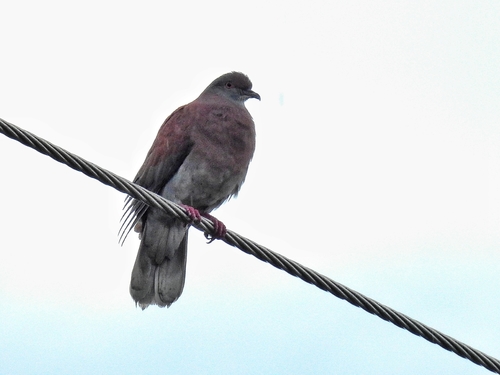 Pale-vented Pigeon
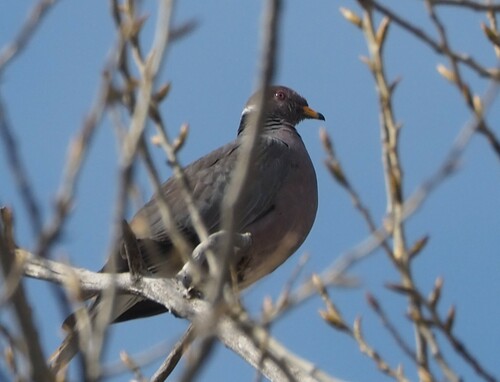 Band-tailed Pigeon
In short
The most reliable field mark to separate Pale-vented Pigeon from Band-tailed Pigeon is the presence of a thin white collar on the nape and a yellow bill in Band-tailed, both absent in Pale-vented. Juvenile Band-tailed Pigeons show a scaly appearance above and lack the white collar, but still differ from the plain, duller immatures of Pale-vented. Adults of Pale-vented have a dull purple head and breast with copper gloss on the nape and red bare parts, while Band-tailed is overall gray with a faint pink cast and a pale tail with a dark band. In flight or at a distance, bill and leg color, as well as the tail pattern, are key. Both are large pigeons, but Band-tailed is generally bulkier and longer.
Identification tips
- White nape collar (Band-tailed only): Adult Band-tailed Pigeons have a thin white collar on the nape, visible at rest and sometimes in flight. Pale-vented Pigeons never show this mark. Juvenile Band-taileds lack the collar but still differ in other ways.
- Bill and leg color: Band-tailed has a yellow bill (sometimes with a black tip in northern birds) and yellow feet; Pale-vented has a black bill and red legs/eye-ring. These colors are visible at close range or in good light.
- Tail pattern: Band-tailed shows a pale gray tail tip with a contrasting dark band at the base (except in Baja California birds); Pale-vented has a uniformly dark gray tail. This is especially useful in flight or distant perched views.
- Head and breast color: Pale-vented adults have a dull purple head and breast with copper gloss on the nape, while Band-tailed is mostly gray with a faint pinkish or purple-gray cast, never as rich as Pale-vented.
- Underparts: Band-tailed's belly is nearly white, contrasting with the rest of the underparts. Pale-vented has pale gray (or white in southern subspecies) lower underparts, but the transition is less sharp.
- Juvenile/immature pattern: Juvenile Band-taileds have a scaly look above due to pale feather edges, and lack the white collar. Immature Pale-vented are plain, dull, and grayish-brown, lacking any scaly effect or collar.
- Bare part color: Red legs and eye-ring in Pale-vented vs. yellow feet in Band-tailed are strong clues at close range.
- Size and structure: Band-tailed is bulkier, longer, and has a broader wingspan (up to 66 cm), while Pale-vented is slightly smaller and slimmer. This is most noticeable when both species are seen together.
- Flight style: Both species have strong, direct flight, but Band-tailed may appear heavier and more deliberate. Display flights (semi-circular glide) are noted for Pale-vented.
- Habitat: Pale-vented prefers tropical lowland edges and open areas with trees; Band-tailed is more likely in montane or temperate forests, especially oaks, and sometimes suburban parks.
- Voice: Listen for the initial kuk in Pale-vented's call; Band-tailed lacks this feature.
- Sex differences: Both species show only subtle sexual dimorphism; females are duller in both, but this is rarely diagnostic.
- Subspecies variation: Southern Pale-vented (P. c. andersoni) has whiter lower underparts, but still lacks the white nape collar and yellow bill of Band-tailed.
- Pitfalls: Juvenile Band-taileds without the white collar can be confused with Pale-vented, but check for scaly upperparts and yellow bare parts. Immature Pale-vented are always plain and dull.
- Geographic context: If in tropical lowlands, Pale-vented is more likely; in montane or temperate forests, especially in North America, Band-tailed is expected.
Size
Band-tailed Pigeon is larger overall, measuring 33–40 cm in length and weighing 226–460 g, with a wingspan up to 66 cm. Pale-vented Pigeon is slightly smaller, at 30–32 cm and 230–250 g. While there is some overlap in weight, Band-tailed is usually noticeably bigger and more robust, especially in direct comparison. Both species are among the largest pigeons in their respective ranges, but Band-tailed tends to look longer and heavier-bodied.
Plumage
- Juvenile/immature plumage: Juvenile Band-tailed Pigeons have pale feather edges above, creating a scaly look, and lack the white nape collar and neck iridescence. Immature Pale-vented Pigeons are very dull, mainly grayish-brown, and lack any scaly pattern or collar, appearing plainer overall.
- Adult plumage: Adult Pale-vented Pigeons show a dull purple head, breast, and upperparts with copper gloss on the nape, a whitish throat, dark gray lower back and tail, and pale gray lower underparts (white in some southern birds). Band-tailed adults are mostly gray, darker above, with a faint pinkish cast on the head and breast, a nearly white belly, and a distinctive thin white collar on the nape. The tail of Band-tailed is pale at the tip with a dark band at the base, while Pale-vented has a uniformly dark gray tail. Bare part colors differ: Pale-vented has a black bill and red legs/eye-ring, Band-tailed has a yellow bill and feet (bill sometimes with a black tip in northern birds).
Behaviour
Both species are strong fliers and can be seen flying high and fast, often over open areas. Pale-vented Pigeon is fairly solitary but may form small flocks at water sources, while Band-tailed Pigeon is more likely to be seen in small colonies or loose flocks, especially at food sources. Both species feed mainly on fruits and seeds. Display flights are described for Pale-vented, with a semi-circular glide down to a perch. In general, Band-tailed may appear bulkier and more deliberate in movement, while Pale-vented is slightly slimmer and less robust in posture.
Habitat
Pale-vented Pigeon is common at forest edges, riverbanks, and partially open areas with scattered trees in the tropical Americas. Band-tailed Pigeon occupies a broader range, including montane forests, oak woodlands, and sometimes suburban areas, mainly in North and Central America. Both species can be found away from dense forest interiors, but Band-tailed is more often associated with higher elevations and temperate zones, while Pale-vented is strictly tropical and subtropical.
Voice
Pale-vented Pigeon gives a soft series of kuk kuk croo-ooos, with the initial short kuk being distinctive for its group. Band-tailed Pigeon's call is not described in detail here, but the absence of the initial kuk and the presence of a different song structure can help separate them if heard well. In practice, voice is less reliable than plumage and structure for these two, but the unique kuk intro of Pale-vented may be a clue.