

Pale-billed Woodpecker vs Cinnamon Woodpecker
Campephilus guatemalensis versus Celeus loricatus
Play a quiz with Pale-billed Woodpecker and Cinnamon Woodpecker
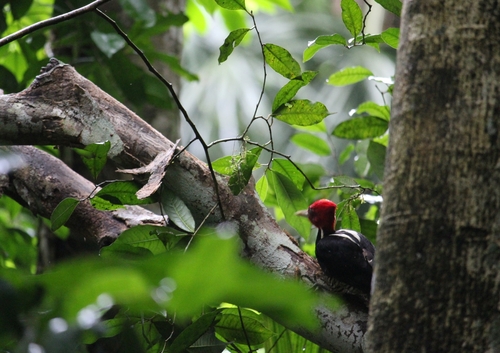 Pale-billed Woodpecker
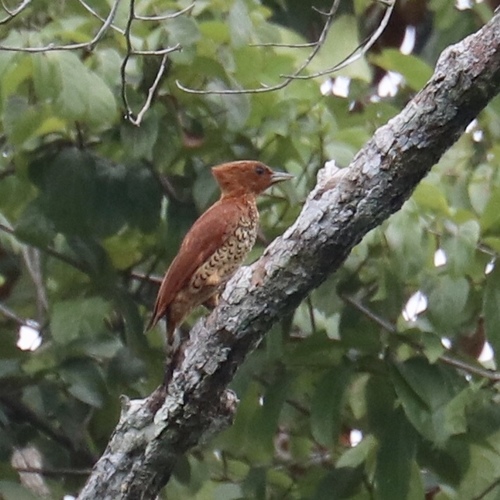 Cinnamon Woodpecker
In short
The most reliable field mark to separate Pale-billed Woodpecker from Cinnamon Woodpecker is overall size and structure: Pale-billed is a massive, heavy-billed Campephilus, while Cinnamon is much smaller, slimmer, and more compact. In all plumages, Pale-billed shows a striking ivory-yellow chisel bill and bold black-and-white upperparts with a pale V on the back, while Cinnamon is warm rufous-cinnamon with black barring and a much smaller, grayish to yellowish bill. In flight, Pale-billed appears large and powerful with broad wings, whereas Cinnamon is quick and light. Juveniles of both are similar to adults but can be separated by the same structural and color contrasts. These two are unlikely to overlap in size or overall impression, but confusion can arise with poor views or when focusing only on head color.
Identification tips
- Size is the fastest check: Pale-billed is huge (almost crow-sized), Cinnamon is small and slim. If you see a woodpecker that looks large and powerful, it's not Cinnamon.
- Bill color and shape: Pale-billed has a long, thick, ivory-yellow chisel bill—very distinctive even at a distance. Cinnamon's bill is much shorter, thinner, and grayish to yellowish.
- Upperparts pattern: Look for the bold pale (white or buff) V or stripes on the black back of Pale-billed. Cinnamon is uniformly rufous-cinnamon above with narrow black barring, never with a pale V.
- Head color and crest: Male Pale-billed has a solid red head with a bushy crest; female has a black forecrown and throat. Cinnamon has a rufous head with black streaks on the crown for both sexes, and a bushy crest. Only male Cinnamon shows red on the chin/throat (with black streaks); female Cinnamon is plain rufous there.
- Tail pattern: Pale-billed's tail is dull brown with olive-brown below; Cinnamon's is black with wide buff/whitish bars—check if the tail is visible.
- Underparts: Pale-billed shows pale yellowish buff underparts with narrow black bars; Cinnamon is paler buff below with bold black arrowhead marks (not bars).
- Juvenile confusion: Juvenile Pale-billed resembles adult female but is duller; juvenile Cinnamon is like adult but with more mottling. Size and overall color still separate them.
- Flight impression: Pale-billed is broad-winged, heavy, and slow in flight; Cinnamon is quick, light, and agile.
- Leg color: Pale-billed has greenish gray legs; Cinnamon's are gray. Not usually diagnostic in the field.
- Eye color: Pale-billed has a light cream-buff iris; Cinnamon's is red. Useful in close views.
- Habitat context: If in a large, mature forest with big dead trees, Pale-billed is more likely. In humid lowland forest, especially in the south of the range, Cinnamon is possible.
- Sex differences: Only male Cinnamon shows red on the chin/throat; both sexes of Pale-billed have a bushy crest, but only the male is all red-headed.
- Mixed flock behavior: Pale-billed does not join mixed flocks; Cinnamon's behavior is not specified but may be more flexible.
- Bill darkness in juveniles: Juvenile Pale-billed has a darker bill than adults, but still much larger and paler than Cinnamon.
- Pitfall: Do not rely on 'red head' alone—both can look red-headed in some views. Always check size, bill, and upperparts pattern for confirmation.
Size
Pale-billed Woodpecker is dramatically larger, with an average mass of 242 g and a length of 35.5–38 cm, compared to Cinnamon Woodpecker's 78 g and 19–23 cm. In the field, Pale-billed looks almost crow-sized, with a heavy, long bill and a robust, elongated body. Cinnamon is closer to a small woodpecker, appearing slim, short-tailed, and with a proportionally smaller head and bill. Size alone is usually enough to separate them if seen together or with a sense of scale.
Plumage
No age-specific upperwing or flight marks are described for either species, but overall plumage is highly distinctive at all ages. Pale-billed Woodpecker of all ages and sexes shows black upperparts with a pale (white or buff) V-shaped stripe down the back, a long ivory-yellow bill, and a red (male) or mostly black (female) head with a bushy crest. The underparts are pale buff with fine black barring. Juveniles resemble adult females but have a darker bill and duller head sides. Cinnamon Woodpecker, in all plumages, is rich rufous-cinnamon above and below with narrow black barring on the back and wings, a bushy rufous crest, and a black-barred or streaked crown. Males have a red-streaked chin and throat, while females are plain rufous there. The bill is much shorter and grayish to yellowish. Juveniles are similar to adults but with more mottling and irregular markings. The tail of Cinnamon is black with wide buff or whitish bars, unlike the dull brown tail of Pale-billed.
Behaviour
Pale-billed Woodpecker forages mostly on large trunks and limbs, often excavating in dead wood, and is usually seen singly or in pairs, sometimes separated by several meters. It rarely joins mixed flocks and may be seen on the ground at stumps. Cinnamon Woodpecker's foraging behavior is not detailed here, but its smaller size and lighter build suggest it may be more agile and less tied to large trunks. Both species excavate nest cavities in trees, but Pale-billed typically uses larger, higher trees.
Habitat
Pale-billed Woodpecker is found from Mexico to Panama, mostly in lowland and montane tropical forests, including evergreen, deciduous, mangroves, and pine-oak, but avoids heavily deforested areas. Cinnamon Woodpecker occurs in Colombia, Costa Rica, Ecuador, Nicaragua, and Panama, overlapping in part of the range but generally in humid forests. Both can be found in mature forest, but Pale-billed is more likely in primary or less disturbed forest with large trees, while Cinnamon may tolerate a wider range of humid forest types.
Pale-billed Woodpecker · Cinnamon Woodpecker · My Tricky Birds