

Pacific Swift vs Sand Martin
Apus pacificus versus Riparia riparia
Play a quiz with Pacific Swift and Sand Martin
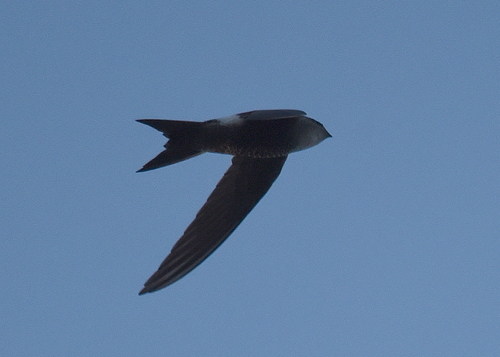 Pacific Swift
 Sand Martin
In short
The most reliable way to separate Pacific Swift from Sand Martin is by size, structure, and flight style: Pacific Swift is much larger, with long, sickle-shaped wings and a deep forked tail, while Sand Martin is a small, compact swallow with short wings and a shallow, squared or slightly notched tail. In flight, Pacific Swift shows a bold white rump band and a scaly-looking belly, while Sand Martin has a brown breast band and a clean white underside. Juvenile Pacific Swifts may show pale fringes on the wings, but Sand Martin juveniles have rufous-tipped coverts and secondaries. Both species are aerial insectivores, but their shape, size, and flight style are immediately different through binoculars.
Identification tips
- Size and shape: Pacific Swift is much larger and bulkier than Sand Martin; if you see both together, the size difference is obvious. Swifts have long, pointed, sickle-shaped wings and a deep forked tail, while Sand Martin is small, compact, with short wings and a shallow, squared or slightly notched tail.
- White rump band (all ages): Pacific Swift always shows a bold white rump band, visible from above and below in flight. Sand Martin never has a white rump—its back is plain brown.
- Underparts: Pacific Swift has black underparts with a scaly look due to white feather fringes, especially when seen from below. Sand Martin is white below with a narrow brown breast band and a clean white belly.
- Breast band: Sand Martin's narrow brown breast band is unique among these two; Pacific Swift never shows a breast band.
- Tail shape: Pacific Swift's tail is deeply forked, especially when spread in flight. Sand Martin's tail is only slightly notched or squared, never as deeply forked as the swift's.
- Juvenile wing pattern: Juvenile Pacific Swifts show pale fringes to the wing feathers, giving a scalloped effect, while juvenile Sand Martins have rufous tips to the coverts and secondaries, visible as warm edges in good light.
- Flight style: Pacific Swift flies with long, stiff, gliding strokes and rapid, shallow wingbeats, often high overhead. Sand Martin has a fluttery, quick, jerky flight, usually low over water or fields.
- Perching behavior: Sand Martin often perches on wires, reeds, or banks; Pacific Swift almost never perches in the open and is nearly always seen in flight.
- Head and bill: Pacific Swift has a more protruding head and a stouter, more powerful look; Sand Martin has a small, rounded head and a tiny bill.
- Context and habitat: If seen near a sandy riverbank or colony, especially perched, Sand Martin is likely. If seen high overhead or migrating in large flocks, especially outside the breeding season, Pacific Swift is more likely.
- Vocalizations: Listen for Sand Martin's gravelly twittering in flight; Pacific Swift is generally silent or gives only brief, non-musical calls.
- Season and range: In Europe or North America, Sand Martin is the expected species; Pacific Swift is a rare vagrant. In eastern Asia or Australasia, Pacific Swift is more likely, especially on migration.
- Pitfalls: A leucistic swift with a white rump could be mistaken for Pacific Swift, but check for size, tail fork, and underpart pattern. No Sand Martin will show a white rump or deeply forked tail.
- Sexes: Both species are sexually monomorphic; plumage differences are not useful for sexing in the field.
- Subspecies variation: Southern Pacific Swifts (A. p. kurodae) have a narrower white rump and greyer throat, but still show the key structural and rump contrasts with Sand Martin.
Size
Pacific Swift is dramatically larger: 17–18 cm long with a wingspan of 43–54 cm, and weighing 42.5–44.5 g. Sand Martin is much smaller, at 12–13 cm in length, a wingspan of 26.5–29 cm, and weighing only 11–16 g (up to 19.5 g pre-migration). Even at a distance, the swift's size and long, pointed wings stand out against the sand martin's compact, short-winged shape.
Plumage
- Juvenile/immature birds: Juvenile Pacific Swifts have pale fringes on the wing feathers, especially visible on the upperwing, giving a subtly scalloped look. Sand Martin juveniles show rufous tips to the coverts and margins to the secondaries, which can be seen as a warm edging on the wing in good light.
- Adults: Pacific Swift adults are black above with a broad white rump band, a somewhat greyer head, and black underparts with white fringes giving a scaly appearance to the belly. The tail is deeply forked. Sand Martin adults are brown above, white below, with a narrow brown breast band and a clean white throat and belly. The tail is only slightly notched or squared.
- Key contrasts: Pacific Swift's white rump band is bold and broad (narrower in some southern subspecies), while Sand Martin lacks any white on the rump. The swift's underparts are dark and patterned, while the martin's are clean white with a single breast band.
Behaviour
Pacific Swift is a powerful, fast-flying aerialist, often seen high overhead or sweeping rapidly with long, stiff, sickle-shaped wings and a deep forked tail. Its flight is strong, direct, and purposeful, with long glides and rapid, shallow wingbeats. Sand Martin is much more fluttery and agile, with quick, jerky wingbeats and frequent changes of direction, often low over water or fields. It perches readily on wires or reeds, whereas Pacific Swift almost never perches in the open. In mixed flocks of swallows and swifts, Pacific Swift will appear much larger and more robust, moving with a different rhythm.
Habitat
Pacific Swift breeds in eastern Asia and migrates through Southeast Asia to Australia, often seen in large flocks on migration, sometimes far from land. Sand Martin has a much wider breeding range across the Holarctic, nesting in colonies in sandy banks near water, and winters in Africa, southern Asia, and South America. In the field, Sand Martins are usually seen near breeding colonies or foraging low over water, while Pacific Swifts are more often seen high in the sky or passing through on migration.
Voice
Sand Martin gives a continuous, gravelly twittering in flight, with a harsh alarm call when alarmed. Pacific Swift is generally less vocal and does not have a similar twittering song; its calls are not described as diagnostic in the available notes.