

Motmot

Pacific Swift vs House Swift

Apus pacificus versus Apus nipalensis

Play a quiz with Pacific Swift and House Swift
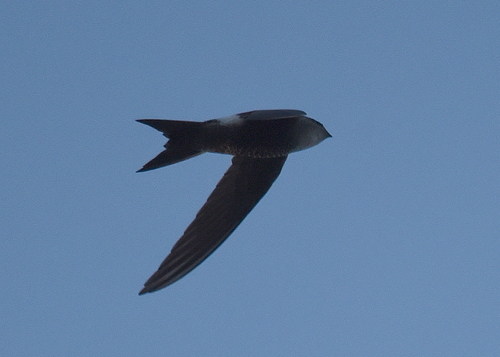
Pacific Swift (Apus pacificus) Pacific Swift
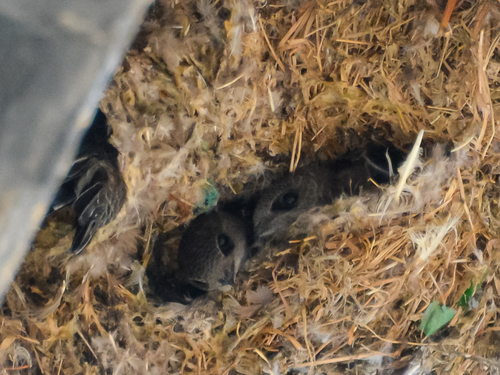
House Swift (Apus nipalensis) House Swift

Media

Loading…

In short

The most reliable way to separate Pacific Swift from House Swift is by size and structure: Pacific Swift is notably larger, with longer, more pointed wings and a deeper tail fork, while House Swift is smaller, compact, and has a shallower forked tail. Both species show a white rump band and dark plumage, but Pacific Swift’s white rump is broader and its underparts can appear scaly due to pale fringes, especially in juveniles. In flight, Pacific Swift looks long-winged and powerful, whereas House Swift is more compact and agile. If you see a swift with a broad white rump, deep tail fork, and long wings, it is almost certainly a Pacific Swift; a smaller bird with a narrow rump band and less pronounced tail fork is likely a House Swift.

Identification tips

  1. Size: Pacific Swift is much larger and heavier than House Swift. If you see two swifts together and one is clearly bulkier, it is likely the Pacific Swift. This is reliable for all ages and sexes.
  2. Wing Shape: Pacific Swift has longer, more pointed wings, giving it a stretched, scythe-like appearance in flight. House Swift’s wings are shorter and more rounded, contributing to a compact look. Works best in flight.
  3. Tail Fork: Pacific Swift’s tail is deeply forked, especially when spread; House Swift’s tail fork is noticeably shallower. This is a key mark in both perched and flying birds.
  4. White Rump Band: The white rump on Pacific Swift is broader (up to 20 mm in the nominate form), while House Swift’s is narrower. This is visible in good light and at close range, but beware of wear or molt.
  5. Underpart Pattern: Pacific Swift can show a scaly appearance on the belly from pale feather fringes, especially in juveniles. House Swift’s underparts are plain black except for the white throat patch. This mark is subtle and requires good views.
  6. Throat Patch: House Swift has a distinct white throat patch, which is less prominent or absent in Pacific Swift (except in some subspecies, where it may be larger but still not as clear as in House Swift).
  7. Head Shape: Pacific Swift has a more protruding head, giving it a heavier front end; House Swift’s head is less prominent, fitting its compact body.
  8. Flight Style: Pacific Swift flies with deep, steady wingbeats and long glides, often high above ground. House Swift is more agile, with rapid, fluttery wingbeats and quick turns, often lower and around buildings.
  9. Habitat Context: House Swift is often seen around human structures, while Pacific Swift is more likely over open country or in migration flocks.
  10. Plumage Wear: Juvenile Pacific Swifts may show more obvious pale fringes on the wings and body, but this is subtle and not always visible at a distance.
  11. Sex and Age: Both species are sexually monomorphic, and age differences are subtle. Focus on structure and rump band for all ages.
  12. Pitfalls: Beware of leucistic swifts or worn plumage, which can make rump bands appear broader or narrower. Always use multiple marks.
  13. Direct Comparison: If both species are present, the size and structure contrast is striking. If only one bird is present, rely on the combination of size, tail fork, and rump band width.
  14. Seasonal Overlap: In Southeast Asia, both species may occur together during migration. Good views are essential for confident identification.
  15. Not Diagnostic: Voice is not a reliable separator with current information.

Size

Pacific Swift is the largest of the Apus swifts, measuring 17–18 cm in length with a wingspan of 43–54 cm and weighing 42–45 g. In contrast, House Swift is much smaller at 14–16 cm long, with a wingspan of 12.5–14.5 cm and a weight of 20–35 g. This size difference is often obvious in direct comparison or with experience, especially in flight.

Plumage

Juvenile and adult Pacific Swifts both show a broad white rump band (15–20 mm wide, depending on subspecies), and the underparts can appear scaly due to pale feather fringes, especially in juveniles. Their tail is deeply forked, and the upperparts are black with a slightly greyer head. House Swift also shows a white rump band, but it is narrower and the tail fork is shallower. House Swift’s plumage is overall blacker, with a white throat patch and a dark, slightly forked tail. Both species have black upperwings and underwings, but Pacific Swift’s larger size and broader rump band are key. Juvenile Pacific Swifts may show more prominent pale fringes on the wings, but this is subtle and best seen at close range. There are no strong age-specific upperwing pattern differences noted for House Swift.

Behaviour

Pacific Swift is a powerful, long-distance migrant, often seen high in the sky with strong, direct flight and long glides. Its flight is purposeful, with deep, steady wingbeats and a long-winged, slightly heavy look. House Swift is more likely to be seen flying rapidly and erratically around buildings or cliffs, with quick, agile wingbeats and a compact, energetic jizz. House Swift often nests on human structures and is more tolerant of close proximity to people.

Habitat

Pacific Swift breeds in open country across eastern Asia and migrates long distances, wintering in Southeast Asia and Australia. It is most often seen in migration or over open landscapes. House Swift is more urban or suburban, frequently nesting on buildings and bridges in Japan, Nepal, and Southeast Asia. While ranges overlap in some areas, House Swift is more likely in built-up areas, while Pacific Swift is more associated with open skies and migration corridors.

Submit a better description

Use the same sections as the comparison. Your text is published immediately.

The most reliable way to separate Pacific Swift from House Swift is by size and structure: Pacific Swift is notably larger, with longer, more pointed wings and a deeper tail fork, while House Swift is smaller, compact, and has a shallower forked tail. Both species show a white rump band and dark plumage, but Pacific Swift’s white rump is broader and its underparts can appear scaly due to pale fringes, especially in juveniles. In flight, Pacific Swift looks long-winged and powerful, whereas House Swift is more compact and agile. If you see a swift with a broad white rump, deep tail fork, and long wings, it is almost certainly a Pacific Swift; a smaller bird with a narrow rump band and less pronounced tail fork is likely a House Swift.

  1. Size: Pacific Swift is much larger and heavier than House Swift. If you see two swifts together and one is clearly bulkier, it is likely the Pacific Swift. This is reliable for all ages and sexes.
  2. Wing Shape: Pacific Swift has longer, more pointed wings, giving it a stretched, scythe-like appearance in flight. House Swift’s wings are shorter and more rounded, contributing to a compact look. Works best in flight.
  3. Tail Fork: Pacific Swift’s tail is deeply forked, especially when spread; House Swift’s tail fork is noticeably shallower. This is a key mark in both perched and flying birds.
  4. White Rump Band: The white rump on Pacific Swift is broader (up to 20 mm in the nominate form), while House Swift’s is narrower. This is visible in good light and at close range, but beware of wear or molt.
  5. Underpart Pattern: Pacific Swift can show a scaly appearance on the belly from pale feather fringes, especially in juveniles. House Swift’s underparts are plain black except for the white throat patch. This mark is subtle and requires good views.
  6. Throat Patch: House Swift has a distinct white throat patch, which is less prominent or absent in Pacific Swift (except in some subspecies, where it may be larger but still not as clear as in House Swift).
  7. Head Shape: Pacific Swift has a more protruding head, giving it a heavier front end; House Swift’s head is less prominent, fitting its compact body.
  8. Flight Style: Pacific Swift flies with deep, steady wingbeats and long glides, often high above ground. House Swift is more agile, with rapid, fluttery wingbeats and quick turns, often lower and around buildings.
  9. Habitat Context: House Swift is often seen around human structures, while Pacific Swift is more likely over open country or in migration flocks.
  10. Plumage Wear: Juvenile Pacific Swifts may show more obvious pale fringes on the wings and body, but this is subtle and not always visible at a distance.
  11. Sex and Age: Both species are sexually monomorphic, and age differences are subtle. Focus on structure and rump band for all ages.
  12. Pitfalls: Beware of leucistic swifts or worn plumage, which can make rump bands appear broader or narrower. Always use multiple marks.
  13. Direct Comparison: If both species are present, the size and structure contrast is striking. If only one bird is present, rely on the combination of size, tail fork, and rump band width.
  14. Seasonal Overlap: In Southeast Asia, both species may occur together during migration. Good views are essential for confident identification.
  15. Not Diagnostic: Voice is not a reliable separator with current information.

Pacific Swift is the largest of the Apus swifts, measuring 17–18 cm in length with a wingspan of 43–54 cm and weighing 42–45 g. In contrast, House Swift is much smaller at 14–16 cm long, with a wingspan of 12.5–14.5 cm and a weight of 20–35 g. This size difference is often obvious in direct comparison or with experience, especially in flight.

Juvenile and adult Pacific Swifts both show a broad white rump band (15–20 mm wide, depending on subspecies), and the underparts can appear scaly due to pale feather fringes, especially in juveniles. Their tail is deeply forked, and the upperparts are black with a slightly greyer head. House Swift also shows a white rump band, but it is narrower and the tail fork is shallower. House Swift’s plumage is overall blacker, with a white throat patch and a dark, slightly forked tail. Both species have black upperwings and underwings, but Pacific Swift’s larger size and broader rump band are key. Juvenile Pacific Swifts may show more prominent pale fringes on the wings, but this is subtle and best seen at close range. There are no strong age-specific upperwing pattern differences noted for House Swift.

Pacific Swift is a powerful, long-distance migrant, often seen high in the sky with strong, direct flight and long glides. Its flight is purposeful, with deep, steady wingbeats and a long-winged, slightly heavy look. House Swift is more likely to be seen flying rapidly and erratically around buildings or cliffs, with quick, agile wingbeats and a compact, energetic jizz. House Swift often nests on human structures and is more tolerant of close proximity to people.

Pacific Swift breeds in open country across eastern Asia and migrates long distances, wintering in Southeast Asia and Australia. It is most often seen in migration or over open landscapes. House Swift is more urban or suburban, frequently nesting on buildings and bridges in Japan, Nepal, and Southeast Asia. While ranges overlap in some areas, House Swift is more likely in built-up areas, while Pacific Swift is more associated with open skies and migration corridors.

Discard your changes?

You have unsaved edits. If you leave now, those changes will be lost.

Pacific Swift · House Swift · My Tricky Birds