

Pacific Golden Plover vs Whimbrel
Pluvialis fulva versus Numenius phaeopus
Play a quiz with Pacific Golden Plover and Whimbrel
 Pacific Golden Plover
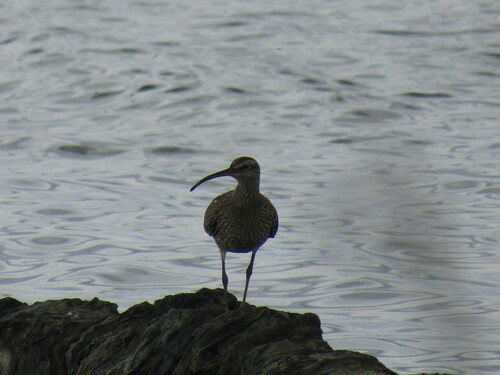 Whimbrel
In short
The most reliable way to separate Pacific Golden Plover from Whimbrel is by overall structure and bill shape: Whimbrels are much larger, with a long, downcurved bill, while Pacific Golden Plovers are compact with a short, straight bill. In flight, Whimbrels show a distinctive white rump (in Eurasian birds), while Pacific Golden Plovers lack this feature. Plumage differences are also strong: breeding Pacific Golden Plovers have striking gold and black spangling, while Whimbrels are plain brownish with a bold head pattern. Even in nonbreeding or juvenile plumage, the plover remains smaller and more compact than the lanky Whimbrel. Confusion is most likely with nonbreeding or juvenile birds, but size and bill shape remain diagnostic.
Identification tips
- Bill shape and length: Whimbrel has a long, downcurved bill with a kink; Pacific Golden Plover has a short, straight, black bill. This is the single most reliable field mark at any age or season.
- Size and structure: Whimbrel is much larger and bulkier, with a longer neck, legs, and wings. Plovers are compact, with shorter legs and a more upright stance.
- Flight pattern and rump: In flight, Eurasian Whimbrel shows a bright white rump and lower back, contrasting with the rest of the body. Pacific Golden Plover lacks any white rump or back—its upperparts are uniform or gold-spangled.
- Head pattern: Whimbrel has a bold, dark crown with a strong pale supercilium (eyebrow) and a dark eye-stripe, visible at all ages. Pacific Golden Plover lacks this strong head pattern; in breeding plumage, the face is black with a white border, and in nonbreeding/juvenile plumage, the face is mottled brown and gold without a strong supercilium.
- Breeding plumage: Male Pacific Golden Plover in breeding plumage is gold and black above, with a solid black face, neck, and breast bordered by white. Whimbrel is never gold-spangled or black below.
- Nonbreeding/juvenile plumage: Pacific Golden Plover is mottled brown and gold above with pale underparts, lacking the Whimbrel's bold head pattern and white rump. Juvenile plovers are especially gold-spangled on the back.
- Leg color: Pacific Golden Plover has gray to black legs; Whimbrel's legs are duller and not as distinctly dark.
- Posture and behavior: Plovers stand upright and run in short bursts, often pausing to scan. Whimbrels walk with a more horizontal posture and probe with their long bills.
- Habitat: Plovers are often found in dry, grassy, or even urban areas; Whimbrels prefer wetlands, mudflats, and coastal zones.
- Voice: Whimbrel's rippling whistle is distinctive and not matched by the plover.
- Group size: Whimbrels are often in larger flocks, especially on migration; plovers are more solitary or in small groups.
- Sex differences: Only male Pacific Golden Plover in breeding plumage has a solid black face and breast; females are mottled, and both sexes are similar in nonbreeding plumage.
- Juvenile confusion: If you see a gold-spangled back and compact shape, it's a juvenile plover; if the bird is large, plain brown, with a white rump in flight, it's a Whimbrel.
- Seasonal timing: Pacific Golden Plovers molt into breeding plumage in March-April and into nonbreeding plumage during Arctic incubation; Whimbrel's plumage is less dramatically seasonal.
- Pitfalls: In dull light or at distance, a nonbreeding plover may look plain, but will always be smaller and lack the Whimbrel's long, curved bill and white rump.
Size
Whimbrel is significantly larger than Pacific Golden Plover. Whimbrel measures 37–47 cm in length with a 75–90 cm wingspan and weighs 270–493 g, while Pacific Golden Plover is about 25 cm long with a 61 cm wingspan and weighs around 135 g at its lightest [wikidata][wikipedia]. In the field, Whimbrel will look almost twice as large as the plover, with much longer legs and a proportionally longer neck and bill.
Plumage
For all ages, the most obvious difference is the Whimbrel's plain, streaked brown plumage with a bold head pattern (dark crown with pale supercilium) and, in flight, a conspicuous white rump (Eurasian birds) [wikipedia]. Pacific Golden Plovers, in breeding plumage, are gold-spangled above with a striking black face, neck, and breast bordered by white, and a dark rump. Females are similar but with less distinct black on the underparts. In nonbreeding and juvenile plumage, plovers are mottled brown and gold above with pale underparts, lacking the strong head pattern of Whimbrel. Juvenile plovers are spangled gold and black on the back and head, while Whimbrel juveniles resemble adults but may be slightly paler. In flight, Pacific Golden Plover lacks any white rump or back, while Whimbrel (Eurasian) shows a white rump and lower back that is obvious when the bird takes off or flies overhead. Bill color is always black in plover, while Whimbrel's bill is dark and much longer.
Behaviour
Pacific Golden Plovers are typically seen singly or in small groups, often standing upright and running in short bursts, pausing to feed. They are more likely to be found in open, grassy areas or short turf, and may be quite tame in some regions. Whimbrels are usually seen in larger flocks, especially on migration, and are more likely to be probing mud or sand with their long bills. Their foraging is more methodical, and they often walk with a horizontal posture. In flight, Whimbrel appears long-winged and heavy, while the plover is compact and swift.
Habitat
Pacific Golden Plovers prefer open spaces with short vegetation, including tundra, grasslands, golf courses, and even urban lawns, especially outside the breeding season [wikipedia]. Whimbrels are more closely tied to wetlands, mudflats, and coastal areas, though they can also be found in tundra during breeding. If you see a bird in a dry, grassy park or inland field, it's more likely a plover; on mudflats or saltmarshes, expect Whimbrel.
Voice
Whimbrel gives a distinctive rippling whistle, often prolonged into a trill, which is very different from the plover's calls. Pacific Golden Plover's voice is not described in the provided notes, but it is not similar to the Whimbrel's loud, rippling song.