

Pacific Emerald Dove vs Bronze Ground Dove
Chalcophaps longirostris versus Pampusana beccarii
Play a quiz with Pacific Emerald Dove and Bronze Ground Dove
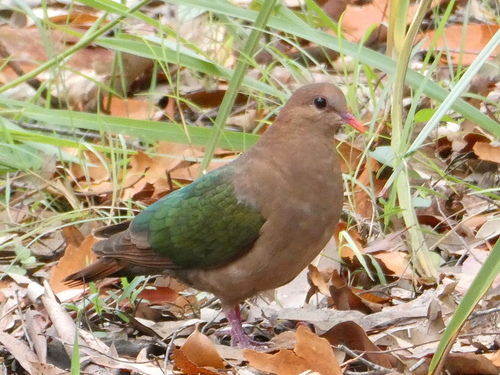 Pacific Emerald Dove
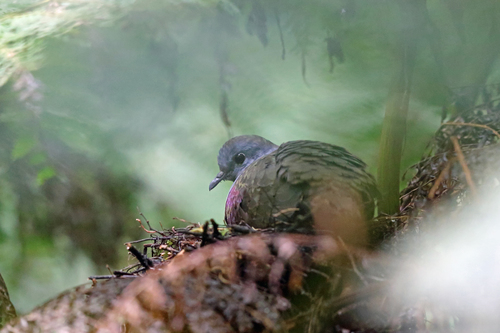 Bronze Ground Dove
In short
The most reliable field mark to separate Pacific Emerald Dove from Bronze Ground Dove is the combination of bright emerald-green upperparts and broad black-and-white bars on the lower back, visible in flight on Pacific Emerald Dove, versus the lack of such vivid green and barring in Bronze Ground Dove. Immature Pacific Emerald Doves show brown scalloping on the wing and body, a feature not described for Bronze Ground Dove. Pacific Emerald Dove is larger, more terrestrial, and often seen walking on the ground in open areas of dense forest, while Bronze Ground Dove is typically smaller and less conspicuous. If you see a stocky, medium-sized pigeon with a bright red bill, emerald wings, and a tendency to walk rather than flush, it is likely Pacific Emerald Dove.
Identification tips
- Immature Pacific Emerald Dove shows brown scalloping on body and wing coverts—if you see this, especially on a green-winged bird, it's not Bronze Ground Dove.
- In flight, look for broad black-and-white bars on the lower back of Pacific Emerald Dove; Bronze Ground Dove lacks these.
- Bright emerald-green upperparts and wings are diagnostic for Pacific Emerald Dove in all plumages except the youngest juveniles; Bronze Ground Dove is never this green.
- Adult male Pacific Emerald Dove has a grey crown and a white shoulder patch; neither feature is present on Bronze Ground Dove.
- Females and immatures of Pacific Emerald Dove are browner but still show green on the wings; Bronze Ground Dove will lack both the green and the shoulder marks.
- Pacific Emerald Dove has a bright red bill and rufous legs/feet—useful at close range or with good light.
- Pacific Emerald Dove is bulkier and longer (23–28 cm) than Bronze Ground Dove; size can be judged if both species are seen together or with experience.
- Pacific Emerald Dove often walks on the ground in the open or at forest edges, while Bronze Ground Dove is more secretive and less likely to be seen walking in open areas.
- Pacific Emerald Dove's flight is fast, direct, and low, with buff underwings and chestnut flight feathers; Bronze Ground Dove's flight is not described but lacks the green and barring.
- If you hear a low, rising cooing sequence or nasal 'hoo-hoo-hoon,' it's Pacific Emerald Dove; Bronze Ground Dove's call is not described here.
- Pacific Emerald Dove is generally tame and approachable; if a ground-dwelling pigeon allows close approach, it's more likely this species.
- Check the context: Pacific Emerald Dove uses a wide range of habitats, including gardens and mangroves; Bronze Ground Dove is more likely in dense, undisturbed forest.
- Tail and flight feathers of Pacific Emerald Dove are blackish; look for contrast with the green back in perched birds.
- Pacific Emerald Dove males perform a bobbing dance during courtship—if you see this behavior, it's diagnostic.
- If uncertain, focus on the combination of green upperparts, red bill, and terrestrial habits for Pacific Emerald Dove; absence of these features should prompt caution and further scrutiny.
Size
Pacific Emerald Dove is a stocky, medium-sized pigeon, typically 23–28 cm in length [wikipedia]. Bronze Ground Dove is smaller, but exact measurements are not provided in the available notes. In the field, Pacific Emerald Dove will appear noticeably bulkier and longer than Bronze Ground Dove, with a more robust build and proportionally longer tail.
Plumage
- Immature/juvenile birds: Pacific Emerald Dove immatures resemble females but show distinctive brown scalloping on the body and wing coverts, a feature not described for Bronze Ground Dove. This scalloping is a strong clue for Pacific Emerald Dove in young birds.
- Adult males: Pacific Emerald Dove males have a bright emerald-green back and wings, a grey crown, and a white patch on the shoulder. Bronze Ground Dove lacks these vivid green upperparts and the white shoulder patch.
- Adult females: Female Pacific Emerald Doves are browner than males, with a grey mark on the shoulder, but still show green on the wings. Bronze Ground Dove females are not described in detail, but absence of green and shoulder markings is expected.
- Flight: In flight, Pacific Emerald Dove shows a buff underwing, chestnut flight feathers, blackish tail, and broad black-and-white bars on the lower back—these are not present in Bronze Ground Dove. The overall impression of green and strong barring is unique to Pacific Emerald Dove.
- Bill and legs: Pacific Emerald Dove has a bright red bill and rufous legs and feet, which are not described for Bronze Ground Dove but are distinctive in the field.
Behaviour
Pacific Emerald Dove is quite terrestrial, often walking on the ground in search of fallen fruit, and is generally tame and approachable. It prefers to walk away rather than fly when disturbed, and when it does fly, it weaves skillfully through dense forest. Bronze Ground Dove's behavior is not detailed in the available notes, but it is generally less conspicuous and less likely to be seen walking in the open. If you see a pigeon walking confidently on the forest floor, especially in more open areas, Pacific Emerald Dove is more likely.
Habitat
Pacific Emerald Dove inhabits rainforest, dense wet woodlands, farms, gardens, mangroves, and coastal heaths, often in areas with patches of dense cover but also in more open, disturbed habitats. Bronze Ground Dove's habitat is not described in the notes, but it is generally more restricted to dense forest and less likely to be found in open or edge habitats compared to Pacific Emerald Dove.
Voice
Pacific Emerald Dove gives a low, soft, moaning coo of about six to seven notes, starting quietly and rising, as well as a nasal 'hoo-hoo-hoon.' Bronze Ground Dove's vocalizations are not described in the available notes, so voice is only diagnostic if you hear the distinctive cooing of Pacific Emerald Dove.