

Oriental Pratincole vs Collared Pratincole
Glareola maldivarum versus Glareola pratincola
Play a quiz with Oriental Pratincole and Collared Pratincole
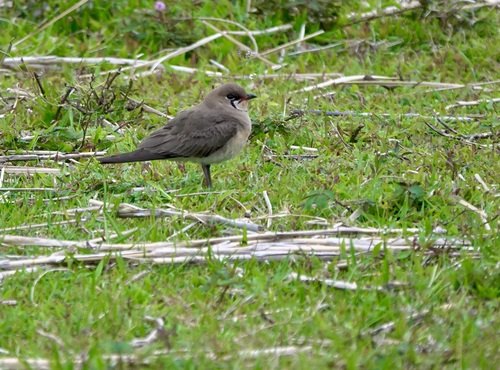 Oriental Pratincole
 Collared Pratincole
In short
Oriental Pratincole and Collared Pratincole are extremely similar in the field, especially in flight, and both require excellent views for confident separation. The most consistent difference is structural: Collared Pratincole has a noticeably longer and more deeply forked tail compared to the slightly shorter tail of Oriental Pratincole. Both species show chestnut underwings that often look dark in the field, and their upperparts and flight feathers are very similar. Subtle differences in tail length and shape, especially when perched or in flight, are your best bet for separation; plumage differences are minimal and unreliable at a distance. Juvenile and immature plumages are not described as distinct between these two in the available notes, so focus on structure and tail shape for all ages.
Identification tips
- Tail length and shape: Collared Pratincole has a noticeably longer and more deeply forked tail than Oriental Pratincole. This is the most reliable structural difference and can be seen both in flight and when perched, though it requires a clear view. This mark applies to all ages and seasons.
- Underwing color: Both species show chestnut underwings, but this is not a useful separation mark as both can appear dark or blackish in typical field views. Do not rely on underwing color alone.
- Flight feathers: Both have dark (black or dark brown) flight feathers. No consistent difference is described between the two in this feature.
- Upperpart and head color: Both species have brown backs and heads; this is not a useful separation point.
- Belly color: Both have white bellies, so this is not diagnostic.
- Bill shape: Both have short bills adapted for aerial feeding; no difference is noted between the two.
- Leg length: Both have short legs; this is not a separation mark.
- Overall size: Both are essentially the same size by mass and apparent bulk; do not use size as a field mark.
- Jizz in flight: Both species have long, pointed wings and agile, swallow-like flight. The slightly longer tail of Collared Pratincole may give a subtly different impression in direct comparison, but this is subtle and easily missed.
- Juvenile/immature plumage: No distinctive juvenile or immature upperwing or body plumage differences are described between these two species. Treat all ages as structurally similar.
- Perched birds: When perched, look for the length and depth of the tail fork; Collared Pratincole's tail should project noticeably beyond the wingtips, while Oriental Pratincole's is shorter.
- In mixed flocks: If both species are present, direct comparison of tail length is the best field approach. Single birds are extremely challenging to separate without excellent views.
- Lighting conditions: Underwing color is only useful in ideal light; in most cases, both species' underwings look dark or blackish.
- Voice: No vocal differences are described in the sources, so do not use voice for separation.
- Habitat and behavior: Both species share similar habitats and feeding behaviors; these are not useful for field separation.
Size
Both species are essentially identical in size, with Oriental Pratincole averaging 76 g and Collared Pratincole 77 g in body mass. Collared Pratincole is described as 24–28 cm in length with a 60–70 cm wingspan, but no length is given for Oriental Pratincole; in practice, size is not a reliable field mark between these two. Any perceived difference is likely due to posture or tail length rather than actual body size.
Plumage
Both species have brown upperparts, white bellies, and chestnut underwings that appear dark in most field conditions. The flight feathers are dark (described as black or darker brown), and both have short legs and long, pointed wings. No age-specific upperwing or juvenile pattern differences are noted between these two species in the sources. The main difference is that Collared Pratincole has a longer, more deeply forked tail, while Oriental Pratincole's tail is shorter. Both species require very good views to separate, especially in flight, as the underwing color is shared and can look nearly identical unless seen in perfect light. No mention is made of seasonal or sex-based plumage differences that would help in the field.
Behaviour
Both species behave similarly, hunting insects on the wing like swallows, and sometimes feeding on the ground. Their flight is agile and swallow-like, and both are typically seen in open country, often near water, especially in the evening. There are no behavioral differences described that would reliably separate these two species in the field.
Habitat
Habitat preferences are essentially identical: both are birds of open country, often near water, and are most active in the evening when hawking for insects. Habitat is not a useful separation point between these two species.