

Oriental Plover vs Tibetan Sand Plover
Anarhynchus veredus versus Anarhynchus atrifrons
Play a quiz with Oriental Plover and Tibetan Sand Plover
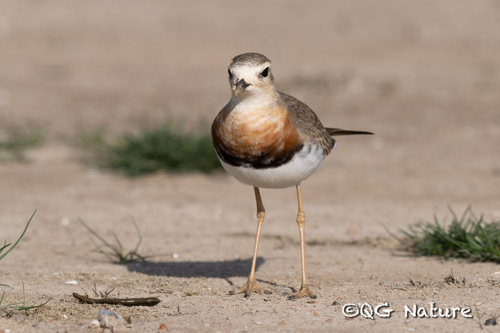 Oriental Plover
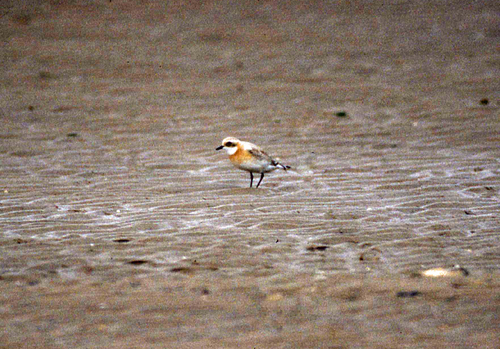 Tibetan Sand Plover
In short
The most reliable field mark between Oriental Plover and Tibetan Sand Plover is the Oriental Plover’s distinctive, broad chestnut breast band in adult breeding males, which is never shown by Tibetan Sand Plover. For non-breeding and immature birds, Oriental Plover is larger, longer-legged, and longer-winged, with a generally paler face and a white streak above the eye, while Tibetan Sand Plover is smaller and shows a black mask and orange chest in breeding plumage. Juvenile and non-breeding birds of both species can be confusing, but Oriental Plover tends to look lankier and paler overall. In flight or at a distance, structure and size are often more helpful than plumage. Habitat overlap is possible on migration, but Oriental Plover winters further southeast.
Identification tips
- Size and structure: Oriental Plover is larger, longer-legged, and longer-winged than Tibetan Sand Plover. Use this especially when birds are side by side or in mixed flocks.
- Posture: Oriental Plover often stands more upright and appears lankier, while Tibetan Sand Plover is more compact and horizontal.
- Adult breeding male plumage: Oriental Plover males show a broad, rich chestnut breast band bordered above by a narrow black band and a white face/throat—this combination is unique and diagnostic. Tibetan Sand Plover never shows this pattern.
- Breeding plumage face pattern: Tibetan Sand Plover in breeding plumage has a distinctive black mask and a light orange chest and neck. Oriental Plover lacks the black mask and has a much richer, chestnut breast band instead.
- Non-breeding and juvenile plumage: Both species are drab, but Oriental Plover typically shows a paler face with a white supercilium (streak above the eye), while Tibetan Sand Plover is more evenly brown above and less contrasty in the face.
- Facial markings: Look for the white streak above the eye in Oriental Plover (all ages except adult breeding males, where the face is mostly white). Tibetan Sand Plover may have some white on the forehead but lacks the strong supercilium.
- Underpart color: In breeding season, Oriental Plover's chestnut breast band is much broader and richer than the pale orange of Tibetan Sand Plover. Out of breeding, both are mostly white below, but Oriental Plover may look cleaner and brighter.
- Wing and tail projection: Oriental Plover has longer wings and legs, which can be seen when the bird is standing or in flight. Tibetan Sand Plover is more compact.
- Bill: No strong differences are noted in the available sources, but Oriental Plover may appear to have a proportionally finer bill due to its larger size.
- Habitat and range: In Australia and Indonesia, Oriental Plover is expected; in Africa, only Tibetan Sand Plover occurs. In South and Southeast Asia, check all other marks carefully as both may be present.
- Sex differences: In Tibetan Sand Plover, males are paler than females in breeding plumage. Oriental Plover females and non-breeding males are similar and less distinctive than breeding males.
- Pitfalls: Non-breeding and juvenile birds of both species can be very similar, especially at a distance. Rely on structure and facial pattern if the breast band or mask is not visible.
- Flight views: No distinctive upperwing or flight pattern differences are described for these species in the available notes. Use size, structure, and underpart pattern if visible.
- Mixed flocks: If both species are present, Oriental Plover will stand out as the larger, paler, longer-legged bird.
- Seasonal context: Breeding plumage is shown in the northern summer; outside this period, both species are duller, so structural and facial clues become more important.
Size
Oriental Plover is notably larger (21–25 cm length, 46–53 cm wingspan, 95 g) than Tibetan Sand Plover, which is described as medium-sized but is smaller and more compact overall [wikipedia]. Oriental Plover also looks longer-legged and longer-winged, giving it a more stretched, upright profile. When seen together, Oriental Plover stands out as the bigger, lankier bird.
Plumage
- Juvenile and non-breeding plumage: Both species show grey-brown upperparts and white underparts, but Oriental Plover juveniles and non-breeding birds often have a paler face with a white supercilium (streak above the eye), while Tibetan Sand Plover is more uniformly brown above with less facial contrast and more variable white on the forehead and back. No distinctive upperwing or flight pattern differences are described for immatures in the available notes.
- Adult breeding plumage: Male Oriental Plover is unmistakable with its white face, throat, and fore-crown, sharply bordered by a narrow black band and a broad, rich chestnut breast band. Female and non-breeding Oriental Plovers are more subdued but still show a pale face and white streak above the eye. Tibetan Sand Plover in breeding plumage has a black mask and a light orange chest and neck, but the orange is paler than the Oriental Plover's chestnut, and the mask is a unique feature not shown by Oriental Plover. Females are on average paler than males in Tibetan Sand Plover.
Behaviour
No strong behavioral differences are described in the available notes. Both species are typical plovers, foraging on open ground. Oriental Plover may appear more upright and stately due to its longer legs and neck, especially when alert. Tibetan Sand Plover is more compact and may seem more active or crouched.
Habitat
Both species breed in Central Asian steppe or plateau regions, but their non-breeding ranges differ. Oriental Plover winters in Indonesia, New Guinea, and northern Australia, while Tibetan Sand Plover winters across east and south Africa, south, east, and southeast Asia. Overlap is possible in south and southeast Asia during migration, but Oriental Plover is more likely in Australia and Indonesia, and Tibetan Sand Plover is more widespread in Africa and southern Asia.