

Orange-bellied Manakin vs White-fronted Manakin
Lepidothrix suavissima versus Lepidothrix serena
Play a quiz with Orange-bellied Manakin and White-fronted Manakin
 Orange-bellied Manakin
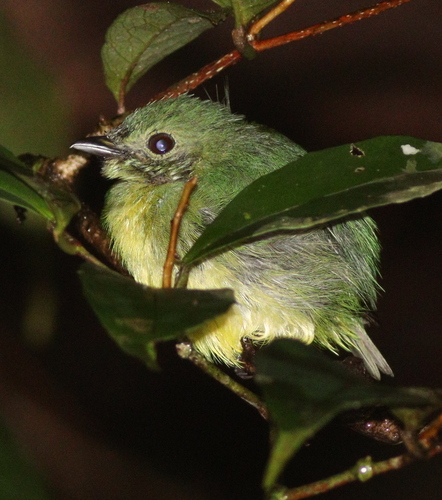 White-fronted Manakin
In short
The most reliable field mark between Orange-bellied Manakin and White-fronted Manakin is the extent and shape of the white on the male's forehead: Orange-bellied has a white forecrown (not extending forward), while White-fronted shows a bold white patch that projects forward over the bill. Both species show a black body, blue rump, and yellow belly in adult males, but the belly color is distinctly orange in Orange-bellied and bright sulphur-yellow in White-fronted. Females are trickier: Orange-bellied females are green above with a bluish forehead, while White-fronted females are grayish-black above with a white eye-ring and yellow belly. Range and habitat can help, but overlap in Guyana means field marks are essential. Immature and female birds are often confused, so pay close attention to face color and belly tone.
Identification tips
- White forehead patch shape (adult males): On perched or close views, White-fronted Manakin has a bold white patch that projects forward over the bill, while Orange-bellied shows a white forecrown that does not extend forward. This is the single most reliable male field mark.
- Belly color (adult males): Orange-bellied has a rich yellow-orange belly, while White-fronted's belly patches are a bright sulphur-yellow and more limited to the breast sides, not a full belly wash.
- Rump color (adult males): Both have blue rumps, but Orange-bellied's is described as bright azure-blue and more extensive (lower rump and uppertail coverts), while White-fronted's is a narrow light blue patch on the lower back-upper rump.
- Female upperparts: Orange-bellied females are green above with a bluish forehead, while White-fronted females are grayish-black above with no green tones.
- Female face: Orange-bellied females have a bluish forehead and grayish face/throat; White-fronted females have a white eye-ring and lack the bluish tones.
- Female belly color: Both have yellow bellies, but Orange-bellied's is a more even yellow, while White-fronted's is described as sulphur-yellow and may be more patchy.
- Eye-ring (females): Only White-fronted females show a distinct white eye-ring; Orange-bellied females do not.
- Bill and leg color: Both species have black bills and dark legs, not useful for separation.
- Juvenile/immature plumage: No described differences in upperwing or flight pattern for immatures; separation relies on face and belly color.
- Perched vs. flight views: Most field marks require perched or close views; in flight, separation is very difficult unless the forehead or belly is visible.
- Range and habitat: In tepui or upland forests of southern Venezuela and adjacent Brazil/Guyana, Orange-bellied is more likely. In lowland humid forests of the Guianas and northeast Brazil, White-fronted is expected. In overlap zones, rely on plumage.
- Sexual dimorphism: Both species are strongly dimorphic; always check for female vs. male features before using color marks.
- Confusion risk: Females and immatures are the main pitfall—look for green upperparts and bluish forehead (Orange-bellied) vs. gray-black and white eye-ring (White-fronted).
- Do not use size or structure: Both are tiny, round-bodied manakins with very similar proportions; size is not a safe separator.
- Voice: No distinctive vocal differences are described in the sources; do not rely on calls for separation.
Size
Both species are very similar in size, with Orange-bellied Manakin males measured at about 9 cm in length and 8.5 g in weight [wikipedia]. No direct size difference is noted in the sources, and both are among the smallest manakins. Structure, bill, and leg color are also very similar and not useful for separation.
Plumage
- Adult males: Both are mostly black with a blue rump and yellowish belly, but Orange-bellied Manakin has a white forecrown (not extending forward), a bright azure-blue lower rump/uppertail, and a yellow-orange belly. White-fronted Manakin has a white forehead patch that extends forward beyond the bill, a light blue narrow rump patch, and bright sulphur-yellow breast patches (not a full belly wash). The rest of the body is deep black in both.
- Adult females: Orange-bellied females are green above with a bluish forehead, grayish face/throat, and yellow belly/undertail. White-fronted females are grayish and black above, with a white eye-ring and sulphur-yellow belly. The green upperparts and bluish forehead of Orange-bellied are distinctive compared to the gray-black and white eye-ring of White-fronted.
- Immature/juvenile birds: No specific wing or flight pattern differences are described for juveniles or immatures in either species in the available sources. Both sexes and ages have dark eyes and dark legs.
- In flight: No unique upperwing or flight pattern differences are described between the two in the sources.
Behaviour
Both species are typical manakins, often seen perched quietly or making short, direct flights in the lower to mid-levels of humid forest. No behavioral differences are noted in the sources that would help separate them in the field.
Habitat
Habitat can be a clue, but is not always diagnostic. Orange-bellied Manakin is found in Brazil, Guyana, and Venezuela, mainly in the tepui region (table-top mountains and adjacent forests). White-fronted Manakin is more widespread in the Guianas (French Guiana, Suriname, Guyana) and northeastern Brazil, especially in lowland humid forests. Where their ranges overlap in Guyana, habitat alone is not enough for separation, but Orange-bellied is more likely in tepui or upland forest, while White-fronted prefers lowland forest.
Orange-bellied Manakin · White-fronted Manakin · My Tricky Birds