

Olive-backed Pipit vs Rock Pipit
Anthus hodgsoni versus Anthus petrosus
Play a quiz with Olive-backed Pipit and Rock Pipit
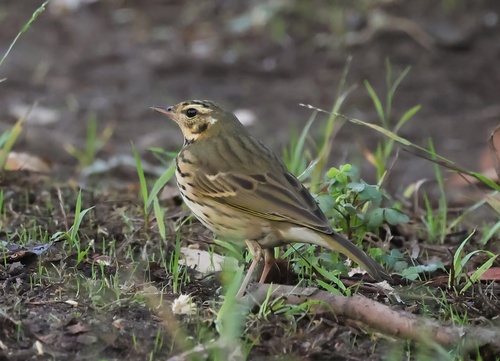 Olive-backed Pipit
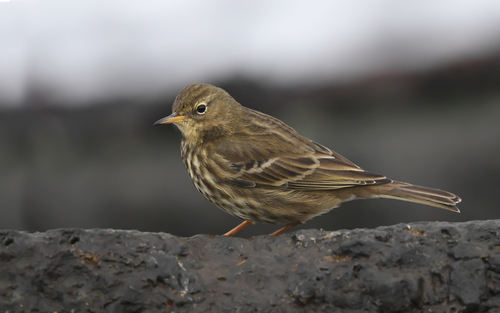 Rock Pipit
In short
The most reliable field mark to separate Olive-backed Pipit from Rock Pipit is the strong, pale supercilium (eyebrow) and the olive-toned, less streaked back of Olive-backed Pipit, compared to the Rock Pipit's duller, greyish-brown upperparts and poorly defined streaking. Juvenile and adult Rock Pipits lack the crisp facial pattern and wingbars of Olive-backed Pipit, and their outer tail feathers are dusky rather than white. In flight or perched, Olive-backed Pipit shows a neater, more contrasting appearance with clear wingbars and a whiter outer tail, while Rock Pipit appears larger, duskier, and more uniformly streaked below. Habitat is also a strong clue: Olive-backed Pipit is found in wooded or open country, while Rock Pipit is strictly coastal.
Identification tips
- Supercilium (eyebrow): Olive-backed Pipit of all ages shows a strong, pale supercilium that stands out, especially in fresh plumage. Rock Pipit has at most a faint pale eye-ring and, in some subspecies in summer, a weak supercilium, but never as bold or long as Olive-backed.
- Wingbars: Olive-backed Pipit displays two clear, whitish wingbars on the coverts, visible both perched and in flight. Rock Pipit lacks wingbars at all ages and seasons.
- Back color and streaking: Olive-backed Pipit has a more olive-toned back with less streaking, giving a cleaner look. Rock Pipit is greyer or smoky-olive, with heavier, less defined streaks.
- Outer tail feathers: Olive-backed Pipit shows white outer tail feathers (rectrices), especially obvious in flight. Rock Pipit's outer tail feathers are dusky, never white, a key mark in flight or when tail is spread.
- Underparts streaking: Olive-backed Pipit has neat, dark streaks on a whitish or buff background, mainly on the breast and flanks. Rock Pipit is buff below with heavy, blurry brown streaks that can cover much of the underparts.
- Facial pattern: Olive-backed Pipit has a crisp, contrasting face with a strong supercilium; Rock Pipit has a plain face with a pale eye-ring at best.
- Size and structure: Rock Pipit is larger, bulkier, and longer-winged, but this is subtle unless birds are side by side. Olive-backed Pipit is more delicate and compact.
- Leg color: Not diagnostic between these two (Rock Pipit has dark legs, but so can Olive-backed Pipit).
- Flight style: Olive-backed Pipit has a jerky, undulating flight and often flies up into trees. Rock Pipit is more likely to fly low along the coast, sometimes with a parachuting display.
- Habitat: Olive-backed Pipit is found in open or wooded areas, often away from water or coast. Rock Pipit is confined to rocky shorelines and never found inland or in trees.
- Vocalizations: Olive-backed Pipit's call is a sharp 'tseep' or 'spek,' while Rock Pipit's is a shrill 'pseep.' Songs are different but can be hard to separate without experience.
- Seasonal confusion: In summer, Rock Pipit subspecies littoralis may show a faint supercilium and pinkish underparts, but still lacks the crispness and wingbars of Olive-backed Pipit.
- Juvenile confusion: Juvenile Rock Pipits are browner and more streaked above, but still lack the neat supercilium and wingbars of Olive-backed Pipit juveniles.
- Context: If you see a pipit in a tree or away from the coast, it is almost certainly Olive-backed. If it is on a rocky shore, check for the lack of wingbars and white in the tail to confirm Rock Pipit.
- Pitfalls: Both species can look similar in poor light or at a distance, especially in dull winter plumage. Focus on the combination of supercilium, wingbars, and tail pattern for the best chance of correct identification.
Size
Olive-backed Pipit is slightly smaller and lighter, with a body mass around 22 g [wikidata], while Rock Pipit is larger and heavier (18–32.5 g [wikipedia]), and also longer (16.5–17 cm vs. about 15 cm for Olive-backed Pipit). Rock Pipit appears bulkier and longer-winged, especially when seen side by side. However, size alone can be misleading without direct comparison.
Plumage
- Juvenile/first-winter birds: Olive-backed Pipit juveniles and immatures already show a strong pale supercilium, double whitish wingbars, and white outer tail feathers, giving a crisp, contrasting look. Their backs are olive-toned and less streaked. Rock Pipit juveniles resemble adults but may be browner and more streaked above, yet still lack the sharp supercilium and wingbars; their outer tail feathers are dusky, not white.
- Adults: Olive-backed Pipit adults are greenish-brown above with dark streaks, but the back is more olive and less streaked than Rock Pipit. Underparts are whitish to buff with clear dark streaks on the breast and flanks. Rock Pipit adults are smoky-olive to grey-brown above, with heavy but poorly defined brown streaks on buff underparts. Their face pattern is plain except for a pale eye-ring, and they lack wingbars. The outer tail feathers remain dusky, not white.
- Seasonal variation: Rock Pipit subspecies A. p. littoralis may show a pale supercilium and pinkish underparts in summer, but never as crisp as Olive-backed Pipit. In winter, Rock Pipit is duller and even more difficult to separate from related pipits, but still lacks the Olive-backed's neat facial and wing pattern.
Behaviour
Olive-backed Pipit is typically seen singly or in pairs, running on the ground in open or wooded areas and flying up into trees when disturbed. Its flight is jerky and undulating. Rock Pipit is highly territorial on rocky coasts, often seen foraging along the shoreline or perched on rocks. During display, males perform a fluttering parachute flight. Rock Pipit is more likely to be seen in small groups or pairs along the coast, rarely far from the sea.
Habitat
Habitat is a strong separator: Olive-backed Pipit breeds and migrates through a wide range of open and wooded habitats, including forests and grasslands, and is rarely found on rocky coasts. Rock Pipit is strictly coastal, breeding and wintering on rocky shorelines in western Europe. If you see a pipit inland or in trees, it is almost certainly not a Rock Pipit; if it is on a rocky seashore, Rock Pipit is far more likely.
Voice
Olive-backed Pipit's song is lark-like, faster and higher-pitched than Tree Pipit, and its call is a single 'tseep' or 'spek.' Rock Pipit's song is a sequence of tinkling 'cheepa' notes followed by rising 'gee' calls and a short trill; its flight call is a shrill 'pseep,' intermediate between Meadow and Water Pipit. Both can sound similar to other pipits, but Olive-backed's call is typically sharper and more piercing, while Rock Pipit's is more subdued.