

Northern Shoveler vs Black Drongo
Spatula clypeata versus Dicrurus macrocercus
Play a quiz with Northern Shoveler and Black Drongo
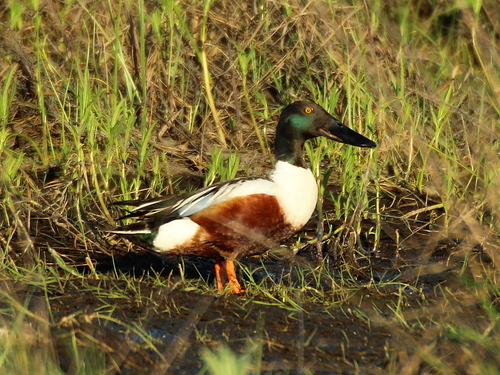 Northern Shoveler
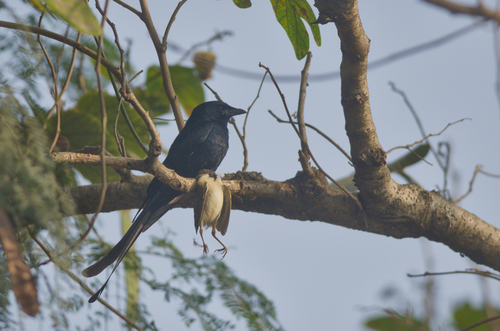 Black Drongo
In short
The most reliable way to separate Northern Shoveler from Black Drongo is by structure: the shoveler’s huge, spatulate bill is unique among ducks and utterly unlike the drongo’s slender, pointed bill. In flight or perched, shovelers show broad, rounded bodies with orange legs and, in all plumages, a large, flat bill; drongos are slim, upright, and have a deeply forked tail. Female and eclipse-plumaged shovelers can look drab and brown, but never have the all-black, glossy appearance or forked tail of a drongo. Juvenile drongos are brownish with some white barring, but still show the characteristic drongo shape and tail. Even at a distance, the combination of bill shape, tail, and overall jizz should prevent confusion.
Identification tips
- Bill shape is diagnostic: Northern Shoveler always has a huge, broad, spatulate bill, even in juveniles and females. Black Drongo has a slender, pointed bill typical of a passerine. If you see a wide, flat bill, it is never a drongo.
- Tail shape: Black Drongo has a long, deeply forked tail in all plumages. Northern Shoveler has a short, rounded tail typical of ducks. Forked tail = drongo.
- Body structure and jizz: Shoveler is a broad, heavy-bodied duck with orange legs and a low, horizontal posture. Drongo is slim, upright, and perches high on wires or branches, often sallying after insects.
- Plumage in flight: All shovelers (including females and eclipse males) show a pale blue forewing panel and green speculum with a white border in flight. Drongos are uniformly dark with no wing panels or speculum.
- Leg color and position: Shoveler legs are bright orange-red and set far back on the body for swimming. Drongo legs are short, dark, and adapted for perching.
- Perching behavior: Drongos perch upright on wires, branches, or livestock; shovelers almost never perch above ground and are usually seen on water or mud.
- Juvenile confusion: Juvenile drongos are brownish with white barring, but still slim and fork-tailed. Juvenile/female shovelers are mottled brown, but always with a broad bill and duck-like shape.
- Adult male shoveler: In breeding plumage, look for iridescent green head, white breast, chestnut flanks, and black bill—never matched by drongo.
- Adult drongo: Glossy black all over, with a small white spot at the gape, and never any brown mottling or blue/green wing panels.
- Habitat context: If the bird is on open water or dabbling in a wetland, it is almost certainly a shoveler. If it is perching in a field or on a wire, it is likely a drongo.
- Flight style: Shovelers have steady, direct duck flight; drongos are agile, with rapid, acrobatic maneuvers.
- Vocalizations: Complex, sharp, or mimicking calls point to drongo; shovelers are much quieter.
- Relative size: Shoveler is much larger and bulkier than drongo. If you see both together, the duck will dwarf the drongo.
- Seasonal confusion: Eclipse male shovelers resemble females but retain the blue forewing—never seen in drongo.
- Pitfalls: Do not rely on overall color alone; structure and bill shape are always more reliable than plumage, especially in poor light or at a distance.
Size
Northern Shoveler is a medium-sized duck, measuring 44–52 cm in length with a wingspan of 70–84 cm and weighing 500–800 g [wikipedia][avonet]. In contrast, Black Drongo is a much smaller passerine, about 28 cm long and much lighter (no weight given, but passerines of this size are typically well under 100 g) [wikipedia]. The shoveler is bulkier, with a broad body and relatively short neck, while the drongo is slender, upright, and long-tailed. Even a female shoveler dwarfs a drongo in direct comparison.
Plumage
-
Juvenile/Immature: Juvenile Black Drongos are brownish with white barring or speckling on the belly and vent, and first-years have white-tipped belly feathers; second-years restrict white to the vent. They are never mottled brown overall, and always retain the slim, forked-tailed drongo shape. Juvenile and female Northern Shovelers are mottled brown, resembling female mallards but with a distinctive long, broad, spatulate bill and orange-tinged legs. The female's forewing is grey, and in flight, both sexes show pale blue forewing panels with a green speculum bordered by white (retained even in eclipse males).
-
Adult Male: Breeding male shoveler is unmistakable: iridescent dark green head, white breast, chestnut flanks, and a huge black bill. In eclipse, males resemble females but keep the blue forewing. Black Drongo adults are glossy black all over, with a small white spot at the base of the gape, and a deeply forked tail. No blue or green speculum, no chestnut, and no pale wing panels.
-
In Flight: Shovelers (all ages) show broad, rounded wings with a pale blue forewing and green speculum, and a large, flat bill projecting ahead. Drongos are slim, with pointed wings and a long, deeply forked tail, and are uniformly dark with no wing panels or speculum.
Behaviour
Northern Shovelers are dabbling ducks, often seen swimming and feeding by sweeping their bills side-to-side at the water’s surface, straining food with their specialized lamellae. They walk awkwardly on land and rarely perch above ground. Black Drongos are agile, aggressive aerial insectivores, often seen sallying from exposed perches, chasing insects in flight, and mobbing larger birds. They perch upright on wires, branches, or even livestock, and rarely if ever swim. Drongos are much more active and acrobatic in flight, with rapid, maneuverable wingbeats, while shovelers have steady, direct duck flight.
Habitat
Northern Shovelers prefer mud-bottomed marshes, shallow lakes, and wetlands rich in aquatic invertebrates, typically in open country. They are rarely found away from water. Black Drongos are common in open country, agricultural fields, and near human habitation throughout tropical southern Asia, often far from water. Drongos are frequently seen perched on wires or exposed branches in dry or cultivated areas, while shovelers are almost always associated with water bodies.
Voice
Black Drongo is a vocal bird, producing a wide range of calls including a distinctive two-note 'tee-hee' call. Northern Shoveler is generally quiet, with typical duck quacks and soft calls, but nothing resembling the drongo’s vocalizations. In the field, hearing a complex, sharp, or mimicking call points to drongo, not shoveler.