

Northern Red Bishop vs Black Bishop
Euplectes franciscanus versus Euplectes gierowii
Play a quiz with Northern Red Bishop and Black Bishop
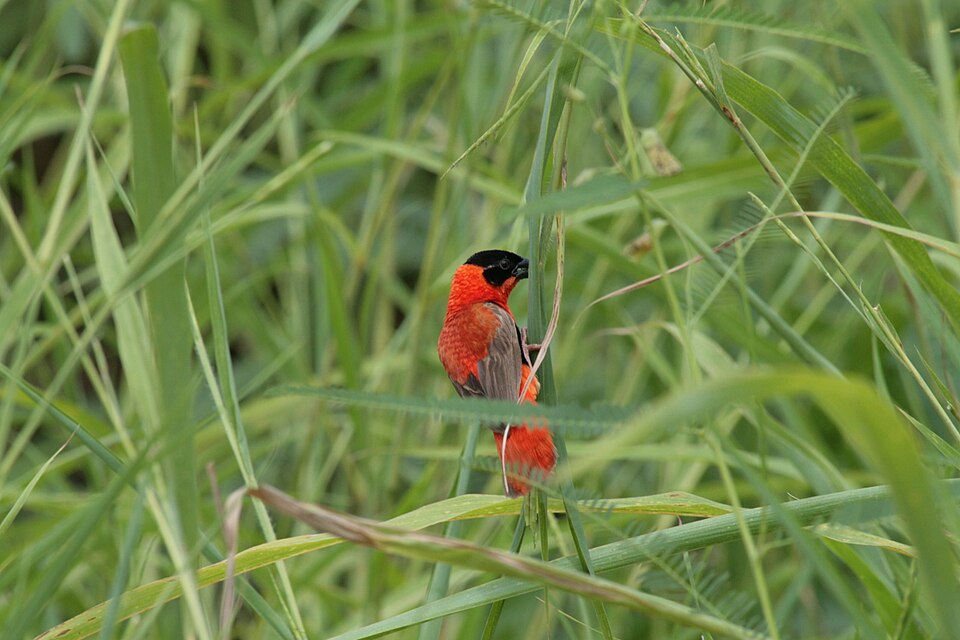 Northern Red Bishop
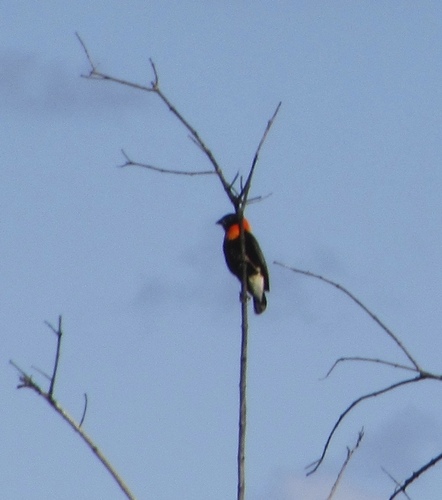 Black Bishop
In short
The most reliable field mark to separate Northern Red Bishop from Black Bishop is the distribution and extent of black and red/orange in breeding males: Northern Red Bishop males show a vivid red-orange body with a sharply defined black face, crown, and belly, while Black Bishop males are predominantly black with a contrasting orange or red collar and upper back. Females and non-breeding males of both species are drab, but Black Bishop females and immatures are darker overall and show more extensive dark spotting below. Black Bishop is also notably larger and heavier-bodied than Northern Red Bishop, which is compact and short-tailed. In flight or perched, focus on the pattern of black and orange/red on the head, breast, and back, and the overall size and structure.
Identification tips
- Breeding male plumage: Look for the extent and placement of black and red/orange. Northern Red Bishop males have a vivid red-orange body with a sharply defined black face, crown, and belly, while Black Bishop males are mostly black with a contrasting orange/red collar and upper back. This is the single most reliable mark in breeding season.
- Face and crown: In breeding plumage, Northern Red Bishop males have a black crown and face set off against red-orange, while Black Bishop males have a black face but the orange/red is restricted to the collar and upper back, not the whole body.
- Belly and flanks: Northern Red Bishop males show a black belly and flanks below the red-orange breast, whereas Black Bishop males are black across the underparts except for the orange/red collar and sometimes a pale buff undertail with black streaks.
- Upper back and rump: Black Bishop males have a yellow or orange upper back and brown rump (subspecies-dependent), while Northern Red Bishop males are red-orange across the back.
- Tail and wing color: Northern Red Bishop has brown upper wings and tail, contrasting with the red-orange body; Black Bishop's wings and tail are black, matching the rest of the plumage.
- Female and non-breeding plumage: Northern Red Bishop females and non-breeding males are pale brown and white, with a sparrow-like pattern and little dark on the face or underparts. Black Bishop females and immatures are darker, with blackish face sides, bold spotting on the undertail, and dark breast spots.
- Juvenile pattern: Black Bishop juveniles are similar to females but with smaller breast spots; Northern Red Bishop juveniles are pale and less marked, resembling the adult female.
- Size and structure: Black Bishop is much larger and bulkier, with a longer tail and heavier build. Northern Red Bishop is compact, short-tailed, and noticeably smaller—size is a useful check if both species are present.
- Bill color: Both species have a black conical bill in breeding plumage; this is not a strong separator.
- Leg color: Northern Red Bishop has pale legs; Black Bishop's tarsus is brown, but this is subtle and not always visible in the field.
- Flight jizz: Northern Red Bishop often appears more compact and short-tailed in flight; Black Bishop is heavier and longer-tailed.
- Habitat context: Both occur in grasslands and wetlands, but Black Bishop may be found in a wider range of habitats, including shrublands. Do not rely on habitat alone.
- Display behavior: Northern Red Bishop males perform conspicuous display flights and puff up their plumage; Black Bishop is less gregarious and less showy in display.
- Vocalization: Black Bishop gives varied twittering calls; Northern Red Bishop's song is monotonous and may be absent outside breeding season. Use voice only as a supporting clue.
- Seasonal timing: Only breeding males of both species show the diagnostic bright plumage; outside the breeding season, both sexes are drab, so rely more on size, structure, and subtle plumage differences.
Size
Black Bishop is significantly larger, measuring 14–16 cm in length and weighing around 28 g [wikidata], while Northern Red Bishop is much smaller at about 11 cm and 12–22 g [wikipedia]. In the field, Black Bishop appears bulkier and longer-tailed, with a heavier build, whereas Northern Red Bishop is compact and short-tailed. This size difference is often apparent when both species are seen in the same area or flock.
Plumage
- Breeding males: Northern Red Bishop males are brilliant red-orange on the body, wrapping from the chin around the throat, breast, and back of the head, with a sharply defined black crown, forehead, face, flanks, and belly. The upper wings and tail are brown. In contrast, Black Bishop breeding males are mostly black on the wings, tail, chest, cheeks, and forehead, with a striking orange or orange-red collar (neck, back of the head, and breast band), and a yellow or orange upper back depending on subspecies. The undertail coverts are pale buff with black streaks. The throat color varies by subspecies (scarlet or black).
- Females and non-breeding males: Northern Red Bishop females and non-breeding males are pale brown and white, with a pattern reminiscent of a song sparrow—generally paler and less marked. Black Bishop females are dark overall, including the sides of the face, and have boldly spotted undertail coverts and dark breast spots. Non-breeding Black Bishop males are black on the back, wings, and rump, with yellowish supercilia and chin, and tawny buff on the face and breast sides.
- Juveniles: Black Bishop juveniles resemble the female but with smaller breast spots. No distinctive juvenile wing pattern is described for either species, but Black Bishop immatures are darker and more marked below than Northern Red Bishop.
Behaviour
Both species are polygynous, but Black Bishop is less gregarious, especially when nesting, and is typically found in small flocks or singly. Northern Red Bishop males are known for elaborate display flights and puffing up their plumage to attract females. Males of both species defend territories during breeding, but Northern Red Bishop males are more conspicuous in their display and less secretive. Females of both species provide all parental care.
Habitat
Both species use grasslands and wetlands, but Black Bishop is reported from a broader range of habitats, including shrublands, across a wider area of sub-Saharan Africa. Northern Red Bishop is often associated with marshy vegetation and reeds, especially during the breeding season. Habitat overlap is possible, so context alone is not always diagnostic.
Voice
Black Bishop's calls are described as subdued twittering, with phrases like 'see-zee see-zee see-zhe see-zhe SEE-ZHEE' and 'hishaah, hishaah, SHAAAAAAH.' Northern Red Bishop's song is monotonous and may be absent outside the breeding season, but no detailed description is provided. Vocalizations are not the most reliable separation in the field, but Black Bishop may sound more varied.