

Northern Pintail vs Cream-coloured Courser
Anas acuta versus Cursorius cursor
Play a quiz with Northern Pintail and Cream-coloured Courser
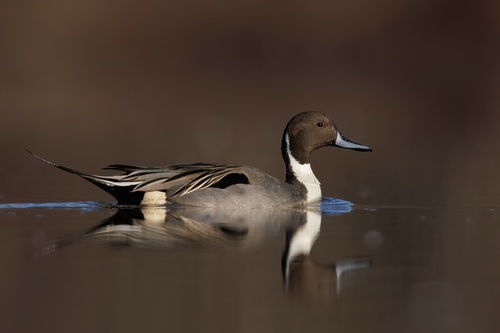 Northern Pintail
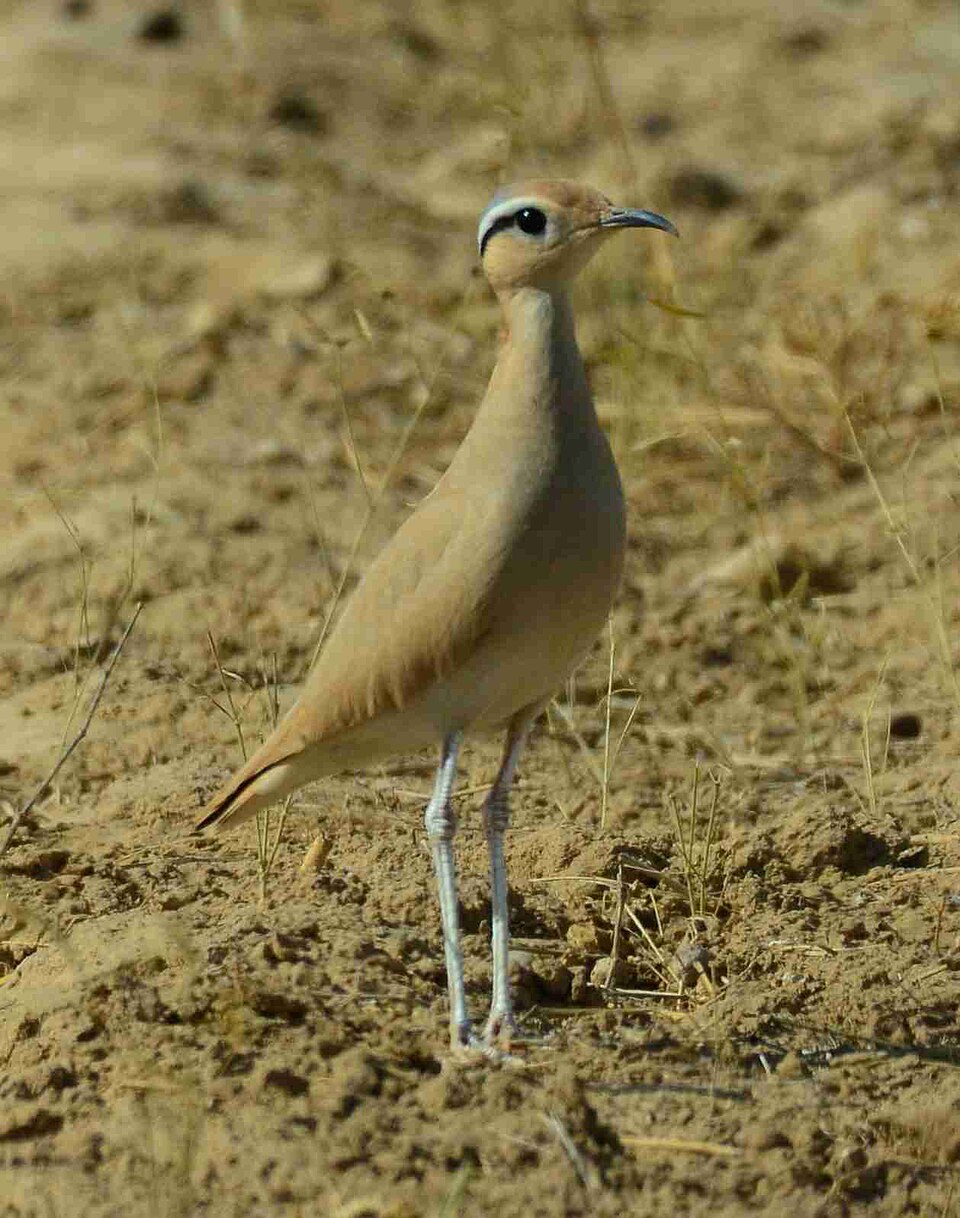 Cream-coloured Courser
In short
The most reliable field mark for separating Northern Pintail from Cream-coloured Courser is the combination of body shape and flight pattern: pintails are large, elegant ducks with long necks and (in males) pointed tails, while coursers are slender, long-legged, sandy-plumaged waders with a distinctive running gait and black underwings in flight. Juvenile pintails in flight show a dull brown speculum with a narrow trailing edge, while juvenile coursers are mottled above and have less distinct head patterns. If you see a bird with a blue-grey bill and feet, swimming or dabbling, it's a pintail; if it's running on dry ground with a downcurved bill and pale sandy tones, it's a courser. Even at a distance, the pintail's elongated shape and the courser's upright, long-legged stance are immediately different.
Identification tips
- Flight pattern and wing markings (all ages): In flight, Cream-coloured Courser shows black outer upperwings and underwings, which are never present in Northern Pintail. Pintail in flight shows a colored speculum (male: black with white border; female: dark brown with white border), but never black underwings.
- Juvenile plumage: Juvenile pintails are less neatly scalloped above and have a duller brown speculum with a narrow trailing edge; juvenile coursers are mottled dark above and have a less distinct head pattern, but always sandy below and never show a duck-like speculum.
- Body shape and posture: Pintails are elongated, with long necks and (in males) long pointed tails. Coursers are upright, with very long legs, a short tail, and a horizontal, runner-like stance.
- Bill shape and color: Pintail has a broad, flat, blue-grey bill typical of ducks; courser has a slender, slightly downcurved bill, never blue-grey.
- Leg color: Pintail legs and feet are blue-grey; courser legs are pale grey, but much longer and more stilt-like.
- Tail: Male pintail has extremely long, pointed central tail feathers (up to 10 cm), a unique feature. Female pintail has a shorter but still pointed tail. Courser has a short, square tail.
- Head pattern (adult): Courser adults have a grey crown, black eyestripe, and striking white supercilium; pintail males have a chocolate-brown head with a white neck stripe, females are more uniform brown.
- Underparts: Courser is sandy above, whitish below; pintail males have white underparts, females are mottled brown but never sandy.
- Habitat: Pintail is always found in or near water; courser is found in dry, open, semi-desert areas, never in wetlands.
- Behavior: Pintail swims and dabbles; courser runs and pauses, rarely if ever swims.
- Size: Pintail is much larger and heavier than courser; even a female pintail dwarfs a courser.
- Voice: Only pintail's voice is described; female quacks, male whistles. Courser's call is not covered here.
- Seasonal confusion: Male pintail in eclipse plumage resembles female but keeps the male's upperwing pattern and long shoulder feathers; courser does not have a comparable seasonal change.
- Sex differences: Pintail males in breeding plumage are striking; females and eclipse males are duller but still show duck structure and blue-grey bill. Courser sexes are similar, but juveniles are duller and more mottled.
- Common pitfalls: Female and juvenile pintails can be mistaken for other ducks but not for coursers if structure, habitat, and behavior are considered. Coursers are unlikely to be confused with any duck in the field due to their terrestrial habits and sandy coloration.
Size
Northern Pintail is dramatically larger and heavier than Cream-coloured Courser: pintail averages about 945.5 g, while the courser is only 129 g. Pintails are 59–76 cm long (males), with a wingspan of 80–95 cm, versus the courser's 19–27 cm length and 51–57 cm wingspan. Even a female pintail dwarfs a courser. This size gap is obvious in the field, especially when seen on the ground or in flight.
Plumage
Juvenile Northern Pintails resemble females but are less neatly scalloped above and have a duller brown speculum with a narrower trailing edge in the wing—this is visible in flight and can help separate them from other ducks, but not from coursers. Juvenile Cream-coloured Coursers are mottled dark above and have a duller head pattern than adults, lacking the crisp black eyestripe and white supercilium. Adult pintail males in breeding plumage are unmistakable: chocolate-brown head, white neck stripe, long pointed tail, and blue-grey bill; females are mottled brown with a more uniform grey-brown head and shorter tail, but still show a long neck and blue-grey bill. Adult coursers are sandy above, whitish below, with a grey crown, black eyestripe, and white supercilium; in flight, both adults and juveniles show black outer upperwings and underwings, which is never shown by pintail. The courser's legs are pale grey, while pintails have blue-grey legs and feet. In eclipse (non-breeding) plumage, male pintails look more like females but retain the male's upperwing pattern and long grey shoulder feathers.
Behaviour
Northern Pintail is a dabbling duck: it swims well, walks on land, and feeds by dabbling or upending in water. Its swimming posture is forward-leaning, with the neck base close to the water. In flight, pintail is fast with slightly swept-back wings. Cream-coloured Courser is a terrestrial wader: it runs rapidly across open ground, hunting insects, and is rarely seen swimming. Its flight is relaxed, with pointed wings and black underwings, resembling a pratincole. The courser's typical behavior is running and pausing, not swimming or dabbling.
Habitat
Northern Pintail is found in wetlands, lakes, and marshes across the northern hemisphere, breeding in temperate to subarctic zones and wintering south to the equator. It is always associated with water. Cream-coloured Courser inhabits dry, open, semi-desert regions in the Middle East, North Africa, and parts of South Asia; it strongly prefers arid, sandy, or stony ground, far from water. If you find a bird in a wetland, it's almost certainly a pintail; on dry open ground, it's a courser.
Voice
Northern Pintail females give a rough quack, while males have a flute-like whistle. Cream-coloured Courser's voice is not described in the provided notes, so vocalization is not a reliable separator here.