

Northern Hawk Owl vs Tengmalm's Owl
Surnia ulula versus Aegolius funereus
Play a quiz with Northern Hawk Owl and Tengmalm's Owl
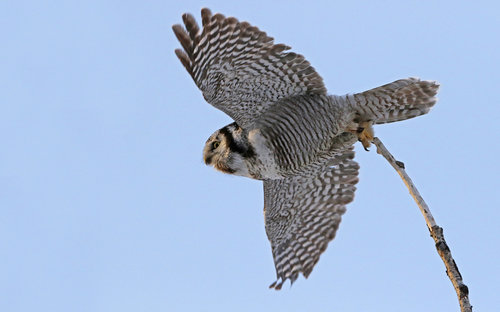 Northern Hawk Owl
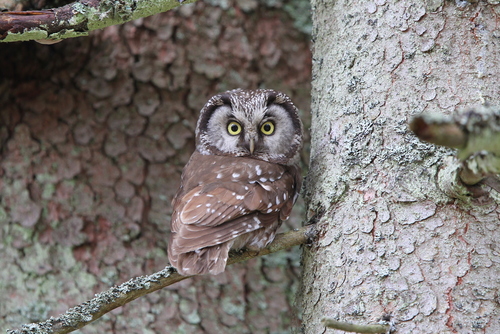 Tengmalm's Owl
In short
The most reliable separation between Northern Hawk Owl and Tengmalm's (Boreal) Owl is size and structure: Hawk Owl is much larger, with a long, banded tail and hawk-like silhouette, while Tengmalm's is a compact, short-tailed, small owl. If you see a perched or flying owl with a strikingly long tail and diurnal activity, it's almost certainly a Northern Hawk Owl. Juvenile plumages are less likely to be confused, as young Tengmalm's are uniformly chocolate-brown with a dark face, while Hawk Owl juveniles resemble adults. Both have spotted upperparts, but Hawk Owl's are coarser and more hawk-like. In flight, Hawk Owl's long tail and direct, falcon-like flight contrast with the short, rounded wings and tail of Tengmalm's. Voice is not usually confusable: Hawk Owl is rarely heard, while Tengmalm's has distinctive trills and whistles.
Identification tips
- Size and structure: Hawk Owl is much larger and longer-tailed than Tengmalm's. If the owl looks hawk-sized or has a tail longer than the body, it's a Hawk Owl.
- Tail shape and length: Hawk Owl's tail is long, with bold brown bands and rounded tips in adults (pointed in first-years); Tengmalm's tail is short, olive-brown, with three rows of white spots that remain separated when folded.
- Flight silhouette: Hawk Owl flies with long, pointed wings and a long tail, resembling a small falcon or hawk; Tengmalm's has short, rounded wings and tail, with a compact, 'classic owl' profile.
- Juvenile plumage: Juvenile Tengmalm's is uniformly chocolate-brown with a dark face and only subtle white marks, developing a white 'X' on the face after fledging. Juvenile Hawk Owls look like adults, with white face, black border, and spotted upperparts.
- Facial disc: Hawk Owl has a white face with a sharp black border and yellow eyes; Tengmalm's has a dull white facial disc, dark border, and prominent white 'eyebrows' giving a 'surprised' look.
- Upperparts spotting: Hawk Owl's dorsal spots are larger and coarser; Tengmalm's has small, pearly-white spots on a brown background.
- Underparts: Hawk Owl is white or off-white below with brown bands; Tengmalm's is cream-white with russet-brown streaks.
- Bill color: Both have yellowish bills, but Tengmalm's is specifically light yellow, not dark (unlike some other small owls).
- Activity pattern: Hawk Owl is often active by day, perching in the open; Tengmalm's is strictly nocturnal and rarely seen in daylight.
- Behavior at close range: Tengmalm's is confiding and may allow close approach if found at roost; Hawk Owl is more wary and alert.
- Vocalizations: Tengmalm's gives trills, whistles, and bill clapping at night; Hawk Owl is rarely heard.
- Habitat context: Hawk Owl prefers open or edge habitats, often visible on exposed perches; Tengmalm's is deep in dense forest.
- Tail barring: Hawk Owl's tail has bold brown bands; Tengmalm's tail bars are narrow, with separated white spots.
- Flight style: Hawk Owl's flight is direct and hawk-like; Tengmalm's is silent, straight, and low.
- Seasonal context: If seen in daylight in winter, especially in open areas, Hawk Owl is far more likely.
Size
Northern Hawk Owl is dramatically larger: males are 35–42.5 cm long (females slightly bigger), with a wingspan of 69–82 cm and weighing 300–340 g [wikipedia]. Tengmalm's Owl is much smaller, with a compact body and short tail (not given here, but always much smaller than Hawk Owl). In the field, Hawk Owl looks close to a small hawk in size and shape, while Tengmalm's is a classic small owl, easily dwarfed by Hawk Owl. If you see them side by side, confusion is impossible.
Plumage
Juvenile Tengmalm's Owls are distinctive: at about 3 weeks old, they are entirely dull chocolate-brown above and below, with a dark brown facial disc and only subtle white markings near the bill. After fledging, they gain a broad white 'X' between the eyes and white streaks on the face, but remain dark overall. Juvenile Hawk Owls, in contrast, look much like adults, with brown upperparts, white spotting, and a white face with a black border. For adults, Hawk Owl is brown above with off-white spots and a white face bordered in black, underparts white with brown bands, and a long, boldly banded tail (rounded tips in adults, pointed in first-years). Tengmalm's adult has brown upperparts with small, pearly-white spots, a dull white facial disc with 'surprised' white eyebrows, and cream underparts with russet streaks. Its tail is olive-brown with narrow bars and three rows of white spots that remain separated even when folded. In flight, Hawk Owl's long tail and pointed wings are distinctive, while Tengmalm's has short, rounded wings and tail, with prominent white spots on the primaries and tail.
Behaviour
Northern Hawk Owl is often active by day and hunts from exposed perches, scanning open areas much like a hawk. Its flight is direct and falcon-like, with long, steady glides and a long tail acting as a rudder. Tengmalm's Owl is strictly nocturnal, rarely seen by day, and is confiding if found at roost. Its flight is silent, straight, and typically low to the ground, with a compact, rounded silhouette. Hawk Owl's diurnal, hawk-like behavior is a strong field clue.
Habitat
Both species occur in boreal forests, but Hawk Owl prefers open coniferous or mixed forests with clearings, often perching high and hunting over open ground. Tengmalm's Owl favors dense, mature taiga or coniferous forests, often in more inaccessible or deep woodland. If you see an owl hunting in broad daylight over an open area, especially in the far north, it's likely a Hawk Owl.
Voice
Tengmalm's Owl is highly vocal, especially at night, with a loud trill (primary song), softer courtship melodies, and a range of calls including screeches, peeping, and bill clapping. Hawk Owl is much less often heard; its vocalizations are not described here and are rarely a field mark. If you hear a series of trills or whistles at night, it's almost certainly Tengmalm's Owl.