

Motmot

オナガフクロウ 対 キンメフクロウ

Surnia ulula 対 Aegolius funereus

オナガフクロウとキンメフクロウのクイズ
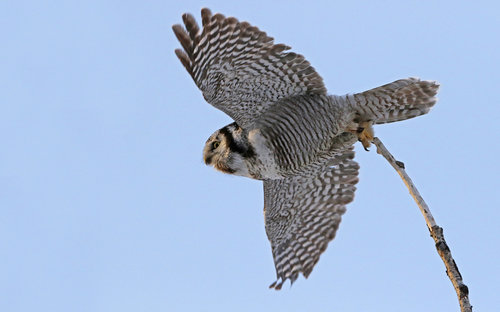
オナガフクロウ (Surnia ulula) オナガフクロウ
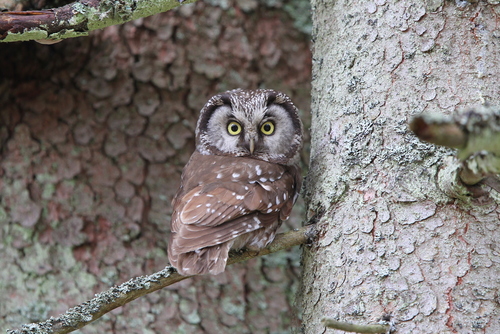
キンメフクロウ (Aegolius funereus) キンメフクロウ

メディア

読み込み中…

要点

オナガフクロウとキンメフクロウ(ボレアルフクロウ)の最も信頼できる区別は、サイズと構造です:オナガフクロウははるかに大きく、長い帯状の尾とタカのようなシルエットを持ち、キンメフクロウはコンパクトで短尾の小さなフクロウです。もし、目立つ長い尾と日中の活動を持つフクロウを見たら、それはほぼ確実にオナガフクロウです。幼鳥の羽毛は混同される可能性が低く、若いキンメフクロウは均一にチョコレートブラウンで顔が暗いのに対し、オナガフクロウの幼鳥は成鳥に似ています。両者は斑点のある上面を持っていますが、オナガフクロウの方が粗く、タカのようです。飛行中、オナガフクロウの長い尾と直接的でハヤブサのような飛行は、キンメフクロウの短く丸い翼と尾と対照的です。声は通常混同されることはありません:オナガフクロウはめったに聞かれず、キンメフクロウは特徴的なトリルや口笛を持っています。

識別のコツ

  1. Size and structure: オナガフクロウはキンメフクロウよりもはるかに大きく、尾が長いです。もしフクロウがタカサイズに見えるか、体よりも長い尾を持っているなら、それはオナガフクロウです。
  2. Tail shape and length: オナガフクロウの尾は長く、大胆な茶色の帯と成鳥では丸い先端(初年度では尖っています)を持っています;キンメフクロウの尾は短く、オリーブブラウンで、折りたたんでも分かれた三列の白い斑点があります。
  3. Flight silhouette: オナガフクロウは長く尖った翼と長い尾で飛び、小さなハヤブサやタカに似ています;キンメフクロウは短く丸い翼と尾を持ち、コンパクトで「クラシックなフクロウ」のプロファイルです。
  4. Juvenile plumage: 幼鳥のキンメフクロウは均一にチョコレートブラウンで暗い顔を持ち、微妙な白い斑点しかなく、巣立ち後に顔に白い「X」を発達させます。幼鳥のオナガフクロウは成鳥に似ており、白い顔、黒い縁、斑点のある上面を持っています。
  5. Facial disc: オナガフクロウは白い顔に鋭い黒い縁と黄色い目を持っています;キンメフクロウは鈍い白い顔盤、暗い縁、目立つ白い「眉」を持ち、「驚いた」ように見えます。
  6. Upperparts spotting: オナガフクロウの背中の斑点は大きく粗いです;キンメフクロウは茶色の背景に小さな真珠のような白い斑点があります。
  7. Underparts: オナガフクロウは下側が白またはオフホワイトで茶色の帯があります;キンメフクロウはクリームホワイトで赤褐色の筋があります。
  8. Bill color: 両者とも黄色がかったくちばしを持っていますが、キンメフクロウは特に薄い黄色で、暗くはありません(他の小さなフクロウとは異なります)。
  9. Activity pattern: オナガフクロウは日中に活動することが多く、開けた場所に止まります;キンメフクロウは完全に夜行性で、日中に見られることはほとんどありません。
  10. Behavior at close range: キンメフクロウは人に慣れやすく、止まり木で見つかると近づくことを許すかもしれません;オナガフクロウはより警戒心が強く、注意深いです。
  11. Vocalizations: キンメフクロウは夜にトリル、口笛、くちばしを叩く音を出します;オナガフクロウはめったに聞かれません。
  12. Habitat context: オナガフクロウは開けたまたはエッジのある生息地を好み、しばしば露出した止まり木に見られます;キンメフクロウは密な森の奥深くにいます。
  13. Tail barring: オナガフクロウの尾には大胆な茶色の帯があります;キンメフクロウの尾の帯は狭く、分かれた白い斑点があります。
  14. Flight style: オナガフクロウの飛行は直接的でタカのようです;キンメフクロウの飛行は静かで、まっすぐで低いです。
  15. Seasonal context: 冬の昼間に特に開けた場所で見られた場合、オナガフクロウの可能性がはるかに高いです。

大きさ

オナガフクロウは劇的に大きいです:オスは35–42.5 cmの長さ(メスはやや大きい)、翼幅は69–82 cmで、体重は300–340 gです [wikipedia]。キンメフクロウははるかに小さく、コンパクトな体と短い尾を持っています(ここでは示されていませんが、常にオナガフクロウよりもはるかに小さいです)。フィールドでは、オナガフクロウはサイズと形で小さなタカに近く見え、キンメフクロウは典型的な小さなフクロウで、オナガフクロウに簡単に圧倒されます。もし彼らを並べて見ると、混同は不可能です。

羽色

幼鳥のキンメフクロウは特徴的です:約3週間齢で、上面と下面は完全に鈍いチョコレートブラウンで、暗い茶色の顔盤とくちばしの近くに微妙な白い斑点しかありません。巣立ち後、彼らは目の間に広い白い「X」を得て、顔に白い筋を持ちますが、全体的には暗いままです。対照的に、幼鳥のオナガフクロウは成鳥に非常に似ており、茶色の上面、白い斑点、黒い縁のある白い顔を持っています。成鳥の場合、オナガフクロウは上面が茶色でオフホワイトの斑点があり、黒い縁のある白い顔、茶色の帯のある白い下面、そして長く大胆な帯のある尾(成鳥では丸い先端、初年度では尖っています)を持っています。キンメフクロウの成鳥は小さな真珠のような白い斑点のある茶色の上面、鈍い白い顔盤と「驚いた」白い眉、赤褐色の筋のあるクリーム色の下面を持っています。尾はオリーブブラウンで狭い帯があり、折りたたんでも分かれた三列の白い斑点があります。飛行中、オナガフクロウの長い尾と尖った翼は特徴的で、キンメフクロウは短く丸い翼と尾を持ち、初列と尾に目立つ白い斑点があります。

行動

オナガフクロウは日中に活動することが多く、露出した止まり木から狩りをし、タカのように開けた場所を見渡します。飛行は直接的でハヤブサのようで、長く安定した滑空と長い尾が舵の役割を果たします。キンメフクロウは完全に夜行性で、日中に見られることはほとんどなく、止まり木で見つかると人に慣れやすいです。飛行は静かで、まっすぐで、通常は地面に近い低い位置で、コンパクトで丸いシルエットを持っています。オナガフクロウの昼行性でタカのような行動は、強力なフィールドの手がかりです。

生息環境

両種はボレアル森林に生息していますが、オナガフクロウは開けた針葉樹林や混合林を好み、しばしば高い場所に止まり、開けた地面を狩ります。キンメフクロウは密で成熟したタイガや針葉樹林を好み、しばしばアクセスが難しい深い森林にいます。もし、特に北の果てで開けた場所で昼間に狩りをしているフクロウを見たら、それはおそらくオナガフクロウです。

声

キンメフクロウは非常に声が多く、特に夜に大きなトリル(主な歌)、柔らかい求愛メロディ、そして叫び声、ピーピー音、くちばしを叩く音などのさまざまな呼び声を持っています。オナガフクロウはめったに聞かれず、その声はここでは説明されておらず、フィールドマークとしてはめったに使われません。もし夜に一連のトリルや口笛を聞いたら、それはほぼ確実にキンメフクロウです。

より良い説明を送る

比較と同じ項目を使ってください。文章はすぐに公開されます。

The most reliable separation between Northern Hawk Owl and Tengmalm's (Boreal) Owl is size and structure: Hawk Owl is much larger, with a long, banded tail and hawk-like silhouette, while Tengmalm's is a compact, short-tailed, small owl. If you see a perched or flying owl with a strikingly long tail and diurnal activity, it's almost certainly a Northern Hawk Owl. Juvenile plumages are less likely to be confused, as young Tengmalm's are uniformly chocolate-brown with a dark face, while Hawk Owl juveniles resemble adults. Both have spotted upperparts, but Hawk Owl's are coarser and more hawk-like. In flight, Hawk Owl's long tail and direct, falcon-like flight contrast with the short, rounded wings and tail of Tengmalm's. Voice is not usually confusable: Hawk Owl is rarely heard, while Tengmalm's has distinctive trills and whistles.

  1. Size and structure: Hawk Owl is much larger and longer-tailed than Tengmalm's. If the owl looks hawk-sized or has a tail longer than the body, it's a Hawk Owl.
  2. Tail shape and length: Hawk Owl's tail is long, with bold brown bands and rounded tips in adults (pointed in first-years); Tengmalm's tail is short, olive-brown, with three rows of white spots that remain separated when folded.
  3. Flight silhouette: Hawk Owl flies with long, pointed wings and a long tail, resembling a small falcon or hawk; Tengmalm's has short, rounded wings and tail, with a compact, 'classic owl' profile.
  4. Juvenile plumage: Juvenile Tengmalm's is uniformly chocolate-brown with a dark face and only subtle white marks, developing a white 'X' on the face after fledging. Juvenile Hawk Owls look like adults, with white face, black border, and spotted upperparts.
  5. Facial disc: Hawk Owl has a white face with a sharp black border and yellow eyes; Tengmalm's has a dull white facial disc, dark border, and prominent white 'eyebrows' giving a 'surprised' look.
  6. Upperparts spotting: Hawk Owl's dorsal spots are larger and coarser; Tengmalm's has small, pearly-white spots on a brown background.
  7. Underparts: Hawk Owl is white or off-white below with brown bands; Tengmalm's is cream-white with russet-brown streaks.
  8. Bill color: Both have yellowish bills, but Tengmalm's is specifically light yellow, not dark (unlike some other small owls).
  9. Activity pattern: Hawk Owl is often active by day, perching in the open; Tengmalm's is strictly nocturnal and rarely seen in daylight.
  10. Behavior at close range: Tengmalm's is confiding and may allow close approach if found at roost; Hawk Owl is more wary and alert.
  11. Vocalizations: Tengmalm's gives trills, whistles, and bill clapping at night; Hawk Owl is rarely heard.
  12. Habitat context: Hawk Owl prefers open or edge habitats, often visible on exposed perches; Tengmalm's is deep in dense forest.
  13. Tail barring: Hawk Owl's tail has bold brown bands; Tengmalm's tail bars are narrow, with separated white spots.
  14. Flight style: Hawk Owl's flight is direct and hawk-like; Tengmalm's is silent, straight, and low.
  15. Seasonal context: If seen in daylight in winter, especially in open areas, Hawk Owl is far more likely.

Northern Hawk Owl is dramatically larger: males are 35–42.5 cm long (females slightly bigger), with a wingspan of 69–82 cm and weighing 300–340 g [wikipedia]. Tengmalm's Owl is much smaller, with a compact body and short tail (not given here, but always much smaller than Hawk Owl). In the field, Hawk Owl looks close to a small hawk in size and shape, while Tengmalm's is a classic small owl, easily dwarfed by Hawk Owl. If you see them side by side, confusion is impossible.

Juvenile Tengmalm's Owls are distinctive: at about 3 weeks old, they are entirely dull chocolate-brown above and below, with a dark brown facial disc and only subtle white markings near the bill. After fledging, they gain a broad white 'X' between the eyes and white streaks on the face, but remain dark overall. Juvenile Hawk Owls, in contrast, look much like adults, with brown upperparts, white spotting, and a white face with a black border. For adults, Hawk Owl is brown above with off-white spots and a white face bordered in black, underparts white with brown bands, and a long, boldly banded tail (rounded tips in adults, pointed in first-years). Tengmalm's adult has brown upperparts with small, pearly-white spots, a dull white facial disc with 'surprised' white eyebrows, and cream underparts with russet streaks. Its tail is olive-brown with narrow bars and three rows of white spots that remain separated even when folded. In flight, Hawk Owl's long tail and pointed wings are distinctive, while Tengmalm's has short, rounded wings and tail, with prominent white spots on the primaries and tail.

Northern Hawk Owl is often active by day and hunts from exposed perches, scanning open areas much like a hawk. Its flight is direct and falcon-like, with long, steady glides and a long tail acting as a rudder. Tengmalm's Owl is strictly nocturnal, rarely seen by day, and is confiding if found at roost. Its flight is silent, straight, and typically low to the ground, with a compact, rounded silhouette. Hawk Owl's diurnal, hawk-like behavior is a strong field clue.

Both species occur in boreal forests, but Hawk Owl prefers open coniferous or mixed forests with clearings, often perching high and hunting over open ground. Tengmalm's Owl favors dense, mature taiga or coniferous forests, often in more inaccessible or deep woodland. If you see an owl hunting in broad daylight over an open area, especially in the far north, it's likely a Hawk Owl.

Tengmalm's Owl is highly vocal, especially at night, with a loud trill (primary song), softer courtship melodies, and a range of calls including screeches, peeping, and bill clapping. Hawk Owl is much less often heard; its vocalizations are not described here and are rarely a field mark. If you hear a series of trills or whistles at night, it's almost certainly Tengmalm's Owl.

変更を破棄しますか?

保存していない編集があります。今離れると失われます。

オナガフクロウ · キンメフクロウ · 苦手な鳥