

Motmot

Northern Fulmar vs Sooty Shearwater

Fulmarus glacialis versus Ardenna grisea

Play a quiz with Northern Fulmar and Sooty Shearwater
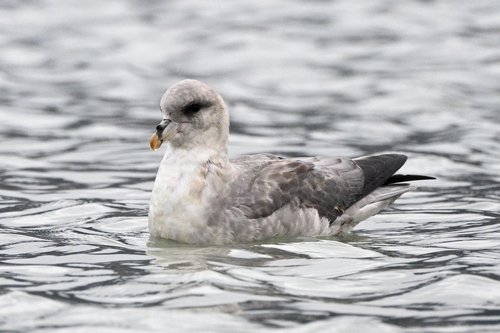
Northern Fulmar (Fulmarus glacialis) Northern Fulmar
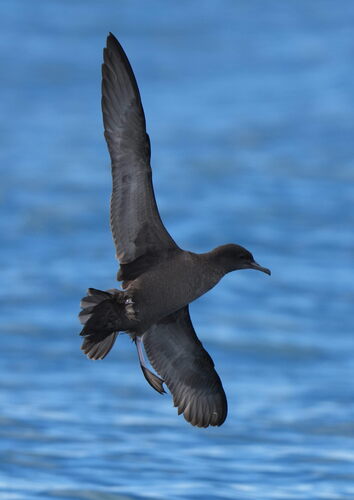
Sooty Shearwater (Ardenna grisea) Sooty Shearwater

Media

Loading…

In short

The most reliable field mark between Northern Fulmar and Sooty Shearwater is overall plumage color and underwing pattern: Sooty Shearwater is uniformly dark brown to sooty-black with a distinctive silvery panel along the center of the underwing, while Northern Fulmar shows a much paler look, especially in the common light morph, with white head and body and contrasting grey wings, lacking the silvery underwing panel. Fulmar appears bull-necked and thick-billed, with a stiff, direct flight, while Sooty Shearwater is slimmer, longer-winged, and slices low over the water with deep, shearing glides. Fulmar is abundant in subarctic North Atlantic and North Pacific, whereas Sooty Shearwater is a southern breeder and a long-distance migrant, only passing through northern oceans in migration. If you see a large, all-dark seabird with a silvery underwing streak, it is a Sooty Shearwater; a pale, gull-like seabird with a thick bill and contrasting grey wings is a Northern Fulmar.

Identification tips

  1. Underwing pattern: Sooty Shearwater of all ages shows a silvery or pale streak along the center of the underwing, visible in good light; Fulmar never shows this, instead having pale inner primaries but not a silvery panel.
  2. Overall coloration: Sooty Shearwater is uniformly dark brown to sooty-black above and below, often appearing all-dark at a distance; Fulmar (light morph) is much paler, with a white head and body and grey wings and tail, and even the dark morph is only medium grey, not blackish.
  3. Head and bill shape: Fulmar has a thick, stubby, pale yellow bill and a bull-necked, chunky appearance; Sooty Shearwater is slimmer, with a more slender bill and less pronounced neck.
  4. Flight style: Fulmar flies with stiff, shallow wingbeats and direct glides, rarely shearing low over the water; Sooty Shearwater banks and glides low over the waves with long, stiff wings, often with wingtips nearly touching the surface.
  5. Jizz at rest: Fulmar sits high on the water, appearing heavy and thick-necked; Sooty Shearwater sits lower and looks more streamlined.
  6. Tail: Fulmar's tail is short and often appears squared-off; Sooty Shearwater's tail is longer and more tapered, but this is subtle.
  7. Bill color: Fulmar always has a pale yellow bill; Sooty Shearwater's bill is dark and slender.
  8. Plumage morphs: Fulmar comes in light and dark morphs, but even the darkest Fulmar is only medium grey and never truly blackish; Sooty Shearwater is always dark.
  9. Habitat and season: In the North Atlantic, Fulmar is resident or summer visitor; Sooty Shearwater is only present as a migrant, mainly in late spring and autumn.
  10. Size impression: Fulmar looks chunkier and heavier, while Sooty Shearwater is longer-winged and more graceful in flight.
  11. Underwing contrast: Fulmar's underwing is pale with contrasting dark edges only in the dark morph; Sooty Shearwater's underwing always shows a silvery central panel.
  12. Confusion risk: In poor light, Sooty Shearwater can look all-black and might be mistaken for a dark morph Fulmar, but the underwing panel and flight style will separate them.
  13. Bill structure: Fulmar's bill is thick and has visible tube nostrils on top; Sooty Shearwater's bill is more slender, with less prominent tubes.
  14. Group behavior: Sooty Shearwaters often migrate in large flocks; Fulmars are more often seen singly or in small groups.
  15. Vocalization: Not useful at sea, but Sooty Shearwater is noisy at colonies at night; Fulmar is not notably vocal in the field.

Size

Northern Fulmar is slightly longer and heavier, measuring about 46 cm in length with a wingspan of 102–112 cm and a mass of 450–1,000 g [wikipedia][avonet]. Sooty Shearwater is 40–51 cm in length, with a wingspan of 94–110 cm [wikipedia][avonet]. The size overlap is considerable, but Fulmar tends to look chunkier and more bull-necked, while Sooty Shearwater is slimmer and more streamlined. In the field, Fulmar's short, thick neck and stubby bill contrast with the longer, sleeker look of Sooty Shearwater.

Plumage

Juvenile and adult Sooty Shearwaters are uniformly dark chocolate-brown to sooty-black, often appearing all-dark at a distance or in poor light. Their key feature is a silvery or pale streak along the center of the underwing, visible in good light and diagnostic for the species [wikipedia]. Northern Fulmar, by contrast, comes in two main color morphs: the light morph (most common in temperate areas) has a white head and body with grey wings and tail, while the dark ("blue") morph is uniformly grey. Both morphs lack the Sooty Shearwater's silvery underwing panel. Fulmar's upperwings always show pale inner primaries, and the bird never looks truly all-dark. The Pacific Fulmar morph may have a darker tail, but still shows contrast between body and wings. In flight, Fulmar appears pale and contrasting, while Sooty Shearwater is dark overall with the underwing flash. These differences are present in all age groups, as neither species has a distinct juvenile or immature wing pattern that would confuse the issue.

Behaviour

Northern Fulmar flies with stiff, shallow wingbeats and glides, often appearing heavy and direct, sometimes recalling a small gull but with a more mechanical, less buoyant flight. It often sits high on the water and appears bull-necked and thick-billed. Sooty Shearwater, on the other hand, is a classic shearwater: it slices low over the waves, banking from side to side with long, stiff wings and deep, shearing glides, sometimes with wingtips nearly touching the water. Sooty Shearwater's flight is more dynamic and graceful, resembling a small albatross. Fulmar rarely shows this shearing, low-to-the-water behavior.

Habitat

Northern Fulmar is abundant in subarctic waters of the North Atlantic and North Pacific, often seen near breeding cliffs or at sea in cold, northern waters. Sooty Shearwater breeds in the southern hemisphere (New Zealand, Falklands, southern South America) and is seen in northern oceans only as a migrant, often in large flocks during migration seasons. In the Atlantic, Sooty Shearwater is the only all-dark large shearwater, while Fulmar is a resident or summer visitor in northern waters. Both species are pelagic, but Fulmar is more likely near northern coasts and cliffs, while Sooty Shearwater is a passage migrant.

Voice

Sooty Shearwater is mostly silent at sea, but can be loud and vocal (coos, croaks) at breeding colonies at night. Northern Fulmar is not described as particularly vocal in these notes, and voice is not a practical field mark at sea for either species.

Submit a better description

Use the same sections as the comparison. Your text is published immediately.

The most reliable field mark between Northern Fulmar and Sooty Shearwater is overall plumage color and underwing pattern: Sooty Shearwater is uniformly dark brown to sooty-black with a distinctive silvery panel along the center of the underwing, while Northern Fulmar shows a much paler look, especially in the common light morph, with white head and body and contrasting grey wings, lacking the silvery underwing panel. Fulmar appears bull-necked and thick-billed, with a stiff, direct flight, while Sooty Shearwater is slimmer, longer-winged, and slices low over the water with deep, shearing glides. Fulmar is abundant in subarctic North Atlantic and North Pacific, whereas Sooty Shearwater is a southern breeder and a long-distance migrant, only passing through northern oceans in migration. If you see a large, all-dark seabird with a silvery underwing streak, it is a Sooty Shearwater; a pale, gull-like seabird with a thick bill and contrasting grey wings is a Northern Fulmar.

  1. Underwing pattern: Sooty Shearwater of all ages shows a silvery or pale streak along the center of the underwing, visible in good light; Fulmar never shows this, instead having pale inner primaries but not a silvery panel.
  2. Overall coloration: Sooty Shearwater is uniformly dark brown to sooty-black above and below, often appearing all-dark at a distance; Fulmar (light morph) is much paler, with a white head and body and grey wings and tail, and even the dark morph is only medium grey, not blackish.
  3. Head and bill shape: Fulmar has a thick, stubby, pale yellow bill and a bull-necked, chunky appearance; Sooty Shearwater is slimmer, with a more slender bill and less pronounced neck.
  4. Flight style: Fulmar flies with stiff, shallow wingbeats and direct glides, rarely shearing low over the water; Sooty Shearwater banks and glides low over the waves with long, stiff wings, often with wingtips nearly touching the surface.
  5. Jizz at rest: Fulmar sits high on the water, appearing heavy and thick-necked; Sooty Shearwater sits lower and looks more streamlined.
  6. Tail: Fulmar's tail is short and often appears squared-off; Sooty Shearwater's tail is longer and more tapered, but this is subtle.
  7. Bill color: Fulmar always has a pale yellow bill; Sooty Shearwater's bill is dark and slender.
  8. Plumage morphs: Fulmar comes in light and dark morphs, but even the darkest Fulmar is only medium grey and never truly blackish; Sooty Shearwater is always dark.
  9. Habitat and season: In the North Atlantic, Fulmar is resident or summer visitor; Sooty Shearwater is only present as a migrant, mainly in late spring and autumn.
  10. Size impression: Fulmar looks chunkier and heavier, while Sooty Shearwater is longer-winged and more graceful in flight.
  11. Underwing contrast: Fulmar's underwing is pale with contrasting dark edges only in the dark morph; Sooty Shearwater's underwing always shows a silvery central panel.
  12. Confusion risk: In poor light, Sooty Shearwater can look all-black and might be mistaken for a dark morph Fulmar, but the underwing panel and flight style will separate them.
  13. Bill structure: Fulmar's bill is thick and has visible tube nostrils on top; Sooty Shearwater's bill is more slender, with less prominent tubes.
  14. Group behavior: Sooty Shearwaters often migrate in large flocks; Fulmars are more often seen singly or in small groups.
  15. Vocalization: Not useful at sea, but Sooty Shearwater is noisy at colonies at night; Fulmar is not notably vocal in the field.

Northern Fulmar is slightly longer and heavier, measuring about 46 cm in length with a wingspan of 102–112 cm and a mass of 450–1,000 g [wikipedia][avonet]. Sooty Shearwater is 40–51 cm in length, with a wingspan of 94–110 cm [wikipedia][avonet]. The size overlap is considerable, but Fulmar tends to look chunkier and more bull-necked, while Sooty Shearwater is slimmer and more streamlined. In the field, Fulmar's short, thick neck and stubby bill contrast with the longer, sleeker look of Sooty Shearwater.

Juvenile and adult Sooty Shearwaters are uniformly dark chocolate-brown to sooty-black, often appearing all-dark at a distance or in poor light. Their key feature is a silvery or pale streak along the center of the underwing, visible in good light and diagnostic for the species [wikipedia]. Northern Fulmar, by contrast, comes in two main color morphs: the light morph (most common in temperate areas) has a white head and body with grey wings and tail, while the dark ("blue") morph is uniformly grey. Both morphs lack the Sooty Shearwater's silvery underwing panel. Fulmar's upperwings always show pale inner primaries, and the bird never looks truly all-dark. The Pacific Fulmar morph may have a darker tail, but still shows contrast between body and wings. In flight, Fulmar appears pale and contrasting, while Sooty Shearwater is dark overall with the underwing flash. These differences are present in all age groups, as neither species has a distinct juvenile or immature wing pattern that would confuse the issue.

Northern Fulmar flies with stiff, shallow wingbeats and glides, often appearing heavy and direct, sometimes recalling a small gull but with a more mechanical, less buoyant flight. It often sits high on the water and appears bull-necked and thick-billed. Sooty Shearwater, on the other hand, is a classic shearwater: it slices low over the waves, banking from side to side with long, stiff wings and deep, shearing glides, sometimes with wingtips nearly touching the water. Sooty Shearwater's flight is more dynamic and graceful, resembling a small albatross. Fulmar rarely shows this shearing, low-to-the-water behavior.

Northern Fulmar is abundant in subarctic waters of the North Atlantic and North Pacific, often seen near breeding cliffs or at sea in cold, northern waters. Sooty Shearwater breeds in the southern hemisphere (New Zealand, Falklands, southern South America) and is seen in northern oceans only as a migrant, often in large flocks during migration seasons. In the Atlantic, Sooty Shearwater is the only all-dark large shearwater, while Fulmar is a resident or summer visitor in northern waters. Both species are pelagic, but Fulmar is more likely near northern coasts and cliffs, while Sooty Shearwater is a passage migrant.

Sooty Shearwater is mostly silent at sea, but can be loud and vocal (coos, croaks) at breeding colonies at night. Northern Fulmar is not described as particularly vocal in these notes, and voice is not a practical field mark at sea for either species.

Discard your changes?

You have unsaved edits. If you leave now, those changes will be lost.

Northern Fulmar · Sooty Shearwater · My Tricky Birds