

Northern Fulmar vs Balearic Shearwater
Fulmarus glacialis versus Puffinus mauretanicus
Play a quiz with Northern Fulmar and Balearic Shearwater
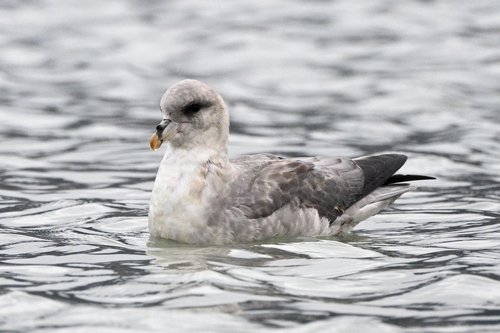 Northern Fulmar
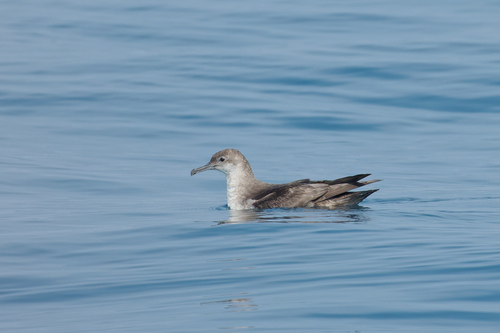 Balearic Shearwater
In short
The most reliable field mark between Northern Fulmar and Balearic Shearwater is the fulmar’s thick, pale yellow bill and bull-necked, heavy-headed appearance, which is obvious even at a distance. Fulmars also show a distinctly stiff, direct flight with little flex in the wings, while Balearic Shearwaters have a more buoyant, arcing flight, often skimming low over the water. In all plumages, fulmars appear chunkier and broader-winged, while Balearic Shearwaters are slimmer, with longer, narrower wings and a more streamlined look. Both can appear greyish above and pale below, but the fulmar’s color morphs and structure are key for separation.
Identification tips
- Bill shape and color: Fulmar has a thick, pale yellow bill with tubular nostrils on top; Balearic Shearwater’s bill is slimmer, darker, and more pointed. This is visible at moderate range in good light.
- Head and neck: Fulmar appears bull-necked and heavy-headed, with a short, thick neck; Balearic Shearwater has a more slender, streamlined head and neck.
- Flight style: Fulmar flies with stiff, shallow wingbeats and glides on straight wings, rarely dipping or banking; Balearic Shearwater has a buoyant, arcing flight, banking from side to side and often skimming the water.
- Wing shape: Fulmar’s wings are broad and blunt-tipped; Balearic Shearwater’s wings are long, narrow, and pointed, giving a more elegant silhouette.
- Body shape: Fulmar is chunky and deep-bodied, often described as barrel-chested; Balearic Shearwater is slim and elongated.
- Plumage contrast: Light-morph Fulmar shows sharp contrast between white head/body and grey wings/tail; Balearic Shearwater is more uniformly brown above and dirty white below, with less contrast.
- Dark morph confusion: Dark-morph Fulmars can appear uniformly grey and may be confused with Balearic Shearwater at distance, but still show a heavier build and thick bill.
- Underwing pattern: Fulmars (especially light morphs) have pale inner primaries above; Balearic Shearwater lacks this, showing more uniform dark upperwings.
- Leg color: Fulmar has bluish legs (seen when perched or close on water); Balearic Shearwater’s legs are not distinctive in the field.
- Sitting posture: On water, Fulmar sits high and looks bulky; Balearic Shearwater sits lower and appears sleeker.
- Size impression: Fulmar is much larger and heavier; if seen together, the size difference is obvious.
- Habitat and range: Fulmar is common in subarctic and North Atlantic waters; Balearic Shearwater is rare outside the Mediterranean.
- Plumage variation: Fulmar shows marked individual variation (light, dark, intermediate morphs); Balearic Shearwater is more consistent in coloration.
- Association: Fulmars often associate with other large seabirds and can be seen in mixed flocks; Balearic Shearwaters are more likely to be seen in smaller groups or singly.
- Pitfall: Gulls can be mistaken for Fulmar due to similar coloration, but the thick bill and flight style are distinctive; Balearic Shearwater is unlikely to be confused with gulls but can be mistaken for other shearwaters.
Size
Northern Fulmar is significantly larger and heavier: 46 cm long with a 102–112 cm wingspan and body mass of 450–1000 g [wikipedia][avonet]. Balearic Shearwater is smaller and lighter, at 34–39 cm in length, 78–90 cm wingspan, and a much slimmer build [wikipedia][avonet]. In the field, fulmars look broad and chunky, while Balearic Shearwaters are noticeably sleeker and more elongated.
Plumage
No age-specific upperwing patterns are described for either species, so separation relies on overall coloration and structure. Northern Fulmar comes in light and dark morphs: light morphs have a white head and body with grey wings and tail, while dark morphs are uniformly grey. All morphs show pale inner primaries on the upperwing, but only the dark morph has extensive dark below. Balearic Shearwater is overall less contrasting: dark brown above and dirty white below, with a gradual transition between upper and underparts. In flight, Balearic Shearwater shows a classic shearwater pattern, with the dark upperparts and paler undersides flashing as it banks, but lacks the sharp contrast of a light-morph fulmar. Fulmars always show a thick, pale bill and bluish legs, while Balearic Shearwater’s bill is slimmer and more pointed.
Behaviour
Northern Fulmar flies with stiff, shallow wingbeats and little flex, often gliding on straight wings, giving a mechanical, purposeful impression. It rarely shears or arcs. Balearic Shearwater, like other Puffinus, has a buoyant, arcing flight, dipping from side to side with wings held out straight, often flying low over the water with wingtips nearly touching the surface. On the water, fulmars sit higher and look bulkier, while shearwaters are more streamlined and sit lower.
Habitat
Northern Fulmar is primarily found in subarctic North Atlantic and North Pacific waters, often far offshore but sometimes seen closer to land. Balearic Shearwater is a Mediterranean specialist, rarely straying far from the region except in migration, and is generally less likely to be seen in colder northern waters. Fulmars are much more abundant and widespread, especially in the North Atlantic, while Balearic Shearwater is local and scarce outside the Mediterranean.