

Northern Carmine Bee-eater vs Southern Carmine Bee-eater
Merops nubicus versus Merops nubicoides
Play a quiz with Northern Carmine Bee-eater and Southern Carmine Bee-eater
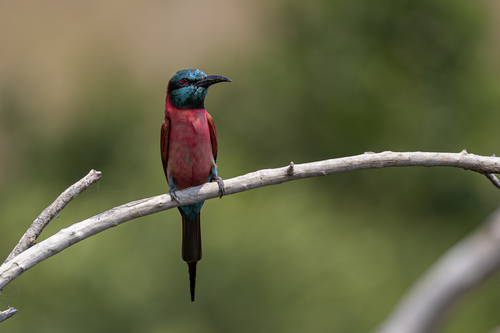 Northern Carmine Bee-eater
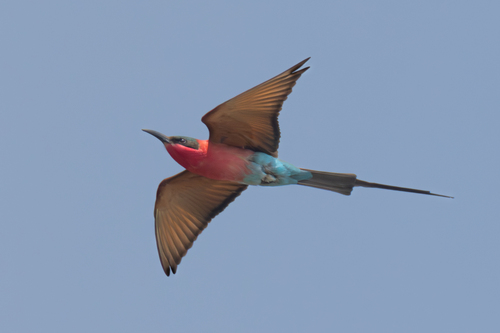 Southern Carmine Bee-eater
In short
The most reliable field mark to separate Northern and Southern Carmine Bee-eaters is the color of the throat: Northern has a blue throat, while Southern shows a carmine (red) throat. Both are strikingly carmine overall with blue crowns and undertails, but this throat color difference is consistent in adults and visible in good light. Juvenile and immature birds are more challenging, as both lack the long central tail streamers and have duller, browner underparts, but the throat color difference remains the best clue. Structure, behavior, and voice are very similar, so focus on the throat and, if possible, confirm by range.
Identification tips
- Throat color is the primary field mark: Northern Carmine Bee-eater has a blue throat, Southern Carmine Bee-eater has a carmine (red) throat. This is reliable in adults and visible in good light.
- Juvenile and immature birds: Both lack long central tail feathers and have duller, pinkish-brown underparts, but the throat color difference remains the best clue for separation at all ages.
- Crown and undertail: Both species have blue crowns and blue undertail coverts, so these are not helpful for separation.
- Overall body color: Both are predominantly carmine, so overall coloration is not diagnostic.
- Black mask: Both species show a black mask through the eye; this is not a separator.
- Tail shape: Adults of both species have elongated central tail feathers; juveniles of both lack these, so tail shape is not useful for separating the two.
- Bill color and shape: Both have a black, decurved bill typical of bee-eaters; not useful for separation.
- Eye color: Both have red eyes; not a separator.
- Voice: No documented differences in calls or songs between the two species, so not reliable for field separation.
- Behavior: Both species behave similarly, sallying for insects and nesting colonially in riverbanks; not diagnostic.
- Habitat and range: If you are outside the overlap zone, range can be a strong clue: Northern in northern tropical Africa, Southern in sub-equatorial Africa.
- Sex differences: Both species are sexually monomorphic; males and females look alike.
- Seasonal variation: No significant seasonal plumage change noted for either species that would affect identification.
- Pitfalls: In poor light or at distance, the throat color may be hard to see. Juveniles can be especially tricky, but the throat color is still the best mark if visible.
- When in doubt: If the throat color cannot be seen and you are in a region where both could occur, identification may not be possible to species level.
Size
Northern Carmine Bee-eater averages about 54.4g in body mass [wikidata], with no published mass for Southern Carmine Bee-eater in the sources provided. Both species are similar in overall size and structure, with long, slender bodies and elongated central tail feathers in adults. No reliable size difference is documented between the two.
Plumage
For adults, the key difference is the throat color: Northern Carmine Bee-eater has a blue throat, while Southern Carmine Bee-eater has a carmine (red) throat. Both have a blue crown and undertail, carmine body, and a black mask. Juveniles of both species lack the long central tail feathers and have duller, pinkish-brown underparts, but the throat color difference is still present and is the best field mark at this age. No distinctive differences in wing pattern, upperwing, or flight marks are noted for either species in the sources provided.
Behaviour
Both species share typical bee-eater behaviors: sallying from perches to catch flying insects, often returning to the same perch. They nest colonially in riverbanks or cliffs, digging horizontal tunnels. No behavioral differences are noted that would help with field separation.
Habitat
Northern Carmine Bee-eater is found across northern tropical Africa, often linked to secondary loess deposits and riverbanks. Southern Carmine Bee-eater occurs in sub-equatorial Africa. Both favor open country near water, especially for nesting, and both may form large colonies. In areas of range overlap, habitat is not a reliable separator, but outside the overlap, range can be a strong clue.
Voice
Northern Carmine Bee-eater gives a deep, throaty 'tunk' in flight and a series of 'rik' notes when perched. No distinctive vocal differences are described between the two species in the sources provided.
Northern Carmine Bee-eater · Southern Carmine Bee-eater · My Tricky Birds