

Northern Barred-Woodcreeper vs Spotted Woodcreeper
Dendrocolaptes sanctithomae versus Xiphorhynchus erythropygius
Play a quiz with Northern Barred-Woodcreeper and Spotted Woodcreeper
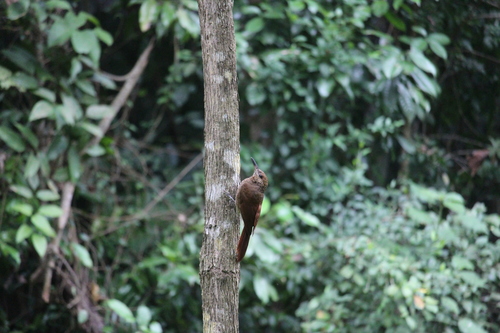 Northern Barred-Woodcreeper
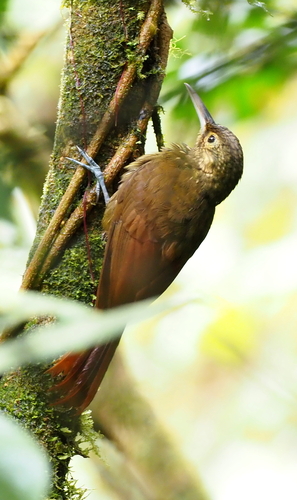 Spotted Woodcreeper
In short
The most reliable field mark between Northern Barred-Woodcreeper and Spotted Woodcreeper is the underpart pattern: Northern Barred shows crisp, narrow black barring on a golden to cinnamon-buff background, while Spotted Woodcreeper has large, pale buff teardrop spots on a pale greenish-olive base. Juveniles of both are similar to adults, but with less distinct markings. Structurally, Northern Barred is larger, bulkier, and has a straighter, heavier bill, while Spotted is slimmer with a slightly decurved, tapering bill. In flight or perched, look for the overall richer rufous tones and heavier barring of Northern Barred versus the spotted and streaked appearance of Spotted. Both can be found in similar forest habitats, so careful attention to these plumage and structural differences is key.
Identification tips
- Underpart pattern (all ages): Northern Barred-Woodcreeper shows crisp, narrow black barring on golden to cinnamon-buff underparts, including the throat and belly. Spotted Woodcreeper has large, pale buff teardrop spots on pale greenish-olive underparts, with a buffy, narrowly barred throat. This is the most reliable mark in all seasons.
- Juvenile differences: Juvenile Northern Barred has more diffuse barring below, redder undertail coverts, and an all-black bill; Spotted juvenile is browner overall with less distinct spots below. These differences are subtle but can help if seen well.
- Crown and back pattern: Northern Barred has black barring on the crown and back, giving a distinctly barred look above. Spotted Woodcreeper has small buff spots and narrow dusky edges on the crown/nape, and wide buff streaks and spots on the back and wing coverts.
- Bill shape and color: Northern Barred's bill is straight, medium-length, and mostly blackish (entirely black in juveniles), appearing heavier in some subspecies. Spotted Woodcreeper's bill is longish, slightly decurved, and gradually tapers, with a blackish maxilla and paler mandible (sometimes with a pale stripe). Bill shape is often visible even at a distance.
- Face pattern: Northern Barred has a faint rufous supercilium and cinnamon-brown face with fine barring; Spotted has a more prominent buff supercilium and eyering, with dusky olive ear coverts streaked buff.
- Rump and tail color: Both have rufous-chestnut tails, but Northern Barred's rump and tail are richer cinnamon-rufous, while Spotted's are dark cinnamon-rufous, with the back more olive-brown or tawny brown.
- Wing pattern in flight: Both show rufous-chestnut flight feathers, but Northern Barred's are more uniform, while Spotted's have olive-brown edges and dusky tips on the primaries.
- Overall size and structure: Northern Barred is noticeably larger and bulkier, with a heavier, straighter bill; Spotted is slimmer and smaller, with a more delicate, decurved bill. Use this when both are seen together or when size is apparent against familiar objects.
- Leg and foot color: Northern Barred's legs and feet are variable (dark brown, black, grayish green, bluish, or horn), while Spotted's are blue- or greenish gray to slate gray. This is rarely diagnostic in the field.
- Sexes: Both species are sexually monomorphic in plumage, so sex is not a useful separator.
- Subspecies variation: Some subspecies of Northern Barred (e.g., D. s. punctipectus) have heavier bills and more brownish-black tones; Spotted Woodcreeper subspecies vary in size, rufous tones, and extent of spotting/streaking, but the basic underpart pattern remains diagnostic.
- Habitat context: Both can occur together in humid forests, but Northern Barred is more sensitive to fragmentation and less likely in disturbed or marginal habitats.
- Behavior at ant swarms: Both follow army ants, but Northern Barred is more likely to be seen singly or in pairs, sometimes up to four; Spotted's numbers at swarms are not specified, but behavior is similar.
- Vocalizations: Not described in the provided notes; do not rely on song or call for separation with this information.
- Pitfalls: In poor light, the barring of Northern Barred can appear spotty, and the spots of Spotted Woodcreeper can look like bars. Focus on the shape and clarity of the markings, especially on the breast and belly, and use bill shape and size as backup.
Size
Northern Barred-Woodcreeper is distinctly larger and heavier: 25–29 cm long, with males weighing 53–72 g and females 54–83 g. Spotted Woodcreeper is smaller at 19–24 cm and lighter, with males 40–54 g and females 40–46 g [wikipedia][wikidata]. This size difference is often obvious in direct comparison, but may be subtle in the field unless both are seen together. Northern Barred also appears bulkier and more robust overall.
Plumage
-
Juvenile/immature plumage: Both species' juveniles resemble adults but with less distinct markings. Juvenile Northern Barred-Woodcreeper shows more diffuse barring below, redder undertail coverts, and an all-black bill. Juvenile Spotted Woodcreeper is browner overall with less distinct spotting on the underparts.
-
Adult underparts: Northern Barred-Woodcreeper has golden to cinnamon-buff underparts with narrow, well-defined black barring throughout (including throat and belly). Spotted Woodcreeper has pale greenish-olive underparts with large, pale buff teardrop spots, especially bold on the breast and belly, and a buffy, narrowly barred throat.
-
Upperparts: Northern Barred shows black barring on the crown and back, with olive-brown back and cinnamon/rufous rump and tail. Spotted Woodcreeper has small buff spots and narrow dusky edges on the crown/nape, and wide buff streaks and spots on the back and wing coverts, with a dark cinnamon-rufous rump and tail.
-
Wings and tail in flight: Both have rufous-chestnut flight feathers and tail, but Northern Barred's are richer and more uniform, while Spotted's have olive-brown edges and dusky tips on the primaries.
-
Bill: Northern Barred's bill is straight, mostly blackish (juvenile all black), heavier in some subspecies; Spotted's is longish, slightly decurved, blackish to dark brown maxilla, paler mandible.
-
Face: Northern Barred has a faint rufous supercilium and cinnamon-brown face with fine barring; Spotted has a buff supercilium and eyering, dusky olive ear coverts with buff streaks.
Behaviour
Both species often follow army ant swarms to feed on prey disturbed by the ants, sometimes singly or in pairs. Northern Barred-Woodcreeper is described as requiring a larger home range and being more sensitive to forest fragmentation. Spotted Woodcreeper's foraging and movement are similar, but it is not noted as being as sensitive to habitat fragmentation. Neither species is particularly gregarious, and both are typically seen moving methodically along trunks and large branches.
Habitat
Both species overlap broadly in Central American and northern South American forests, occurring from southern Mexico through Central America into Colombia and Ecuador [wikipedia]. Both favor humid forests, but Northern Barred-Woodcreeper is generally less common at higher elevations and in marginal habitats, and is more sensitive to forest fragmentation. Spotted Woodcreeper is found in a similar range of forest types, including mature and secondary forest, and is not noted as being as sensitive to disturbance. Local abundance can vary, so habitat alone is not a reliable separator.
Northern Barred-Woodcreeper · Spotted Woodcreeper · My Tricky Birds