

New Caledonian Thicketbird vs Broad-tailed Grassbird
Cincloramphus mariae versus Schoenicola platyurus
Play a quiz with New Caledonian Thicketbird and Broad-tailed Grassbird
 New Caledonian Thicketbird
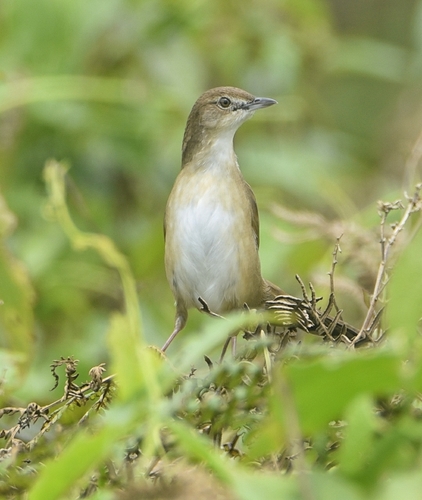 Broad-tailed Grassbird
In short
The most reliable field mark to separate New Caledonian Thicketbird from Broad-tailed Grassbird is the supercilium: the thicketbird shows a bold white supercilium, while the grassbird has a buff supercilium that is less striking. Both are long-tailed, brownish warblers, but the Broad-tailed Grassbird stands out with its broad, rounded, and obviously graduated tail featuring thin dark bars and white tips below—details not seen in the thicketbird. The thicketbird is unstreaked above and below, with olive-brown upperparts and creamy white underparts, while the grassbird’s upperparts and flanks vary from pale grey-brown to rich rufous-brown depending on region. Habitat is also a strong clue: thicketbird is endemic to New Caledonia’s thickets, while grassbird is restricted to the high grassy hills of India’s Western Ghats.
Identification tips
- Supercilium color: The New Caledonian Thicketbird always shows a bold white supercilium, which is much more striking than the buff supercilium of the Broad-tailed Grassbird. This is visible in all ages and seasons.
- Tail structure and pattern: The Broad-tailed Grassbird has a broad, rounded, and strongly graduated tail with thin dark bars and white tips below. This is visible in perched birds, especially when the tail is fanned during display. The thicketbird’s tail is long but lacks the broad, rounded shape and barring.
- Tail in flight/display: If you see a bird with a fanned, broad, and rounded tail in a fluttering display flight, it is the grassbird. The thicketbird does not perform such displays and has a plainer tail.
- Upperparts coloration: Thicketbird is olive-brown above and unstreaked; grassbird varies from pale grey-brown (north) to dark rufous-brown (south), but is always uniform and lacks the olive tone.
- Underparts: Thicketbird is creamy white below; grassbird is more variable, with southern birds showing bright buff on the breast and flanks and northern birds sandy-brown flanks.
- Streaking: Both species are unstreaked above and below, so streaking is not a separator.
- Bill: Grassbird has a short, strong bill with a slightly curved culmen and two rictal bristles, but this is subtle and not usually diagnostic at a distance.
- Sex differences: Both species are sexually monomorphic in plumage; do not rely on sex for ID.
- Juvenile/immature marks: No distinctive age-specific wing or flight marks are described for either species, so do not rely on upperwing pattern in young birds.
- Voice: Only the Broad-tailed Grassbird’s song is described—a lark-like trill in flight. If you hear this, it is diagnostic for grassbird. Thicketbird’s voice is unknown.
- Behavior: Grassbird males display in flight with fanned tails during breeding; thicketbird is more likely to stay hidden in thickets.
- Habitat: Thicketbird is only in New Caledonian thickets; grassbird is only in high-altitude grassy hills of SW India. Habitat is a strong clue if you know your location.
- Geography: If you are not in New Caledonia or the Western Ghats, neither species is likely. If you are in one of these regions, the local endemic is the default.
- Perched vs. in flight: Grassbird’s tail features (broad, rounded, barred, white-tipped below) are best seen when perched or in display flight. Thicketbird’s tail is long but plain.
- Pitfalls: Do not confuse the bold white supercilium of thicketbird with the buff supercilium of grassbird, especially in poor light. Tail shape and pattern are the best backup if supercilium color is unclear.
Size
Both species are medium-sized for grass warblers, but the notes do not provide direct measurements for either. The Broad-tailed Grassbird is described as a small, mostly brown bird, while the New Caledonian Thicketbird is called medium-sized. Without direct numbers, size is not a reliable separator in the field.
Plumage
- Juvenile/immature wing pattern: No age-specific upperwing or flight pattern marks are described for either species, so separation relies on overall plumage and tail features.
- New Caledonian Thicketbird (all ages): Shows unstreaked olive-brown upperparts (including crown and wings) and creamy white underparts. The bold white supercilium is a standout feature. The tail is long but not described as especially broad, rounded, or patterned.
- Broad-tailed Grassbird (all ages): Has uniform brown upperparts, but with significant regional variation: northern birds are paler and greyer above with sandy-brown flanks, while southern birds are darker rufous-brown above with bright buff on the breast/flanks and more whitish below. The supercilium is buff, not white. The tail is broad, rounded, and strongly graduated, with thin dark bars and white tips below—these tail features are unique and visible in perched or fanned-tail display. Underside of the tail is very dark with white tips. Males and females look alike.
Behaviour
Both species are skulking and prefer dense cover, but the Broad-tailed Grassbird is especially secretive outside the breeding season, moving rapidly through grass and reeds and only occasionally perching in the open. During breeding, grassbird males perform display flights with fanned tails and fluttering flight, often singing conspicuously in the air. The thicketbird’s behavior is not detailed, but it is implied to be a typical thicket-dweller, likely more often seen in dense vegetation and less likely to display in open air.
Habitat
Habitat is a strong separator. The New Caledonian Thicketbird is strictly endemic to New Caledonia, found in thickets and dense undergrowth. The Broad-tailed Grassbird is endemic to the moist, grassy highlands of the Western Ghats in southern India, with a possible but unconfirmed presence in Sri Lanka. It is found only at higher altitudes in open grassy hills, rarely in thickets. If you are outside these regions, neither species is likely; if you are in their respective habitats, this is a key clue.
Voice
Only the Broad-tailed Grassbird’s voice is described: the male’s breeding song is a repeated, lark-like trill delivered in flight, and other calls include a 'chack' and 'zink' note. The New Caledonian Thicketbird’s vocalizations are not described, so voice is only diagnostic if you hear the grassbird’s distinctive song or calls.
New Caledonian Thicketbird · Broad-tailed Grassbird · My Tricky Birds