

Namaqua Sandgrouse vs Chestnut-bellied Sandgrouse
Pterocles namaqua versus Pterocles exustus
Play a quiz with Namaqua Sandgrouse and Chestnut-bellied Sandgrouse
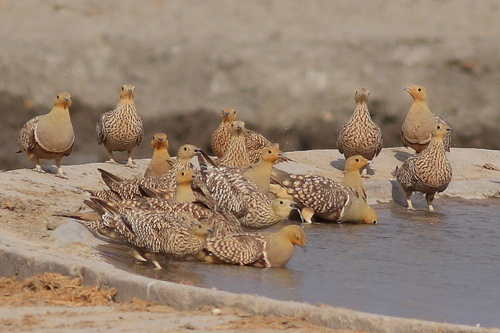 Namaqua Sandgrouse
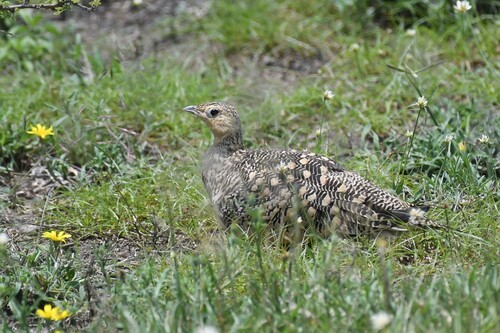 Chestnut-bellied Sandgrouse
In short
The most reliable field mark between Namaqua Sandgrouse and Chestnut-bellied Sandgrouse is the male's head and chest pattern: Namaqua males show a striking orangish-buff head and chest sharply divided by a narrow white and dark brown band, while Chestnut-bellied males have a duller yellow-ochre face and throat, with a vinous-buff upper breast separated from the chocolate belly by a narrow black-and-white band. In flight, both species have long pointed tails, but Namaqua males show two very long black tail filaments, which are less pronounced in Chestnut-bellied. Females and juveniles of both species are cryptic and mottled, but Namaqua tends to be more speckled with white, while Chestnut-bellied females are more barred and streaked. Both species are ground-dwelling and similar in shape, but Chestnut-bellied is heavier and slightly bulkier. Habitat and range can help: Namaqua is restricted to arid southwestern Africa, while Chestnut-bellied is found across northern/central Africa and into Asia.
Identification tips
- Male head and chest pattern: Namaqua males have a bright orangish-buff head, throat, and chest, sharply divided by a narrow white and dark brown band; Chestnut-bellied males have a dull yellow-ochre face and throat, vinous-buff upper breast, and a narrow black-and-white band above a chocolate belly. This is the single most reliable mark for adult males.
- Tail filaments in males: Namaqua males show two very long, thin black tail filaments extending well beyond the tail tip, visible both perched and in flight. Chestnut-bellied males have elongated, pointed tails but lack the extreme filaments.
- Back and wing pattern: Namaqua males have a mottled brown back and wings with large white specks; Chestnut-bellied males are more uniform, with ochre or olive tones and less obvious speckling.
- Female/juvenile pattern: Namaqua females and juveniles are brown with white speckling, giving a more spotted appearance. Chestnut-bellied females are more heavily barred and streaked, especially on the underparts, with less white speckling and more buff tones.
- Underparts (male): Chestnut-bellied males have a distinctive chocolate-colored belly, sharply separated from the upper breast by a narrow black-and-white band. Namaqua males have a more uniform orangish-buff underpart above the band, with less contrast below.
- Face color (male): Namaqua males have a more orangish face; Chestnut-bellied males are duller yellow-ochre, sometimes with a greyish crown depending on subspecies.
- Tail shape in flight: Both species have long, pointed tails in flight, but the Namaqua male's tail filaments are unique and diagnostic when seen well.
- Size and bulk: Chestnut-bellied is heavier and slightly bulkier, but this is subtle and not reliable unless both species are side by side.
- Subspecies variation (Chestnut-bellied): Be aware that Chestnut-bellied Sandgrouse shows regional variation in tone (from greyer to more ochre), but the basic pattern differences with Namaqua remain.
- Neck-stretching behavior: Chestnut-bellied may stretch its neck when wary, making it look longer-necked than Namaqua.
- Habitat and range: Namaqua is only in southwestern Africa; Chestnut-bellied is much more widespread. If you are outside Namaqua's range, default to Chestnut-bellied.
- Group behavior: Both species can be seen in flocks, especially at water, but this does not help with separation.
- Juvenile/immature flight marks: No distinctive juvenile upperwing patterns are described for either species, so rely on body and tail pattern for young birds.
- Perched vs. flight views: Tail filaments of Namaqua males are best seen in flight or when perched on open ground; Chestnut-bellied's tail is pointed but lacks filaments.
- Plumage pitfalls: Females and juveniles of both species are cryptic and can be confused; focus on the degree of white speckling (Namaqua) vs. barring/streaking (Chestnut-bellied) and overall tone.
Size
Chestnut-bellied Sandgrouse is noticeably heavier (210g vs 176g) and may appear slightly bulkier than Namaqua Sandgrouse. Both are medium-sized sandgrouse, but Namaqua is a bit more compact. In the field, size difference is subtle and best judged when both are seen together, which is rare due to limited range overlap.
Plumage
For adult males, Namaqua stands out with its orangish-buff head, throat, and chest, set off by a crisp narrow white and dark brown band across the chest. The back and wings are mottled brown with large white specks, and the tail has two long black filaments. Chestnut-bellied males have a dull yellow-ochre face and throat, vinous-buff upper breast, and a narrow black-and-white band separating the upper breast from a chocolate-colored belly; the tail is elongated and pointed but lacks the extremely long filaments of Namaqua. Females and juveniles are more challenging: Namaqua females/juveniles are cryptic, brown with white specks, while Chestnut-bellied females are more heavily barred and streaked, especially on the underparts, and have less white speckling. Subspecific variation in Chestnut-bellied can affect overall tone (from greyer to more ochre), but the basic pattern differences hold. In flight, both show long, pointed tails, but the Namaqua male's tail filaments are a key mark. Juvenile/immature upperwing patterns are not described in detail for either species, so rely on body and tail pattern for separation.
Behaviour
Both species are ground-dwelling, short-legged, and often seen in groups. When wary, Chestnut-bellied Sandgrouse may stretch out their long necks, a behavior less emphasized in Namaqua. Both species fly with fast, direct flight and long, pointed tails, but Namaqua males' tail filaments are more obvious in flight. Both species are adapted to arid environments and may be seen flying to water at dawn or dusk.
Habitat
Namaqua Sandgrouse is found only in arid regions of southwestern Africa, such as Namibia and South Africa. Chestnut-bellied Sandgrouse has a much broader range, from northern and central Africa to western and southern Asia, occupying arid and semi-arid habitats. If you are outside southwestern Africa, Namaqua is highly unlikely.
Namaqua Sandgrouse · Chestnut-bellied Sandgrouse · My Tricky Birds